
We read your photo as:
Define fundamental quantities and give examples. 2. Determine the dimensions of 'a' and 'b' in Van der Waals' equation.
ScanSolve AI Answer
Step-by-step solution
4 stepsHere are the solutions for question 1a and 1b:
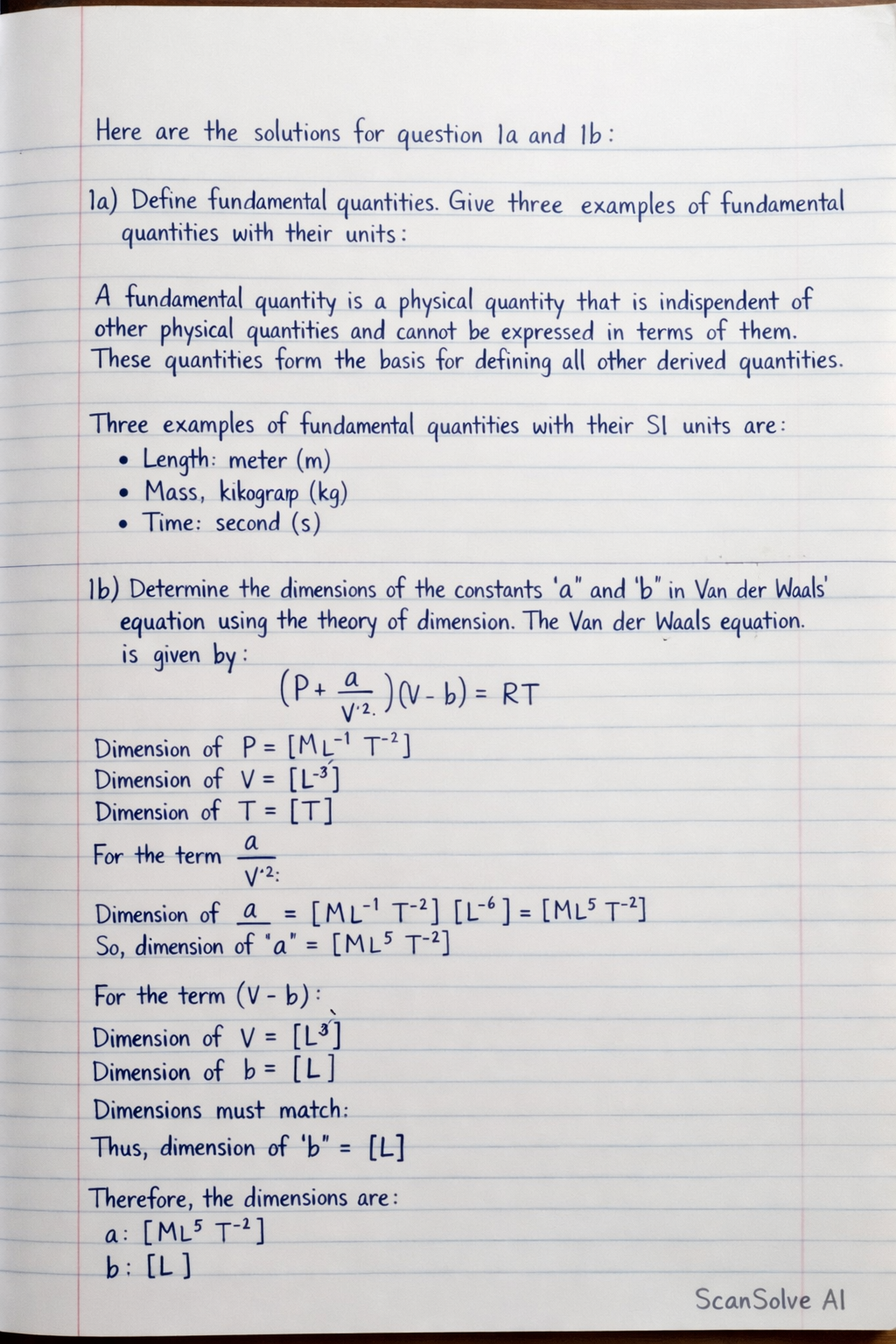
1a) Define fundamental quantities. Give three examples of fundamental quantities with their units.
-
A fundamental quantity is a physical quantity that is independent of other physical quantities and cannot be expressed in terms of them. These quantities form the basis for defining all other derived quantities.
-
Three examples of fundamental quantities with their SI units are:
- Length: meter (m)
- Mass: kilogram (kg)
- Time: second (s)
1b) Determine the dimensions of the constants 'a' and 'b' in Van der Waals' equation using the theory of dimension. The equation is given as .
The Van der Waals equation is given by:
Where is pressure, is volume, is temperature, and is the molar gas constant.
Determine the dimension of constant 'b'.
For quantities to be subtracted or added, they must have the same dimensions. In the term , is volume.
Therefore, the dimension of must be the same as the dimension of .
The dimension of volume is .
Thus, the dimension of is .Determine the dimension of constant 'a'.
In the term , is pressure. For quantities to be added, they must have the same dimensions.
Therefore, the dimension of must be the same as the dimension of .
First, find the dimension of pressure .
Pressure .
Dimension of Force = (Mass Acceleration)
Dimension of Area =
Dimension of .Equate the dimensions.
Dimension of = Dimension of
We know Dimension of , so .
Solve for the dimension of 'a'.
Dimension of
Dimension of
Thus, the dimension of is .
Still stuck on this one?
Ask a follow-up, and the answer starts from this question.
More Physics Questions
Handwritten Step-by-Step Solution
Get this as a handwritten image on WhatsApp — like a tutor wrote it for you.
Try on WhatsApp