This physics problem tests your understanding of fundamental physical laws and their applications. The step-by-step solution below breaks down the problem using relevant equations and physical reasoning.
ScanSolve AI Answer
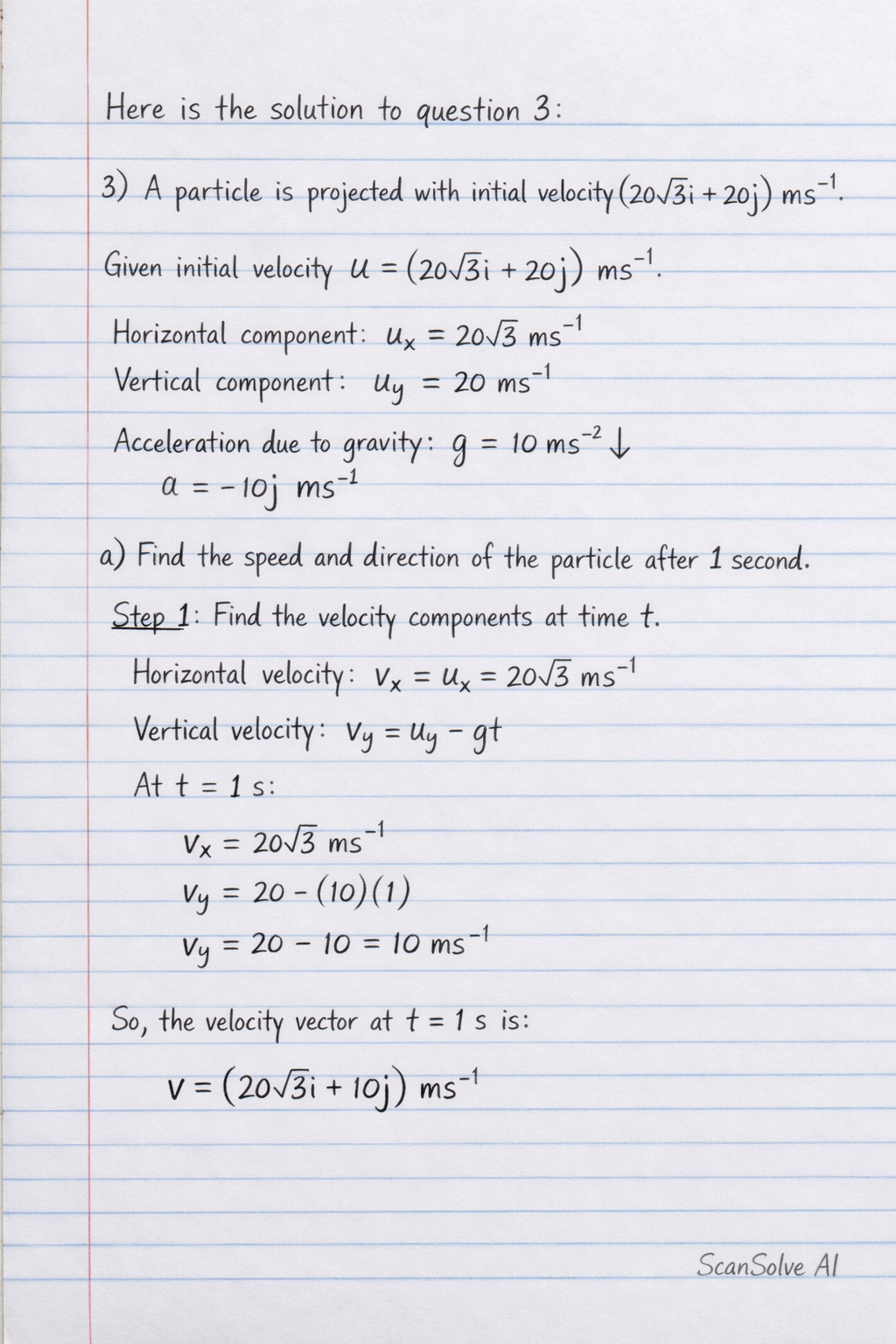
Here is the solution to question 3:
3) A particle is projected with initial velocity $(20\sqrt{3}\mathbf{i} + 20\mathbf{j})$ ms$^{-1}$.
Given initial velocity $\mathbf{u} = (20\sqrt{3}\mathbf{i} + 20\mathbf{j})$ ms$^{-1}$.
This means the horizontal component of initial velocity is $u_x = 20\sqrt{3}$ ms$^{-1}$ and the vertical component is $u_y = 20$ ms$^{-1}$.
We assume the acceleration due to gravity $g = 10$ ms$^{-2}$ acts downwards, so $\mathbf{a} = -10\mathbf{j}$ ms$^{-2}$.
a) Find the speed and direction of the particle after 1 second.
Step 1: Find the velocity components at time $t$.
The horizontal velocity remains constant: $v_x = u_x = 20\sqrt{3}$ ms$^{-1}$.
The vertical velocity changes due to gravity: $v_y = u_y - gt$.
At $t=1$ s:
$$ v_x = 20\sqrt{3}\, \text{ms}^{-1} $$
$$ v_y = 20 - (10)(1) = 10\, \text{ms}^{-1} $$
So, the velocity vector at $t=1$ s is $\mathbf{v} = (20\sqrt{3}\mathbf{i} + 10\mathbf{j})$ ms$^{-1}$.
Step 2: Calculate the speed (magnitude of velocity).
$$ |\mathbf{v}| = \sqrt{v_x^2 + v_y^2} $$
$$ |\mathbf{v}| = \sqrt{(20\sqrt{3})^2 + (10)^2} $$
$$ |\mathbf{v}| = \sqrt{(400 \times 3) + 100} $$
$$ |\mathbf{v}| = \sqrt{1200 + 100} $$
$$ |\mathbf{v}| = \sqrt{1300} = \sqrt{100 \times 13} = 10\sqrt{13}\, \text{ms}^{-1} $$
Step 3: Calculate the direction.
The direction is given by the angle $\alpha$ with the horizontal.
$$ \tan \alpha = \frac{v_y}{v_x} = \frac{10}{20\sqrt{3}} = \frac{1}{2\sqrt{3}} $$
$$ \alpha = \arctan\left(\frac{1}{2\sqrt{3}}\right) \approx 16.1^\circ $$
The speed of the particle after 1 second is $\boxed{10\sqrt{13}\, \text{ms}^{-1}}$ and its direction is $\boxed{\arctan\left(\frac{1}{2\sqrt{3}}\right) \text{ above the horizontal}}$.
b) The time of flight of the particle.
Step 1: The time of flight $T$ is the time when the vertical displacement $y$ is zero.
The vertical displacement is given by $y = u_y t - \frac{1}{2}gt^2$.
Set $y=0$:
$$ 0 = u_y T - \frac{1}{2}gT^2 $$
$$ 0 = T\left(u_y - \frac{1}{2}gT\right) $$
This gives $T=0$ (initial projection) or $u_y - \frac{1}{2}gT = 0$.
$$ \frac{1}{2}gT = u_y $$
$$ T = \frac{2u_y}{g} $$
Step 2: Substitute the values $u_y = 20$ ms$^{-1}$ and $g = 10$ ms$^{-2}$.
$$ T = \frac{2 \times 20}{10} = \frac{40}{10} = 4\, \text{s} $$
The time of flight of the particle is $\boxed{4\, \text{s}}$.
c) The range of the particle.
Step 1: The range $R$ is the horizontal distance covered during the time of flight.
$$ R = u_x T $$
Step 2: Substitute the values $u_x = 20\sqrt{3}$ ms$^{-1}$ and $T = 4$ s.
$$ R = (20\sqrt{3})(4) = 80\sqrt{3}\, \text{m} $$
The range of the particle is $\boxed{80\sqrt{3}\, \text{m}}$.
d) The maximum height attained by the particle.
Step 1: At maximum height, the vertical component of velocity $v_y = 0$.
We can use the kinematic equation $v_y^2 = u_y^2 - 2gH$, where $H$ is the maximum height.
$$ 0^2 = (20)^2 - 2(10)H $$
$$ 0 = 400 - 20H $$
Step 2: Solve for $H$.
$$ 20H = 400 $$
$$ H = \frac{400}{20} = 20\, \text{m} $$
The maximum height attained by the particle is $\boxed{20\, \text{m}}$.
e) The Cartesian equation of the path of the particle.
Step 1: Express time $t$ in terms of horizontal displacement $x$.
The horizontal displacement is $x = u_x t$.
$$ t = \frac{x}{u_x} = \frac{x}{20\sqrt{3}} $$
Step 2: Substitute this expression for $t$ into the equation for vertical displacement $y$.
$$ y = u_y t - \frac{1}{2}gt^2 $$
$$ y = (20)\left(\frac{x}{20\sqrt{3}}\right) - \frac{1}{2}(10)\left(\frac{x}{20\sqrt{3}}\right)^2 $$
Step 3: Simplify the equation.
$$ y = \frac{x}{\sqrt{3}} - 5\left(\frac{x^2}{400 \times 3}\right) $$
$$ y = \frac{x}{\sqrt{3}} - 5\left(\frac{x^2}{1200}\right) $$
$$ y = \frac{x}{\sqrt{3}} - \frac{x^2}{240} $$
The Cartesian equation of the path of the particle is
Given initial velocity u = (20sqrt(3)i + 20j) ms^-1.
|Physics
Given initial velocity u = (20sqrt(3)i + 20j) ms^-1.
ScanSolve AI Answer
Here is the solution to question 3:
3) A particle is projected with initial velocity (203i+20j) ms−1.
Given initial velocity u=(203i+20j) ms−1.
This means the horizontal component of initial velocity is ux=203 ms−1 and the vertical component is uy=20 ms−1.
We assume the acceleration due to gravity g=10 ms−2 acts downwards, so a=−10j ms−2.
a) Find the speed and direction of the particle after 1 second.
Step 1: Find the velocity components at time t.
The horizontal velocity remains constant: vx=ux=203 ms−1.
The vertical velocity changes due to gravity: vy=uy−gt.
At t=1 s:
vx=203ms−1vy=20−(10)(1)=10ms−1
So, the velocity vector at t=1 s is v=(203i+10j) ms−1.
Step 2: Calculate the speed (magnitude of velocity).
∣v∣=vx2+vy2∣v∣=(203)2+(10)2∣v∣=(400×3)+100∣v∣=1200+100∣v∣=1300=100×13=1013ms−1
Step 3: Calculate the direction.
The direction is given by the angle α with the horizontal.
tanα=vxvy=20310=231α=arctan(231)≈16.1∘
The speed of the particle after 1 second is ∗1013ms−1∗ and its direction is ∗arctan(231)abovethehorizontal∗.
b) The time of flight of the particle.
Step 1: The time of flight T is the time when the vertical displacement y is zero.
The vertical displacement is given by y=uyt−21gt2.
Set y=0:
0=uyT−21gT20=T(uy−21gT)
This gives T=0 (initial projection) or uy−21gT=0.
21gT=uyT=g2uy
Step 2: Substitute the values uy=20 ms−1 and g=10 ms−2.
T=102×20=1040=4s
The time of flight of the particle is ∗4s∗.
c) The range of the particle.
Step 1: The range R is the horizontal distance covered during the time of flight.
R=uxT
Step 2: Substitute the values ux=203 ms−1 and T=4 s.
R=(203)(4)=803m
The range of the particle is ∗803m∗.
d) The maximum height attained by the particle.
Step 1: At maximum height, the vertical component of velocity vy=0.
We can use the kinematic equation vy2=uy2−2gH, where H is the maximum height.
02=(20)2−2(10)H0=400−20H
Step 2: Solve for H.
20H=400H=20400=20m
The maximum height attained by the particle is ∗20m∗.
e) The Cartesian equation of the path of the particle.
Step 1: Express time t in terms of horizontal displacement x.
The horizontal displacement is x=uxt.
t=uxx=203x
Step 2: Substitute this expression for t into the equation for vertical displacement y.
y=uyt−21gt2y=(20)(203x)−21(10)(203x)2
Step 3: Simplify the equation.
y=3x−5(400×3x2)y=3x−5(1200x2)y=3x−240x2
The Cartesian equation of the path of the particle is
Need help with your own homework?
Get instant step-by-step solutions to any question. Free to start.