Calculate the gravitational force and initial accelerations of two particles with given masses and separation.
|Physics
Calculate the gravitational force and initial accelerations of two particles with given masses and separation.
ScanSolve AI Answer
5 steps
Answer
5.34×10⁻¹⁰ N
Right Blessing, let's go.
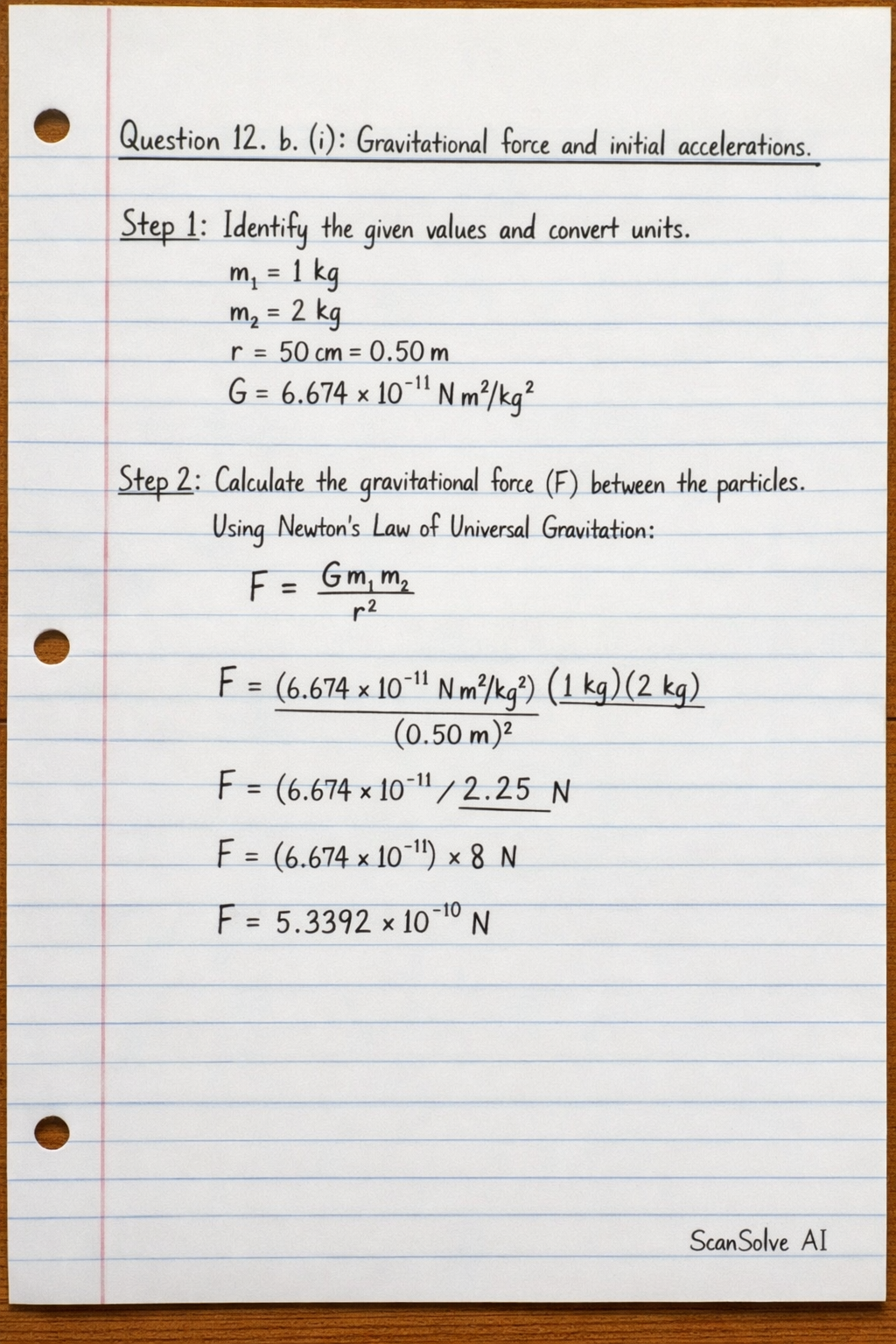
Question 12. b. (i): Gravitational force and initial accelerations
Step 1: Identify the given values and convert units.
Mass of particle 1: m1=1 kg.
Mass of particle 2: m2=2 kg.
Separation distance: r=50cm=0.50 m.
Gravitational constant: G=6.674×10⁻¹¹Nm2/kg2.
Step 2: Calculate the gravitational force (F) between the particles.
Using Newton's Law of Universal Gravitation:
F=Gr2m1m2F=(6.674×10⁻¹¹Nm2/kg2)(0.50m)2(1kg)(2kg)F=(6.674×10−11)0.252 NF=(6.674×10−11)×8 NF=5.3392×10⁻¹⁰ N
Step 3: Calculate the initial acceleration of each particle.
Using Newton's Second Law (F=ma):
For particle 1 (m1):
a1=m1F=1kg5.3392×10−10Na1=5.3392×10⁻¹⁰m/s2
For particle 2 (m2):
a2=m2F=2kg5.3392×10−10Na2=2.6696×10⁻¹⁰m/s2
The gravitational force is 5.34×10⁻¹⁰N.
The initial acceleration of the 1 kg particle is 5.34×10⁻¹⁰m/s2.
The initial acceleration of the 2 kg particle is 2.67×10⁻¹⁰m/s2.
Question 12. b. (ii): Escape velocity from the moon
Step 1: Identify the given values and convert units.
Mass of the moon: M=7.4×10²² kg.
Radius of the moon: R=1740km=1740×103m=1.74×10⁶ m.
Gravitational constant: G=6.674×10⁻¹¹Nm2/kg2.
Step 2: Calculate the escape velocity (ve).
The formula for escape velocity is:
ve=R2GMve=1.74×10⁶m2×(6.674×10−11Nm2/kg2)×(7.4×1022kg)ve=1.74×1069.87752×1012 m/sve=5.67673×106 m/sve≈2382.59 m/s
Rounding to two significant figures:
ve≈2.4×10³ m/s
The escape velocity from the moon is:
2.4×10³m/s
Question 13. a. (i): Viscosity and coefficient of viscosity
• Viscosity: A measure of a fluid's resistance to flow. It describes the internal friction within a fluid when it is in motion. A highly viscous fluid flows slowly, while a low-viscosity fluid flows easily.
• Coefficient of viscosity (η): A quantitative measure of a fluid's viscosity. It is defined as the ratio of the shear stress to the rate of shear strain in a fluid.
* SI unit: Pascal-second (Pa⋅s) or Newton-second per square meter (N s/m2).
* Dimensions: [ML−1T−1].
Question 13. a. (ii): Stokes's Law and Terminal Velocity derivation
Step 1: State the mathematical expression for Stokes's Law and define symbols.
Stokes's Law describes the viscous drag force (Fd) on a small spherical object moving through a viscous fluid at low Reynolds numbers:
Fd=6πηav
Where:
• η (eta) is the coefficient of viscosity of the fluid.
• a is the radius of the spherical object.
• v is the velocity of the spherical object relative to the fluid.
Step 2: Sketch the forces acting on the sphere.
When a metallic sphere falls under gravity in a liquid, three forces act on it:
Gravitational force (Fg) acting downwards.
Buoyant force (Fb) acting upwards (due to Archimedes' principle).
Viscous drag force (Fd) acting upwards (due to Stokes's Law).
Step 3: Show the derivation of terminal velocity.
At terminal velocity, the net force on the sphere is zero, meaning the upward forces balance the downward force:
Fg=Fb+Fd
Substitute the expressions for each force:
• Gravitational force: Fg=mg=ρVg, where V is the volume of the sphere. For a sphere, V=34πa3.
Fg=ρ(34πa3)g
• Buoyant force: Fb=σVg, where σ is the density of the liquid.
Fb=σ(34πa3)g
• Viscous drag force (at terminal velocity v):
Fd=6πηav
Substitute these into the force balance equation:
ρ(34πa3)g=σ(34πa3)g+6πηav
Rearrange to solve for v:
6πηav=ρ(34πa3)g−σ(34πa3)g6πηav=(34πa3)g(ρ−σ)
Divide both sides by 6πηa:
v=6πηa(34πa3)g(ρ−σ)
Simplify the expression:
v=3×6πηa4πa3g(ρ−σ)v=18πηa4πa3g(ρ−σ)
Cancel π and one a:
v=18η4a2g(ρ−σ)
Reduce the fraction 184 to 92:
v=9η2a2(ρ−σ)g
Question 13. b. (i): Conditions for liquid to be ideal
Two conditions for a liquid to be considered ideal are:
It is incompressible: Its density remains constant regardless of pressure changes.
It is non-viscous: It has no internal friction, meaning its coefficient of viscosity is zero.
Question 13. b. (ii): Kinetic and potential energies per unit volume
Step 1: Define density.
The density of the liquid is ρ=Vm.
Step 2: Derive the expression for kinetic energy per unit volume.
The kinetic energy (KE) of a liquid of mass m and velocity v is:
KE=21mv2
To find the kinetic energy per unit volume, divide by the volume V:
VKE=V21mv2
Substitute m=ρV:
VKE=V21(ρV)v2VKE=21ρv2
Step 3: Derive the expression for potential energy per unit volume.
The potential energy (PE) of a liquid of mass m at a height h is:
PE=mgh
To find the potential energy per unit volume, divide by the volume V:
VPE=Vmgh
Substitute m=ρV:
VPE=V(ρV)ghVPE=ρgh
Question 14. a. (i): State the zeroth and first laws of thermodynamics
• Zeroth Law of Thermodynamics: If two thermodynamic systems are each in thermal equilibrium with a third system, then they are in thermal equilibrium with each other. This law establishes the concept of temperature.
• First Law of Thermodynamics: The change in the internal energy (ΔU) of a system is equal to the heat added to the system (Q) minus the work done by the system (W). It is a statement of the conservation of energy.
ΔU=Q−W
Drop the next question.
Was this helpful?
Need help with your own homework?
Get instant step-by-step solutions to any question. Free to start.
This physics problem tests your understanding of fundamental physical laws and their applications. The step-by-step solution below breaks down the problem using relevant equations and physical reasoning.
ScanSolve AI Answer
Right Blessing, let's go. Question 12. b. (i): Gravitational force and initial accelerations Step 1: Identify the given values and convert units. Mass of particle 1: m_1 = 1 kg. Mass of particle 2: m_2 = 2 kg. Separation distance: r = 50 cm = 0.50 m. Gravitational constant: G = 6.674 × 10^-11 N m^2/kg^2. Step 2: Calculate the gravitational force (F) between the particles. Using Newton's Law of Universal Gravitation: F = G (m_1 m_2)/(r^2) F = (6.674 × 10^-11 N m^2/kg^2) (1 kg)(2 kg)(0.50 m)^2 F = (6.674 × 10^-11) (2)/(0.25) N F = (6.674 × 10^-11) × 8 N F = 5.3392 × 10^-10 N Step 3: Calculate the initial acceleration of each particle. Using Newton's Second Law (F = ma): For particle 1 (m_1): a_1 = (F)/(m_1) = 5.3392 × 10^-10 N1 kg a_1 = 5.3392 × 10^-10 m/s^2 For particle 2 (m_2): a_2 = (F)/(m_2) = 5.3392 × 10^-10 N2 kg a_2 = 2.6696 × 10^-10 m/s^2 The gravitational force is 5.34 × 10^-10 N. The initial acceleration of the 1 kg particle is 5.34 × 10^-10 m/s^2. The initial acceleration of the 2 kg particle is 2.67 × 10^-10 m/s^2. Question 12. b. (ii): Escape velocity from the moon Step 1: Identify the given values and convert units. Mass of the moon: M = 7.4 × 10^22 kg. Radius of the moon: R = 1740 km = 1740 × 10^3 m = 1.74 × 10^6 m. Gravitational constant: G = 6.674 × 10^-11 N m^2/kg^2. Step 2: Calculate the escape velocity (v_e). The formula for escape velocity is: v_e = sqrt((2GM)/(R)) v_e = sqrt(2 × (6.674 × 10^-11) N m^2/kg^2) × (7.4 × 10^22 kg)1.74 × 10^6 m v_e = sqrt(9.87752 × 10^12)1.74 × 10^6 m/s v_e = sqrt(5.67673 × 10^6) m/s v_e ≈ 2382.59 m/s Rounding to two significant figures: v_e ≈ 2.4 × 10^3 m/s The escape velocity from the moon is: 2.4 × 10^3 m/s Question 13. a. (i): Viscosity and coefficient of viscosity • Viscosity: A measure of a fluid's resistance to flow. It describes the internal friction within a fluid when it is in motion. A highly viscous fluid flows slowly, while a low-viscosity fluid flows easily. • Coefficient of viscosity (): A quantitative measure of a fluid's viscosity. It is defined as the ratio of the shear stress to the rate of shear strain in a fluid. SI unit: Pascal-second (Pa · s) or Newton-second per square meter* (N s/m^2). Dimensions: [ML^-1T^-1]. Question 13. a. (ii): Stokes's Law and Terminal Velocity derivation Step 1: State the mathematical expression for Stokes's Law and define symbols. Stokes's Law describes the viscous drag force (F_d) on a small spherical object moving through a viscous fluid at low Reynolds numbers: F_d = 6 a v Where: • (eta) is the coefficient of viscosity of the fluid. • a is the radius of the spherical object. • v is the velocity of the spherical object relative to the fluid. Step 2: Sketch the forces acting on the sphere. When a metallic sphere falls under gravity in a liquid, three forces act on it: 1. Gravitational force (F_g) acting downwards. 2. Buoyant force (F_b) acting upwards (due to Archimedes' principle). 3. Viscous drag force (F_d) acting upwards (due to Stokes's Law). Step 3: Show the derivation of terminal velocity. At terminal velocity, the net force on the sphere is zero, meaning the upward forces balance the downward force: F_g = F_b + F_d Substitute the expressions for each force: • Gravitational force: F_g = mg = V g, where V is the volume of the sphere. For a sphere, V = (4)/(3) a^3. F_g = ((4)/(3) a^3) g • Buoyant force: F_b = V g, where is the density of the liquid. F_b = ((4)/(3) a^3) g • Viscous drag force (at terminal velocity v): F_d = 6 a v Substitute these into the force balance equation: ((4)/(3) a^3) g = ((4)/(3) a^3) g + 6 a v Rearrange to solve for v: 6 a v = ((4)/(3) a^3) g - ((4)/(3) a^3) g 6 a v = ((4)/(3) a^3) g ( - ) Divide both sides by 6 a: v = ((4)/(3) a^3) g ( - )6 a Simplify the expression: v = (4 a^3 g ( - ))/(3 × 6 a) v = (4 a^3 g ( - ))/(18 a) Cancel and one a: v = (4 a^2 g ( - ))/(18 ) Reduce the fraction (4)/(18) to (2)/(9): v = (2a^2( - )g)/(9) Question 13. b. (i): Conditions for liquid to be ideal Two conditions for a liquid to be considered ideal are: 1. It is incompressible: Its density remains constant regardless of pressure changes. 2. It is non-viscous: It has no internal friction, meaning its coefficient of viscosity is zero. Question 13. b. (ii): Kinetic and potential energies per unit volume Step 1: Define density. The density of the liquid is = (m)/(V). Step 2: Derive the expression for kinetic energy per unit volume. The kinetic energy (KE) of a liquid of mass m and velocity v is: KE = (1)/(2)mv^2 To find the kinetic energy per unit volume, divide by the volume V: (KE)/(V) = (1)/(2)mv^2V Substitute m = V: (KE)/(V) = (1)/(2)( V)v^2V (KE)/(V) = (1)/(2) v^2 Step 3: Derive the expression for potential energy per unit volume. The potential energy (PE) of a liquid of mass m at a height h is: PE = mgh To find the potential energy per unit volume, divide by the volume V: (PE)/(V) = (mgh)/(V) Substitute m = V: (PE)/(V) = (( V)gh)/(V) (PE)/(V) = gh Question 14. a. (i): State the zeroth and first laws of thermodynamics • Zeroth Law of Thermodynamics: If two thermodynamic systems are each in thermal equilibrium with a third system, then they are in thermal equilibrium with each other. This law establishes the concept of temperature. • First Law of Thermodynamics: The change in the internal energy ( U) of a system is equal to the heat added to the system (Q) minus the work done by the system (W). It is a statement of the conservation of energy. U = Q - W Drop the next question.