We read your photo as:

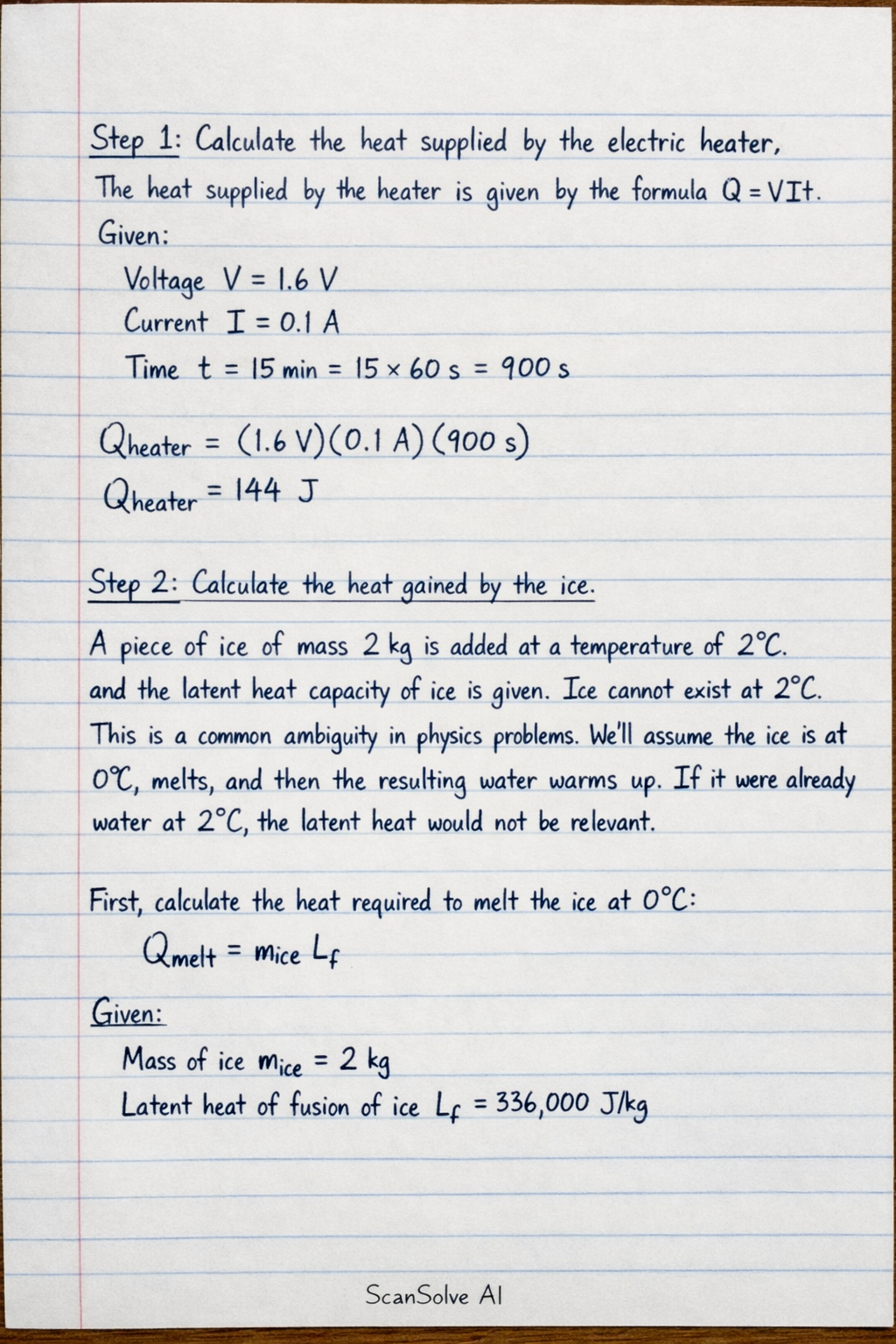
Calculate the heat supplied by the electric heater.

Physics

ScanSolve AI Answer

Answer

24.78∘C\text{24.78}^\circ\text{C}

Step-by-step solution

4 steps
  1. Calculate the heat supplied by the electric heater.

    The heat supplied by the heater is given by the formula Q=VItQ = VIt.
    Given:
    Voltage V=1.6 VV = 1.6\,\text{V}
    Current I=0.1 AI = 0.1\,\text{A}
    Time t=15 min=15×60 s=900 st = 15\,\text{min} = 15 \times 60\,\text{s} = 900\,\text{s}

    Qheater=(1.6 V)(0.1 A)(900 s)Q_{\text{heater}} = (1.6\,\text{V})(0.1\,\text{A})(900\,\text{s}) Qheater=144 JQ_{\text{heater}} = 144\,\text{J}
  2. Calculate the heat gained by the ice.

    The problem states "a piece of ice of mass 2kg is added at a temperature of 2∘C2^\circ\text{C}" and also provides the "latent heat capacity of ice". Ice cannot exist at 2∘C2^\circ\text{C}. This is a common ambiguity in physics problems. We will assume the intention is that the ice is at 0∘C0^\circ\text{C}, melts, and then the resulting water warms up. If it were already water at 2∘C2^\circ\text{C}, the latent heat would not be relevant.

    First, calculate the heat required to melt the ice at 0∘C0^\circ\text{C}:

    Qmelt=miceLfQ_{\text{melt}} = m_{\text{ice}} L_{\text{f}}

    Given:
    Mass of ice mice=2 kgm_{\text{ice}} = 2\,\text{kg}
    Latent heat of fusion of ice Lf=336000 Jkg−1L_{\text{f}} = 336000\,\text{Jkg}^{-1}

    Qmelt=(2 kg)(336000 Jkg−1)Q_{\text{melt}} = (2\,\text{kg})(336000\,\text{Jkg}^{-1}) Qmelt=672000 JQ_{\text{melt}} = 672000\,\text{J}

    Next, calculate the heat required to warm the melted ice (now water) from 0∘C0^\circ\text{C} to the final temperature TfT_{\text{f}}:

    Qwarm, ice water=micecwater(Tf−0∘C)Q_{\text{warm, ice water}} = m_{\text{ice}} c_{\text{water}} (T_{\text{f}} - 0^\circ\text{C})

    Given:
    Specific heat capacity of water cwater=4200 Jkg−1K−1c_{\text{water}} = 4200\,\text{Jkg}^{-1}\text{K}^{-1}

    Qwarm, ice water=(2 kg)(4200 Jkg−1K−1)(Tf)Q_{\text{warm, ice water}} = (2\,\text{kg})(4200\,\text{Jkg}^{-1}\text{K}^{-1})(T_{\text{f}}) Qwarm, ice water=8400Tf JQ_{\text{warm, ice water}} = 8400 T_{\text{f}}\,\text{J}

    The total heat gained by the ice is:

    Qice total=Qmelt+Qwarm, ice waterQ_{\text{ice total}} = Q_{\text{melt}} + Q_{\text{warm, ice water}} Qice total=672000+8400TfQ_{\text{ice total}} = 672000 + 8400 T_{\text{f}}
  3. Calculate the heat lost by the initial water and the copper calorimeter.

    The initial temperature of the water and the calorimeter is 30∘C30^\circ\text{C}.

    Heat lost by the initial water:

    Qwater loss=mwatercwater(Tinitial, water−Tf)Q_{\text{water loss}} = m_{\text{water}} c_{\text{water}} (T_{\text{initial, water}} - T_{\text{f}})

    Given:
    Mass of initial water mwater=40 kgm_{\text{water}} = 40\,\text{kg}
    Initial temperature of water Tinitial, water=30∘CT_{\text{initial, water}} = 30^\circ\text{C}

    Qwater loss=(40 kg)(4200 Jkg−1K−1)(30∘C−Tf)Q_{\text{water loss}} = (40\,\text{kg})(4200\,\text{Jkg}^{-1}\text{K}^{-1})(30^\circ\text{C} - T_{\text{f}}) Qwater loss=168000(30−Tf) JQ_{\text{water loss}} = 168000(30 - T_{\text{f}})\,\text{J}

    Heat lost by the copper calorimeter:

    Qcopper loss=mcopperccopper(Tinitial, copper−Tf)Q_{\text{copper loss}} = m_{\text{copper}} c_{\text{copper}} (T_{\text{initial, copper}} - T_{\text{f}})

    Given:
    Mass of copper calorimeter mcopper=1.5 kgm_{\text{copper}} = 1.5\,\text{kg}
    Specific heat capacity of copper ccopper=400 Jkg−1K−1c_{\text{copper}} = 400\,\text{Jkg}^{-1}\text{K}^{-1}
    Initial temperature of copper Tinitial, copper=30∘CT_{\text{initial, copper}} = 30^\circ\text{C}

    Qcopper loss=(1.5 kg)(400 Jkg−1K−1)(30∘C−Tf)Q_{\text{copper loss}} = (1.5\,\text{kg})(400\,\text{Jkg}^{-1}\text{K}^{-1})(30^\circ\text{C} - T_{\text{f}}) Qcopper loss=600(30−Tf) JQ_{\text{copper loss}} = 600(30 - T_{\text{f}})\,\text{J}

    The total heat lost by the warmer components is:

    Qloss total=Qwater loss+Qcopper lossQ_{\text{loss total}} = Q_{\text{water loss}} + Q_{\text{copper loss}} Qloss total=168000(30−Tf)+600(30−Tf)Q_{\text{loss total}} = 168000(30 - T_{\text{f}}) + 600(30 - T_{\text{f}}) Qloss total=(168000+600)(30−Tf)Q_{\text{loss total}} = (168000 + 600)(30 - T_{\text{f}}) Qloss total=168600(30−Tf)Q_{\text{loss total}} = 168600(30 - T_{\text{f}}) Qloss total=5058000−168600TfQ_{\text{loss total}} = 5058000 - 168600 T_{\text{f}}
  4. Apply the principle of conservation of energy.

    Assuming negligible heat loss to the surroundings, the total heat supplied by the heater plus the heat lost by the warmer components equals the total heat gained by the colder components.

    Qheater+Qloss total=Qice totalQ_{\text{heater}} + Q_{\text{loss total}} = Q_{\text{ice total}} 144+(5058000−168600Tf)=672000+8400Tf144 + (5058000 - 168600 T_{\text{f}}) = 672000 + 8400 T_{\text{f}} 5058144−168600Tf=672000+8400Tf5058144 - 168600 T_{\text{f}} = 672000 + 8400 T_{\text{f}}

    Rearrange the equation to solve for TfT_{\text{f}}:

    5058144−672000=8400Tf+168600Tf5058144 - 672000 = 8400 T_{\text{f}} + 168600 T_{\text{f}} 4386144=177000Tf4386144 = 177000 T_{\text{f}} Tf=4386144177000T_{\text{f}} = \frac{4386144}{177000} Tf≈24.78047∘CT_{\text{f}} \approx 24.78047^\circ\text{C}

    Rounding to two decimal places, the final temperature is:

    Tf≈24.78∘CT_{\text{f}} \approx 24.78^\circ\text{C}

    The final temperature of the mixture is 24.78∘C\text{24.78}^\circ\text{C}.

Was this helpful?

Try one yourself

A new problem that tests the same skill.

Still stuck on this one?

Ask a follow-up, and the answer starts from this question.

Got a different question?Ask your own question
Handwritten step-by-step solution preview

Handwritten Step-by-Step Solution

Get this as a handwritten image on WhatsApp — like a tutor wrote it for you.

Try on WhatsApp