
This physics problem tests your understanding of fundamental physical laws and their applications. The step-by-step solution below breaks down the problem using relevant equations and physical reasoning.
ScanSolve AI Answer
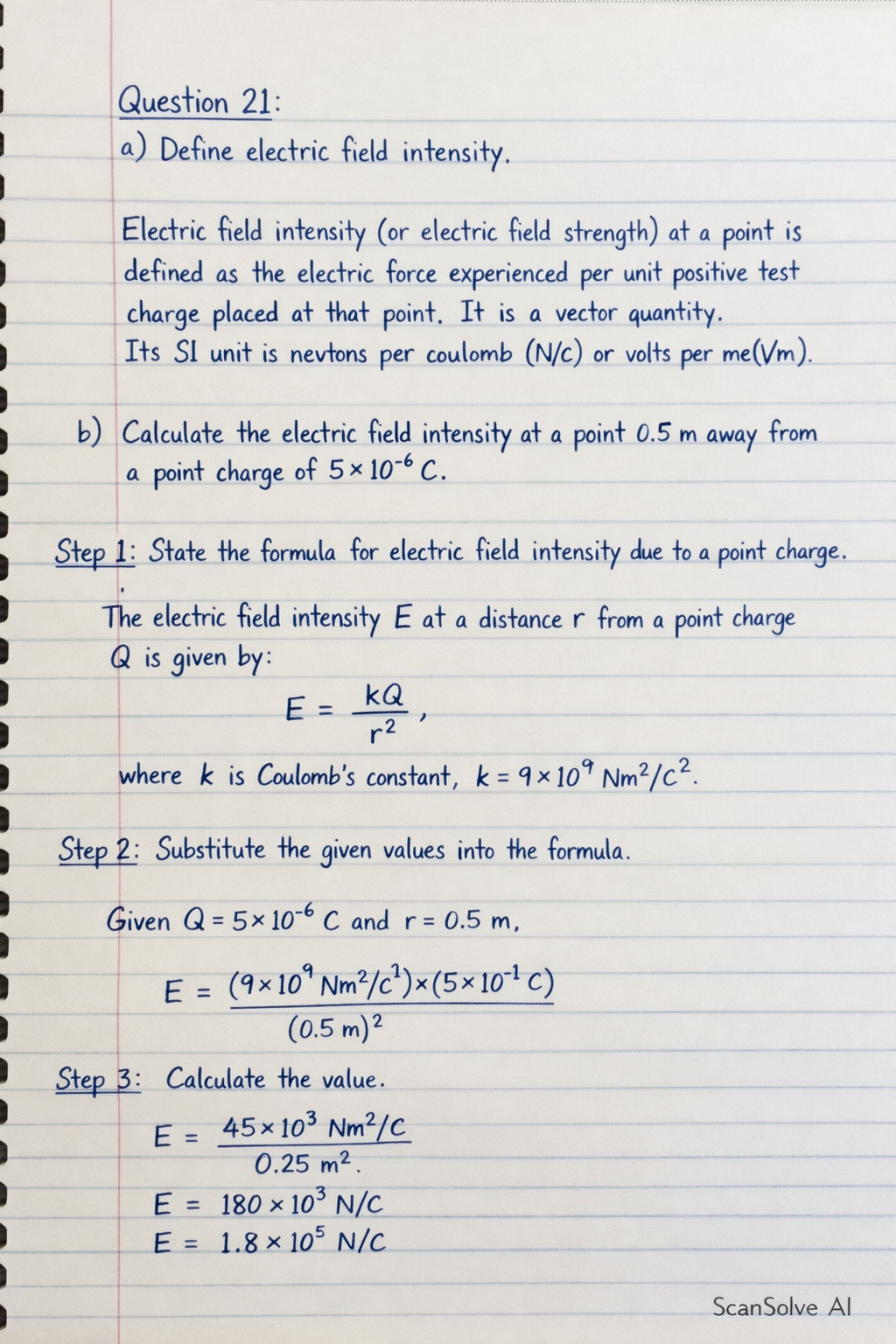
Question 21: a) Define electric field intensity. Electric field intensity (or electric field strength) at a point is defined as the electric force experienced per unit positive test charge placed at that point. It is a vector quantity. Its SI unit is newtons per coulomb (N/C) or volts per meter (V/m). b) Calculate the electric field intensity at a point 0.5 \, m away from a point charge of 5 × 10^-6 \, C. Step 1: State the formula for electric field intensity due to a point charge. The electric field intensity E at a distance r from a point charge Q is given by: E = (kQ)/(r^2) where k is Coulomb's constant, k = 9 × 10^9 \, Nm^2/C^2. Step 2: Substitute the given values into the formula. Given Q = 5 × 10^-6 \, C and r = 0.5 \, m. E = (9 × 10^9 \, Nm^2/C^2) × (5 × 10^-6 \, C)(0.5 \, m)^2 Step 3: Calculate the value. E = 45 × 10^3 \, Nm^2/C0.25 \, m^2 E = 180 × 10^3 \, N/C E = 1.8 × 10^5 \, N/C The electric field intensity is 1.8 × 10^5 \, N/C Question 22: a) Define electric potential. Electric potential at a point in an electric field is defined as the amount of work done per unit positive test charge in bringing the charge from infinity to that point without acceleration. It is a scalar quantity. Its SI unit is joules per coulomb (J/C) or volts (V). b) Calculate the electric potential at a point 0.5 \, m away from a point charge of 5 × 10^-6 \, C. Step 1: State the formula for electric potential due to a point charge. The electric potential V at a distance r from a point charge Q is given by: V = (kQ)/(r) where k is Coulomb's constant, k = 9 × 10^9 \, Nm^2/C^2. Step 2: Substitute the given values into the formula. Given Q = 5 × 10^-6 \, C and r = 0.5 \, m. V = (9 × 10^9 \, Nm^2/C^2) × (5 × 10^-6 \, C)0.5 \, m Step 3: Calculate the value. V = 45 × 10^3 \, Nm/C0.5 V = 90 × 10^3 \, V V = 9.0 × 10^4 \, V The electric potential is 9.0 × 10^4 \, V Question 23: a) Define electric flux. Electric flux is a measure of the number of electric field lines passing through a given surface. It quantifies the flow of the electric field through an area. It is given by the dot product of the electric field and the area vector: _E = E · A = EA . Its SI unit is newton-meter squared per coulomb (Nm^2/C) or volt-meter (Vm). b) State Gauss's Law. Gauss's Law states that the total electric flux through any closed surface (a Gaussian surface) is directly proportional to the total electric charge enclosed within that surface. Mathematically, it is expressed as: _E = E · dA = Q_enc_0 where _E is the total electric flux, E is the electric field, dA is an infinitesimal area vector on the closed surface, Q_enc is the total charge enclosed by the surface, and _0 is the permittivity of free space. Question 24: a) Define electric current. Electric current is defined as the rate of flow of electric charge through a conductor. It measures how much charge passes through a given point in a circuit per unit time. Its SI unit is amperes (A), where 1 \, A = 1 \, C/s. b) Calculate the number of electrons passing through a point in a conductor in 1 \, minute if the current is 2 \, A. Step 1: Calculate the total charge that passes through the point. The relationship between current (I), charge (Q), and time (t) is Q = I × t. Given I = 2 \, A and t = 1 \, minute = 60 \, s. Q = 2 \, A × 60 \, s Q = 120 \, C Step 2: Calculate the number of electrons. The charge of a single electron is e = 1.6 × 10^-19 \, C. The number of electrons N is the total charge divided by the charge of one electron: N = (Q)/(e) N = (120 \, C)/(1.6 × 10^-19) \, C/electron Step 3: Calculate the value. N = 75 × 10^19 \, electrons N = 7.5 × 10^20 \, electrons The number of electrons passing through the point is 7.5 × 10^20 \, electrons Got more? Send 'em!