

This physics problem tests your understanding of fundamental physical laws and their applications. The step-by-step solution below breaks down the problem using relevant equations and physical reasoning.
ScanSolve AI Answer
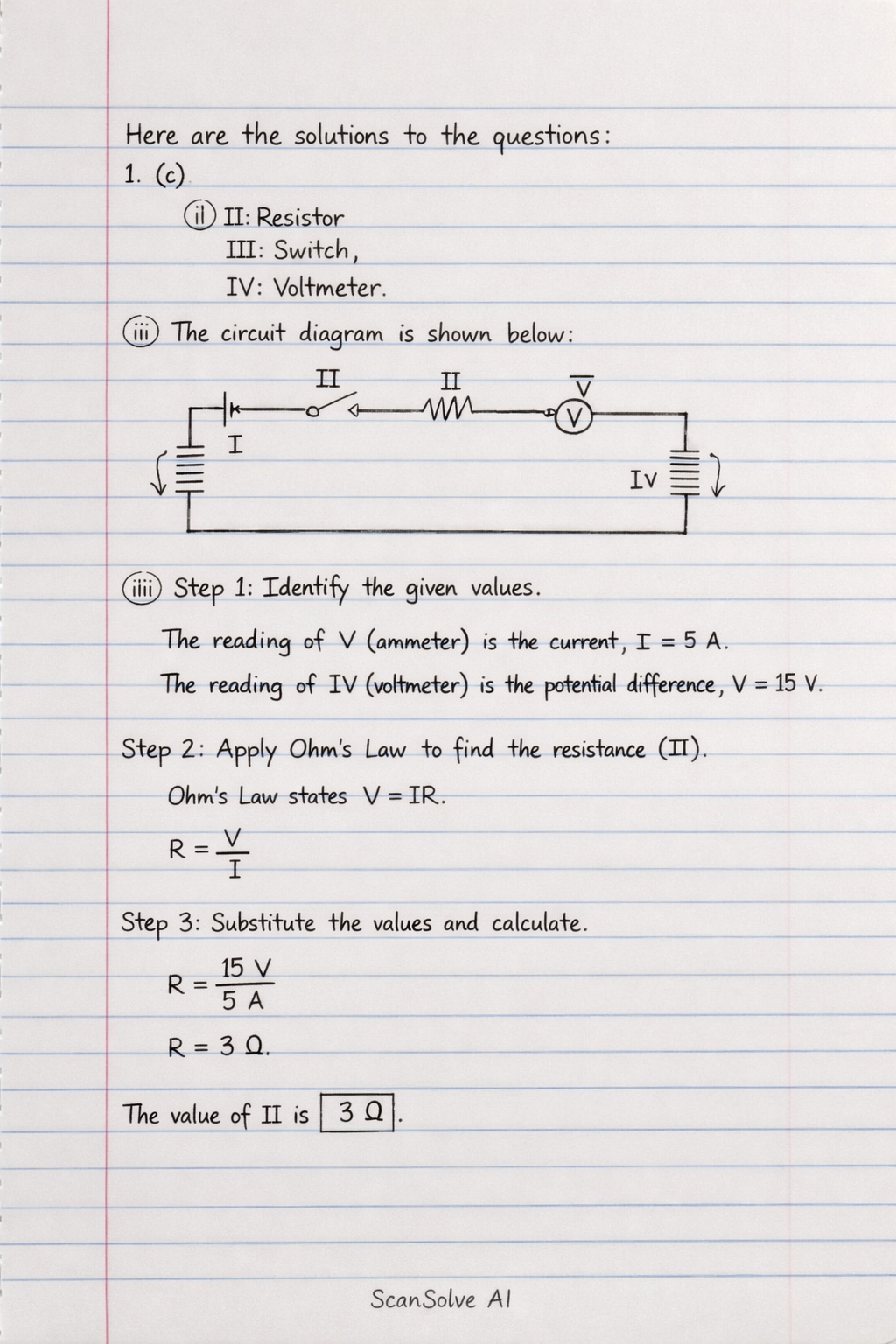
Here are the solutions to the questions: 1. (c) (i) II: Resistor III: Switch IV: Voltmeter (ii) The circuit diagram is shown below: (0,0) to[battery] (0,2) to[switch] (2,2) to[R, l_=II] (4,2) to[ammeter, l_=V] (6,2) -- (6,0) to[battery] (0,0); (4,2) to[voltmeter, l_=IV] (4,0); (Note: The diagram above represents a battery (I), switch (III), resistor (II), ammeter (V) in series, and voltmeter (IV) in parallel across the resistor.) (iii) Step 1: Identify the given values. The reading of V (ammeter) is the current, I = 5 A. The reading of IV (voltmeter) is the potential difference, V = 15 V. Step 2: Apply Ohm's Law to find the resistance (II). Ohm's Law states V = IR. R = (V)/(I) Step 3: Substitute the values and calculate. R = 15\, V5\, A = 3\, The value of II is 3 . 1. (d) (i) (α) 7: C (NaCl is a neutral salt) (β) 14: E (NaOH is a strong base) (ii) (α) strong acid: A (HCl) (β) neutral: C (NaCl) (γ) weak base: D (NH_3) (iii) Step 1: Identify the solution and its concentration. Solution A is 0.1 mol dm^-3 HCl. HCl is a strong acid, so it fully dissociates. Step 2: Calculate the pH. For a strong acid, [H^+] = concentration of acid. [H^+] = 0.1\, mol dm^-3 = 10^-1\, mol dm^-3 pH = -_10[H^+] = -_10(10^-1) = 1 The pH value of solution A is 1. (iv) Solutions that react to form salt and water are an acid and a base. A (HCl) and E (NaOH). (Other valid pairs include A and D, B and E, B and D). (v) Solution C is 0.1 mol dm^-3 NaCl. Sodium chloride (NaCl) is a salt formed from a strong acid (HCl) and a strong base (NaOH), making its solution neutral. Universal indicator turns green in a neutral solution. That's 2 down. 3 left today — send the next one.