
If a single atom of hydrogen is present, how many wavelength will be seen and why
Physics
ScanSolve AI Answer
Answer
A single excited hydrogen atom, at any given instant, will emit one wavelength.
Here's why:
- Single Transition: When an electron in a single hydrogen atom transitions from a higher energy level to a lower one, it undergoes one specific energy change.
- Single Photon: This single energy change results in the emission of one photon of light.
- Single Wavelength: Each photon has a unique energy, frequency, and thus a single corresponding wavelength.
The full hydrogen emission spectrum, which shows multiple distinct wavelengths (lines), is observed from a macroscopic sample of hydrogen gas. In such a sample, many atoms are simultaneously undergoing various different possible electron transitions, each contributing a photon of a specific wavelength to the overall observed spectrum.
Was this helpful?
Still stuck on this one?
Ask a follow-up, and the answer starts from this question.
Got a different question?Ask your own question
More Physics Questions
QUnderstand the relationships for a hydrogen atom.QCalculate the wavelength of light emitted when an electron transitions from the n=7 to n=2 energy…QUsing the Rydberg formula, calculate the wavelength of the second line in the Balmer series of the…QDetermine the initial energy level of the hydrogen atom.QThe nucleus of a hydrogen atom (specifically, the most common isotope, protium, 1H) has an atomic…
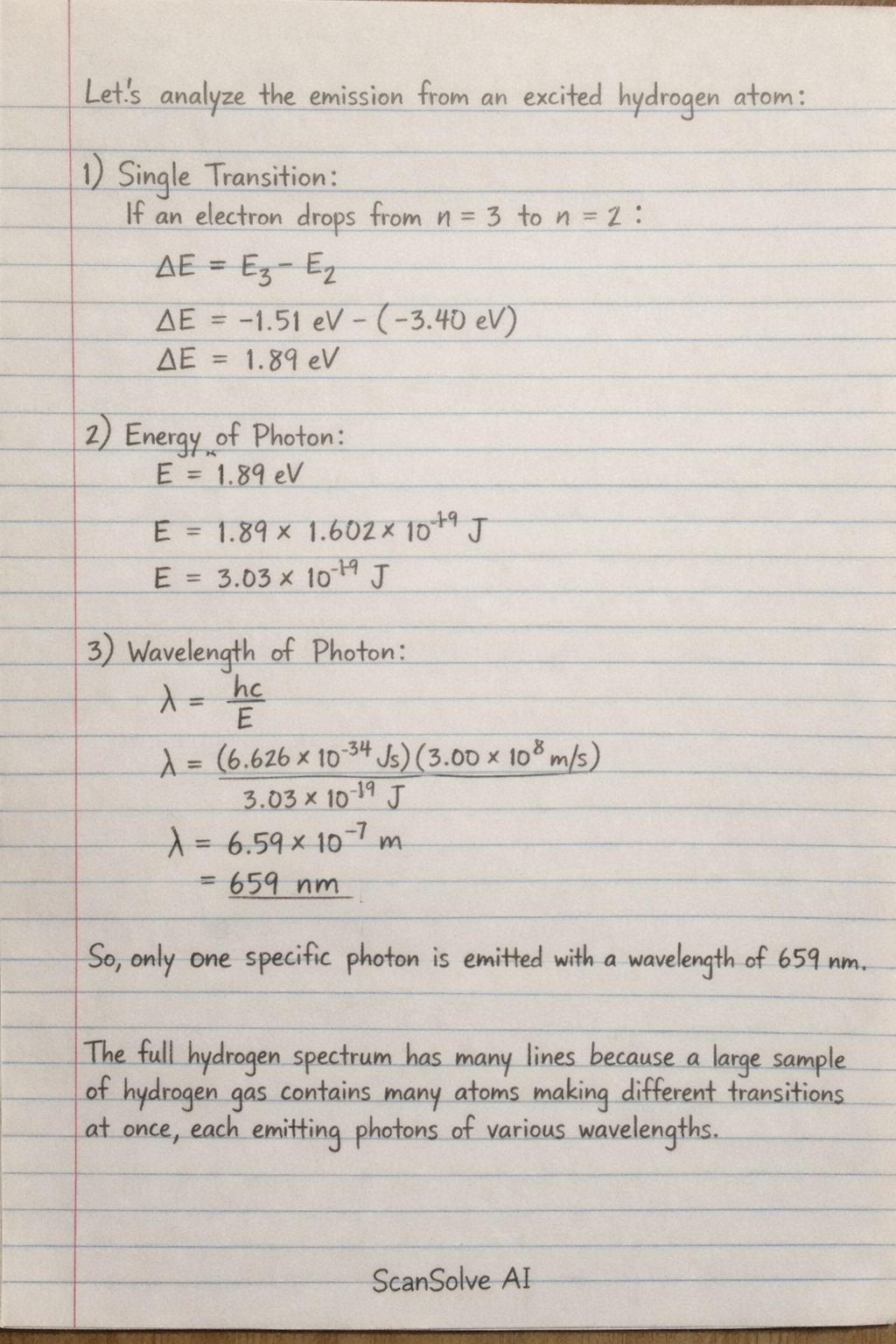
Handwritten Step-by-Step Solution
Get this as a handwritten image on WhatsApp — like a tutor wrote it for you.
Try on WhatsApp