
We read your photo as:
Instruction says the momentum versus time graph of object A ,originally moving horizontally EAST, is shown below
ScanSolve AI Answer
Answer
Step-by-step solution
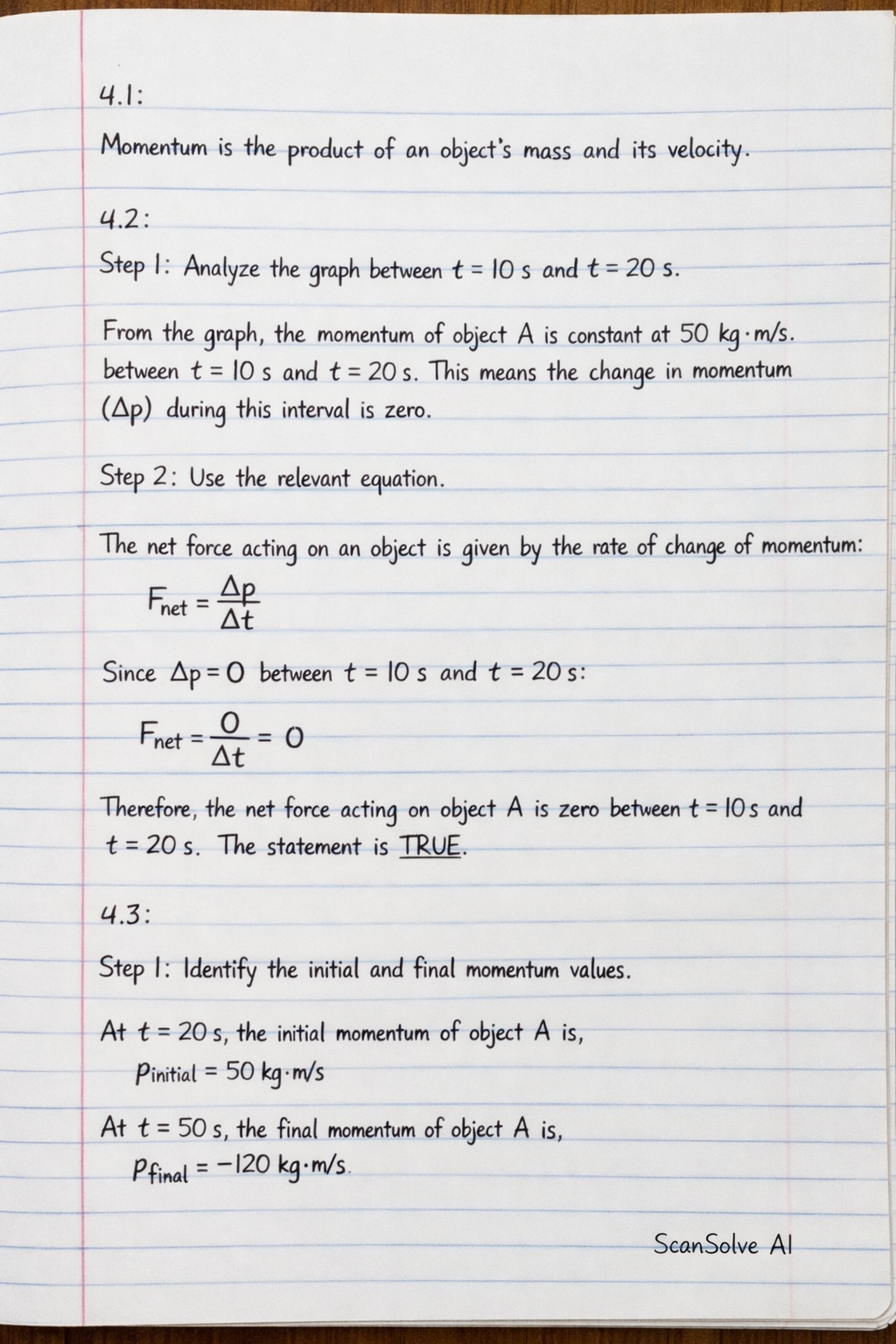
8 steps4.1:
Momentum is the product of an object's mass and its velocity.
4.2:
Analyze the graph between s and s.
From the graph, the momentum of object A is constant at between s and s. This means the change in momentum () during this interval is zero.
Use the relevant equation.
The net force acting on an object is given by the rate of change of momentum:
Since between s and s:
Therefore, the net force acting on object A is zero between s and s. The statement is TRUE.
4.3:
Identify the initial and final momentum values.
At s, the initial momentum of object A is .
At s, the final momentum of object A is .Calculate the impulse.
Impulse () is equal to the change in momentum ():
Determine the magnitude of the impulse.
The magnitude of the impulse is the absolute value:
4.4:
State the relevant principle.
The relevant principle is the Principle of Conservation of Linear Momentum. It states that in an isolated system, the total linear momentum before a collision is equal to the total linear momentum after the collision.
Identify the initial and final momentum values for objects A and B.
Let EAST be the positive direction.
From the graph, just before the collision (at s):
Momentum of object A, (120 kg·m·s⁻¹ WEST).
Momentum of object B, (70 kg·m·s⁻¹ EAST).From the graph, just after the collision (at s, after the vertical jump):
Momentum of object A, (50 kg·m·s⁻¹ EAST).
Momentum of object B after the collision,Apply the principle of conservation of linear momentum.
The negative sign indicates the direction is WEST.
The momentum of object B after the collision is .
Still stuck on this one?
Ask a follow-up, and the answer starts from this question.
More Physics Questions
Handwritten Step-by-Step Solution
Get this as a handwritten image on WhatsApp — like a tutor wrote it for you.
Try on WhatsApp