

This physics problem tests your understanding of fundamental physical laws and their applications. The step-by-step solution below breaks down the problem using relevant equations and physical reasoning.
ScanSolve AI Answer
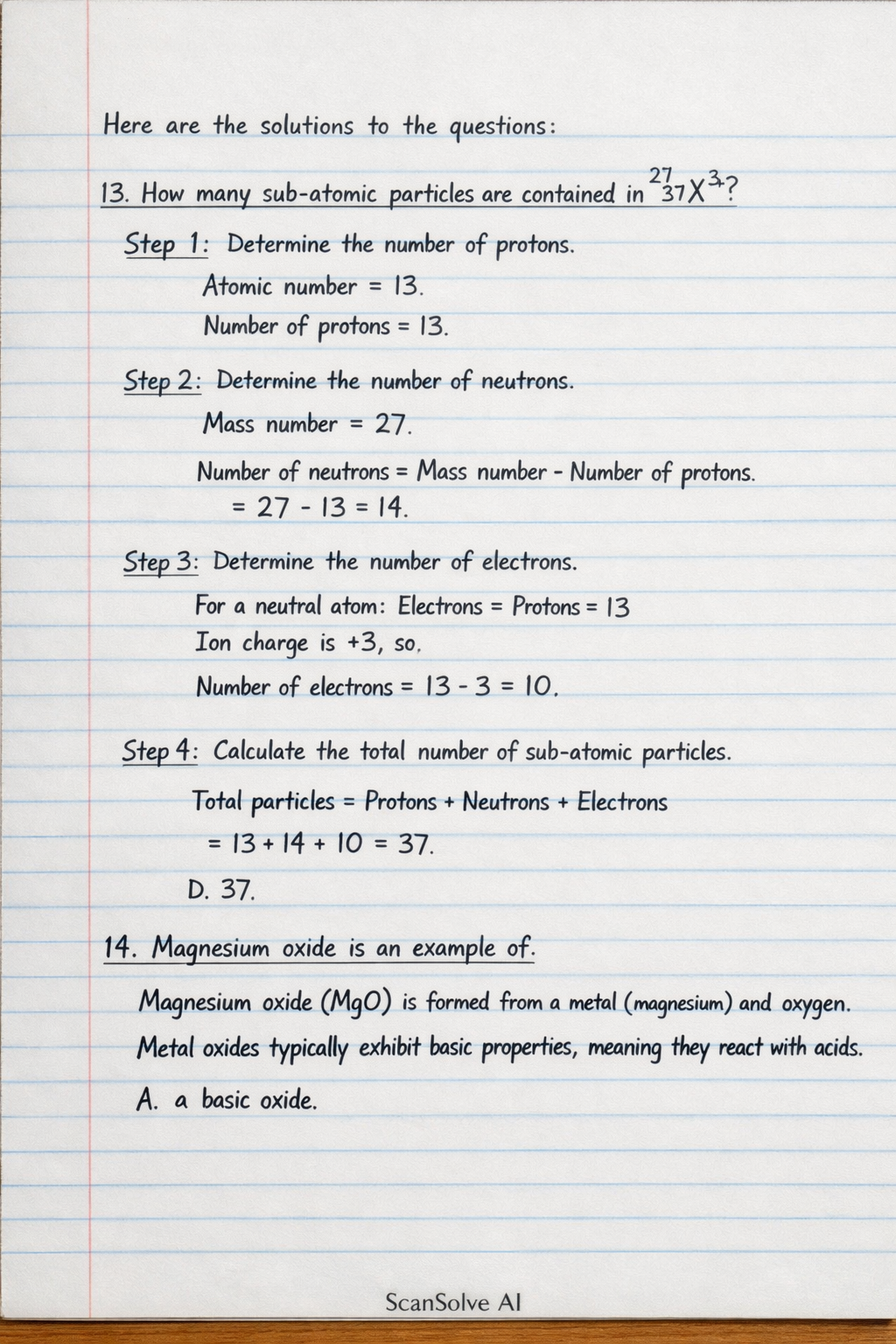
Here are the solutions to the questions: 13. How many sub-atomic particles are contained in ^27_13X^3+? Step 1: Determine the number of protons. The atomic number (the subscript 13) indicates the number of protons. Number of protons = 13. Step 2: Determine the number of neutrons. The mass number (the superscript 27) is the sum of protons and neutrons. Number of neutrons = Mass number - Number of protons = 27 - 13 = 14. Step 3: Determine the number of electrons. For a neutral atom, the number of electrons equals the number of protons (13). The charge of the ion is +3, meaning it has lost 3 electrons. Number of electrons = 13 - 3 = 10. Step 4: Calculate the total number of sub-atomic particles. Total particles = Protons + Neutrons + Electrons = 13 + 14 + 10 = 37. D. 37 14. Magnesium oxide is an example of Magnesium oxide (MgO) is formed from a metal (magnesium) and oxygen. Metal oxides typically exhibit basic properties, meaning they react with acids. A. a basic oxide. 15. A particle that is made up of 10 electrons and 13 protons is Step 1: Calculate the net charge of the particle. Net charge = (Number of protons) - (Number of electrons) = 13 - 10 = +3. Step 2: Classify the particle based on its charge. A particle with a net positive charge is called a cation. D. a cation. 16. A molecule is the smallest independent particle of A molecule is defined as the smallest particle of a substance (element or compound) that retains the chemical and physical properties of that substance and is capable of independent existence. While not all elements exist as discrete molecules (e.g., metals or noble gases), many do (e.g., O_2, N_2, Cl_2). Among the given options, "an element" is the most fitting description for substances that can form molecules. C. an element. 3 done, 2 left today. You're making progress.