
We read your photo as:
Mention three benefits that Ghana could derive from nuclear energy. (b) State the scientific principle involved in each of the following local industries: kenkey production; soap production; salt prod
ScanSolve AI Answer
Step-by-step solution
3 stepshere are the solutions to the questions:
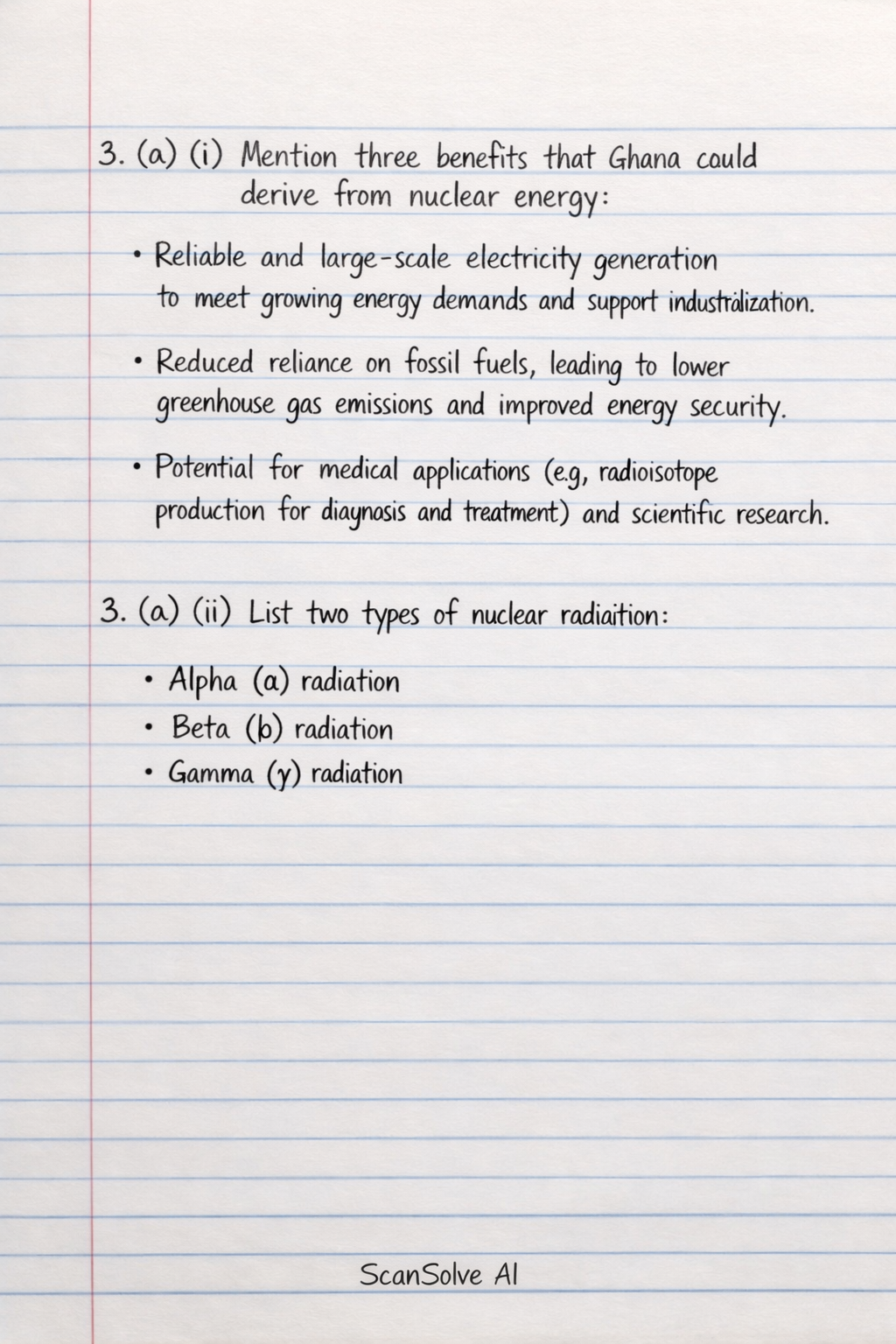
3. (a) (i) Mention three benefits that Ghana could derive from nuclear energy.
- Reliable and large-scale electricity generation to meet growing energy demands and support industrialization.
- Reduced reliance on fossil fuels, leading to lower greenhouse gas emissions and improved energy security.
- Potential for medical applications (e.g., radioisotope production for diagnosis and treatment) and scientific research.
3. (a) (ii) List two types of nuclear radiation.
- Alpha () radiation
- Beta () radiation
- Gamma () radiation
3. (b) State the scientific principle involved in each of the following local industries:
- (i) kenkey production;
- Fermentation (anaerobic respiration by microorganisms, primarily yeast and bacteria, converting carbohydrates into lactic acid and other compounds).
- (ii) soap production;
- Saponification (hydrolysis of fats or oils by a strong alkali to produce soap and glycerol).
- (iii) salt production;
- Evaporation (separation of salt from water by heating or solar energy, leaving the solid salt behind).
- (iv) vegetable oil production;
- Extraction (mechanical pressing or solvent extraction to separate oil from plant material).
- (v) gari processing.
- Fermentation (microbial breakdown of cassava starch, often involving lactic acid bacteria, to detoxify and improve flavor).
- Dehydration/Drying (removal of water content to preserve the gari).
3. (c) (i) List two micronutrients in a soil.
- Boron (B)
- Copper (Cu)
- Iron (Fe)
- Manganese (Mn)
- Zinc (Zn)
- Molybdenum (Mo)
- Chlorine (Cl)
3. (c) (ii) Differentiate between broadcasting and side dressing methods of fertilizer application.
- Broadcasting involves scattering fertilizer uniformly over the entire soil surface, either before planting or to an established crop.
- Side dressing involves applying fertilizer in bands along the sides of rows of growing plants, typically after the crop has emerged, to provide nutrients directly to the root zone.
3. (d) (i) Differentiate between conductors and semi-conductors.
- Conductors are materials that allow electric current to flow easily through them due to having many free electrons (e.g., metals). They have low electrical resistivity.
- Semiconductors are materials with electrical conductivity between that of a conductor and an insulator. Their conductivity can be controlled by doping or temperature, making them suitable for electronic devices.
3. (d) (ii) Name two appliances in the home which use semi-conductors.
- Television
- Computer
- Smartphone
- Radio
4. (a) (i) State three conditions to be considered when selecting viable seeds for planting.
- Purity: Seeds should be free from weed seeds, inert matter, and other crop seeds.
- Germination capacity: Seeds should have a high percentage of germination.
- Vigor: Seeds should be strong and healthy, capable of producing robust seedlings.
- Freedom from pests and diseases: Seeds should be free from pathogens and insect damage.
4. (a) (ii) State two characteristics of good seeds.
- High germination rate.
- Free from pests and diseases.
- Uniform in size and shape.
- True to type (genetically pure).
4. (b) (i) State Ohm's law.
Ohm's law states that the current flowing through a conductor between two points is directly proportional to the voltage across the two points, and inversely proportional to the resistance between them, provided the temperature and other physical conditions remain constant. Mathematically, it is expressed as .
4. (b) (ii) A resistor has a resistance of . If a current of passes through the resistor, calculate the potential difference across the resistor.
State the given values.
- Resistance () =
- Current () =
Apply Ohm's law formula.
Substitute the values and calculate the potential difference ().
The potential difference across the resistor is .
4. (c) (i) Differentiate between a pandemic and an epidemic.
- An epidemic is a sudden increase in the number of cases of a disease in a specific geographical area or population group, exceeding what is normally expected.
- A pandemic is an epidemic that has spread across multiple countries or continents, affecting a large number of people globally.
4. (c) (ii) State two roles of the World Health Organization in the management of the Covid-19 disease.
- Providing guidance and recommendations to countries on public health measures, testing, treatment, and vaccine development.
- Coordinating global efforts for research, development, and equitable distribution of vaccines, diagnostics, and therapeutics.
- Monitoring and reporting on the global spread and evolution of the virus.
4. (d) (i) Name two instruments used for measuring the volume of liquids accurately.
- Measuring cylinder
- Burette
- Pipette
- Volumetric flask
4. (d) (ii) Give three reasons why accurate measurement is necessary.
- Ensures safety in experiments, manufacturing, and daily life (e.g., correct dosage of medicine).
- Guarantees quality control and consistency in products and processes.
- Allows for reliable data collection and valid conclusions in scientific research and engineering.
Still stuck on this one?
Ask a follow-up, and the answer starts from this question.
More Physics Questions
Handwritten Step-by-Step Solution
Get this as a handwritten image on WhatsApp — like a tutor wrote it for you.
Try on WhatsApp