
We read your photo as:
Name any four devices that work on the heating effect of electric current.
ScanSolve AI Answer
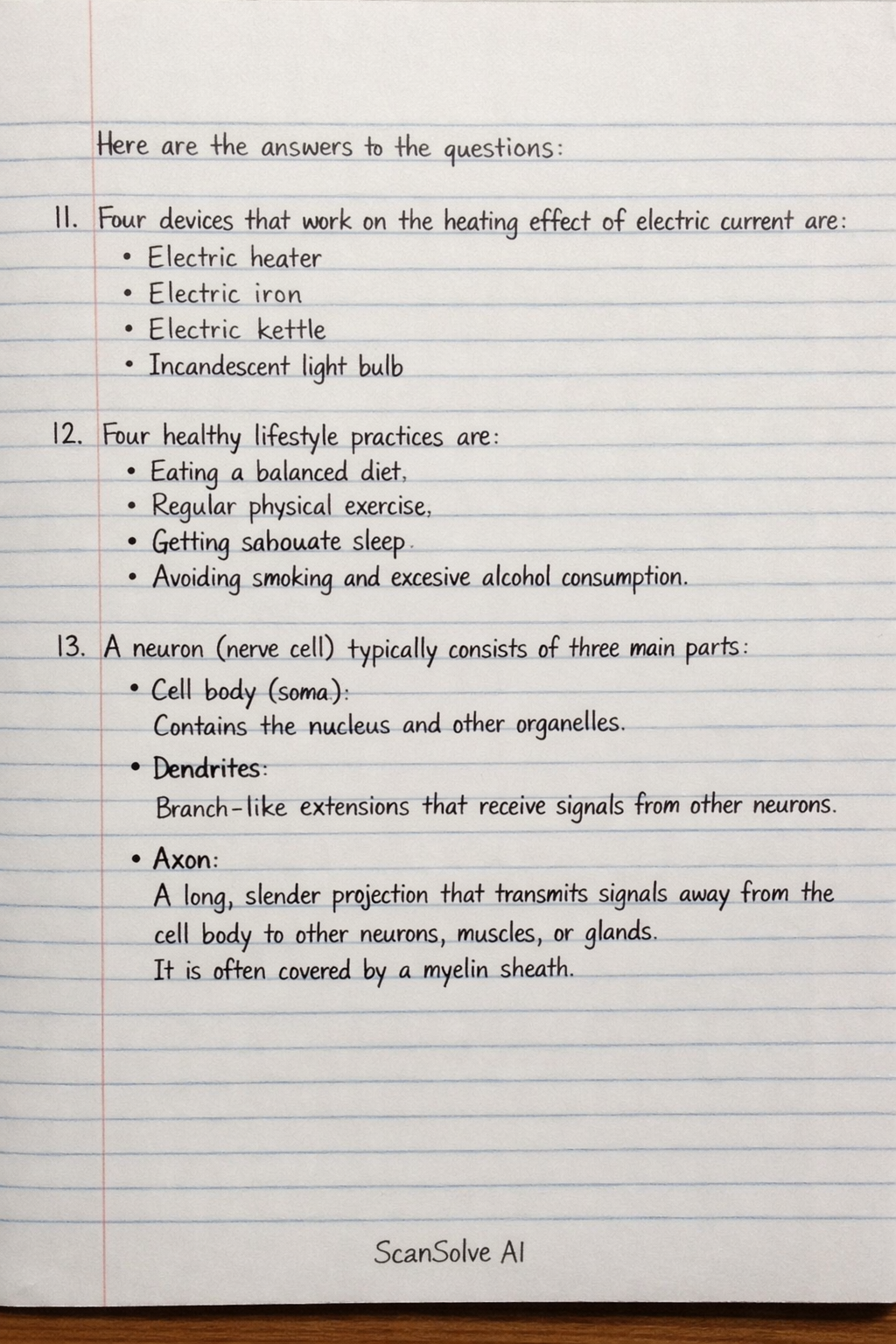
Here are the answers to the questions:
-
Four devices that work on the heating effect of electric current are:
- Electric heater
- Electric iron
- Electric kettle
- Incandescent light bulb
-
Four healthy lifestyle practices are:
- Eating a balanced diet
- Regular physical exercise
- Getting adequate sleep
- Avoiding smoking and excessive alcohol consumption
-
A neuron (nerve cell) typically consists of three main parts:
- Cell body (soma): Contains the nucleus and other organelles.
- Dendrites: Branch-like extensions that receive signals from other neurons.
- Axon: A long, slender projection that transmits signals away from the cell body to other neurons, muscles, or glands. It is often covered by a myelin sheath.
-
Experiment to demonstrate intermolecular space in liquids:
- Step 1: Take a measuring cylinder and fill it with 50 mL of water.
- Step 2: Add 50 mL of alcohol (e.g., ethanol) to the same measuring cylinder containing water.
- Step 3: Observe the total volume.
- Observation: The total volume of the mixture will be less than 100 mL (e.g., around 96 mL).
- Conclusion: This reduction in volume indicates that the alcohol molecules have occupied the empty intermolecular spaces between the water molecules, demonstrating that liquids have intermolecular spaces.
-
A thunderstorm is a storm characterized by the presence of lightning and its acoustic effect on the Earth's atmosphere, known as thunder.
- Formation:
- Step 1: Warm, moist air rises: Warm, moist air near the Earth's surface begins to rise rapidly.
- Step 2: Condensation and cloud formation: As the air rises, it cools, and the water vapor condenses to form cumulus clouds.
- Step 3: Further development: If the updraft continues, the cloud grows vertically into a cumulonimbus cloud (thunderhead). Water droplets and ice crystals within the cloud collide, creating electrical charges.
- Step 4: Precipitation and lightning: When the electrical charge separation becomes large enough, lightning occurs, followed by thunder. Precipitation (rain, hail) falls from the cloud, creating downdrafts.
- Formation:
-
The weight of an object on the Moon is one-sixth of its weight on the Earth because weight is a measure of the gravitational force acting on an object, and the Moon's gravitational acceleration is approximately one-sixth that of Earth's.
- Weight is calculated as , where is mass and is gravitational acceleration. Since , the weight on the Moon is also approximately one-sixth.
- No, the mass of the object does not become one-sixth of its mass on Earth. Mass is an intrinsic property of an object and remains constant regardless of its location or the gravitational field.
-
Rechargeable batteries are secondary cells that can be recharged by applying an external electrical current, which reverses the chemical reactions that occur during discharge.
- Uses: They are used in devices that require frequent power and where disposable batteries would be costly or environmentally wasteful.
- Two devices:
- Mobile phones
- Laptops
-
Four measures to prevent the spread of a cold from a child in school to other children:
- Encourage frequent handwashing: Teach children to wash their hands thoroughly with soap and water, especially after coughing, sneezing, or blowing their nose.
- Promote respiratory hygiene: Teach children to cover their mouth and nose with a tissue or their elbow when coughing or sneezing.
- Isolate the sick child: If possible, keep the sick child at home until they are no longer contagious to prevent further spread.
- Clean and disinfect surfaces: Regularly clean and disinfect frequently touched surfaces in the classroom (e.g., desks, doorknobs, toys).
-
A. Three differences between plant cells and animal cells:
- Cell Wall: Plant cells have a rigid cell wall outside the cell membrane, while animal cells do not.
- Chloroplasts: Plant cells contain chloroplasts for photosynthesis, while animal cells do not.
- Vacuole: Plant cells typically have a large, central vacuole, whereas animal cells have small, temporary, or no vacuoles.
-
B. A plant cell diagram would typically include and label the following parts:
- Cell Wall
- Cell Membrane
- Cytoplasm
- Nucleus (with Nucleolus)
- Mitochondria
- Chloroplasts
- Large Central Vacuole
- Endoplasmic Reticulum (Rough and Smooth)
- Ribosomes
- Golgi Apparatus (or Golgi complex/body)
Still stuck on this one?
Ask a follow-up, and the answer starts from this question.
More Physics Questions
Handwritten Step-by-Step Solution
Get this as a handwritten image on WhatsApp — like a tutor wrote it for you.
Try on WhatsApp