
We read your photo as:
Which of the following instrument does not depend on pressure for its operation?
ScanSolve AI Answer
Answer
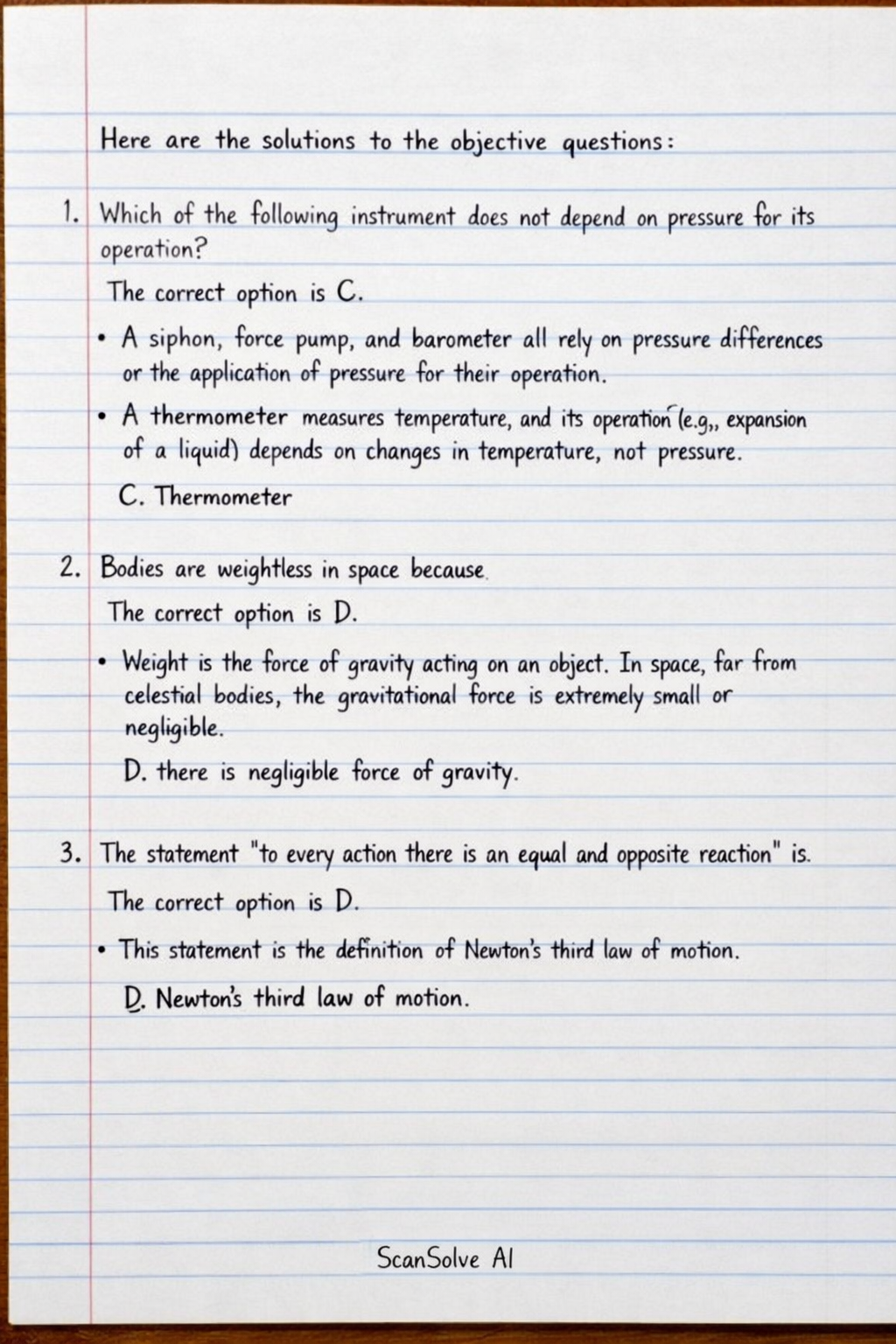
Here are the solutions to the objective questions:
1. Which of the following instrument does not depend on pressure for its operation?
The correct option is C.
- A siphon, force pump, and barometer all rely on pressure differences or the application of pressure for their operation.
- A thermometer measures temperature, and its operation (e.g., expansion of a liquid) depends on changes in temperature, not pressure.
C. Thermometer
2. Bodies are weightless in space because
The correct option is D.
- Weight is the force of gravity acting on an object. In space, far from celestial bodies, the gravitational force is extremely small or negligible.
D. there is negligible force of gravity.
3. The statement 'to every action there is an equal and opposite reaction' is
The correct option is D.
- This statement is the definition of Newton's third law of motion.
D. Newton's third law of motion.
4. A uniform beam of rod is pivoted in horizontal equilibrium as shown below.
The correct option is C.
For a beam to be in equilibrium, the sum of clockwise moments must equal the sum of anticlockwise moments about the pivot.
The anticlockwise moment due to is .
The clockwise moment due to is .
For equilibrium:
Dividing both sides by :
C.
5. Which of the following devices does not employ the application of pressure?
The correct option is D.
- A hydraulic press, siphon, and bicycle pump all actively use or rely on the application of pressure to function (e.g., to multiply force, move liquid, or compress air).
- A hydrometer measures the relative density of liquids by floating. While its operation involves buoyancy, which arises from pressure differences in the fluid, it does not employ the application of pressure in the same active sense as the other devices; it passively responds to the fluid's properties.
D. Hydrometer
6. Which of the following statements is correct?
I. Inertia and momentum are identical.
II. The unit of inertia is kilogram metre per second.
III. Momentum is the product of mass and velocity.
The correct option is C.
- Statement I is incorrect: Inertia is a measure of an object's resistance to changes in motion (related to mass), while momentum is the product of mass and velocity.
- Statement II is incorrect: The unit of inertia (mass) is kilograms (kg). The unit of momentum is kg m/s.
- Statement III is correct: Momentum () is defined as the product of mass () and velocity (), i.e., .
C. III only
7. When a hydrometer floats in a liquid, it means that the
The correct option is A.
- According to Archimedes' principle, when an object floats, the buoyant force (upthrust) acting on it is equal to its weight. The buoyant force is also equal to the weight of the fluid displaced by the submerged part of the object. Therefore, the weight of the liquid displaced is equal to the weight of the hydrometer.
A. weight of the liquid displaced is equal to the weight of the hydrometer.
8. An object has a mass of 220.0 kg. Calculate its weight. [g = 10.0 m s]
The correct option is A.
The weight () of an object is calculated using the formula:
where is the mass and is the acceleration due to gravity.
Given:
A. 2200.0 N
9. Objects are weightless in space, because
The correct option is C.
- Weight is the force of gravity acting on an object. In space, far from celestial bodies, the gravitational force is extremely small or negligible.
C. there is negligible force of gravity.
Try one yourself
A new problem that tests the same skill.
Still stuck on this one?
Ask a follow-up, and the answer starts from this question.
More Physics Questions
Handwritten Step-by-Step Solution
Get this as a handwritten image on WhatsApp — like a tutor wrote it for you.
Try on WhatsApp