
We read your photo as:
Explain the path of a light ray through a right-angled isosceles prism when the critical angle is 42 degrees and the incident ray enters perpendicular to one face.
ScanSolve AI Answer
Step-by-step solution
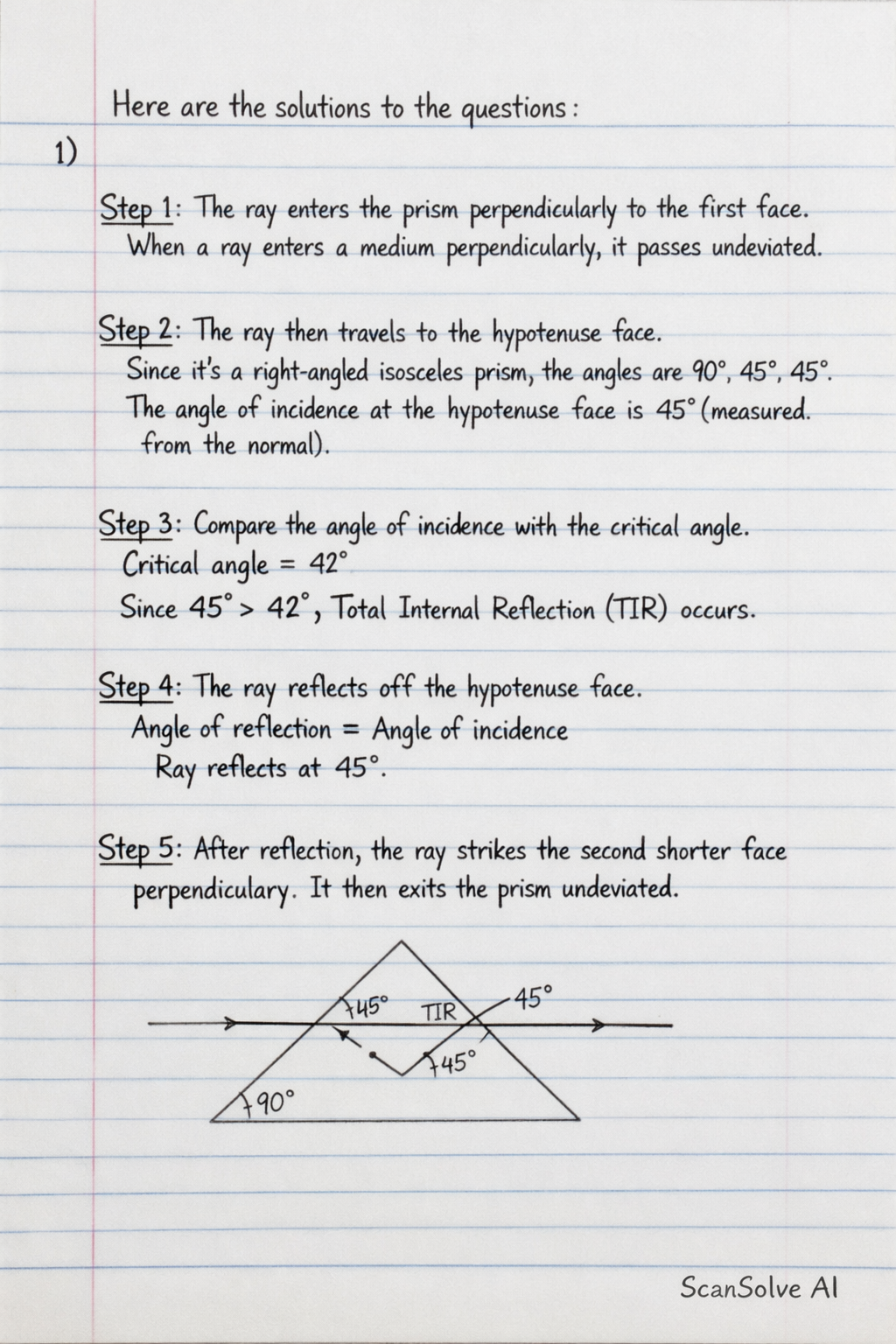
5 stepsHere are the solutions to the questions:
1)
The ray enters the prism perpendicularly to the first face.
When a ray enters a medium perpendicularly, it passes undeviated.
The ray then travels to the hypotenuse face.
Since it's a right-angled isosceles prism, the angles are , , and . The angle of incidence at the hypotenuse face is (measured from the normal).
Compare the angle of incidence with the critical angle.
The critical angle is given as . Since the angle of incidence () is greater than the critical angle (), Total Internal Reflection (TIR) occurs.
The ray reflects off the hypotenuse face.
The angle of reflection is equal to the angle of incidence, so the ray reflects at .
After reflection, the ray strikes the second shorter face perpendicularly.
It then exits the prism undeviated.
\begin{tikzpicture}[scale=1.5]
    % Prism vertices
    \coordinate (A) at (0,2);
    \coordinate (B) at (0,0);
    \coordinate (C) at (2,0);

    % Draw prism
    \draw (A) -- (B) -- (C) -- cycle;

    % Incident ray
    \draw[->, thick] (-1,1.5) -- (0,1.5); % Incident ray
    \draw[dashed] (0,1.5) -- (0,0.5); % Normal at first surface (not needed as ray is perpendicular)

    % Ray inside prism (first segment)
    \draw[thick] (0,1.5) -- (1.5,0); % Ray travels to hypotenuse

    % Normal at hypotenuse
    \draw[dashed] (1.5,0) -- (1.5,1.5); % Normal at hypotenuse
    \node at (1.6, 0.75) {$N$};

    % Angles at hypotenuse
    \pic [draw, angle radius=5mm, "45$^\circ$"] {angle = {1.5,1.5}--(1.5,0)--(0,1.5)}; % Angle of incidence
    \pic [draw, angle radius=5mm, "45$^\circ$"] {angle = {1.5,1.5}--(1.5,0)--(3,0)}; % Angle of reflection (relative to normal)

    % Reflected ray inside prism
    \draw[thick] (1.5,0) -- (3,0); % Reflected ray to second short face

    % Exit ray
    \draw[->, thick] (3,0) -- (4,0); % Exit ray (perpendicular to face)

    % Right angle symbol
    \draw (0.2,0.2) rectangle (0,0);
    \draw (1.8,0.2) rectangle (2,0); % Right angle at C
    \draw (0.2,1.8) rectangle (0,2); % Right angle at A
    \draw (1.8,0.2) rectangle (2,0); % Right angle at C

    % Angles of prism
    \pic [draw, angle radius=5mm, "45$^\circ$"] {angle = {0,0}--(2,0)--(0,2)};
    \pic [draw, angle radius=5mm, "45$^\circ$"] {angle = {2,0}--(0,2)--(0,0)};

\end{tikzpicture}
2)
An atom becomes positively charged when it loses one or more electrons. Since electrons carry a negative charge, the atom is left with more positively charged protons than negatively charged electrons, resulting in a net positive charge.3)
Soft iron keepers are ferromagnetic materials that are easily magnetized. When placed across the poles of a magnet, they complete the magnetic circuit, which helps to maintain the alignment of the magnetic domains within the magnet. This prevents the magnet from losing its magnetism (demagnetizing) over time, thus preserving its strength.4)
If cells with different electromotive forces (e.m.f.'s) are connected in parallel, the cell with the higher e.m.f. will discharge into the cell with the lower e.m.f. This creates a circulating current between the cells, leading to energy loss as heat due to the internal resistance of the cells. This reduces the overall efficiency and can cause the stronger cell to discharge prematurely.
Still stuck on this one?
Ask a follow-up, and the answer starts from this question.
More Physics Questions
Handwritten Step-by-Step Solution
Get this as a handwritten image on WhatsApp — like a tutor wrote it for you.
Try on WhatsApp