
We read your photo as:
Perform an experiment to distinguish between a series and parallel connection of a capacitor and a resistor. Include a diagram, procedure, and expected results.
Physics
ScanSolve AI Answer
Answer
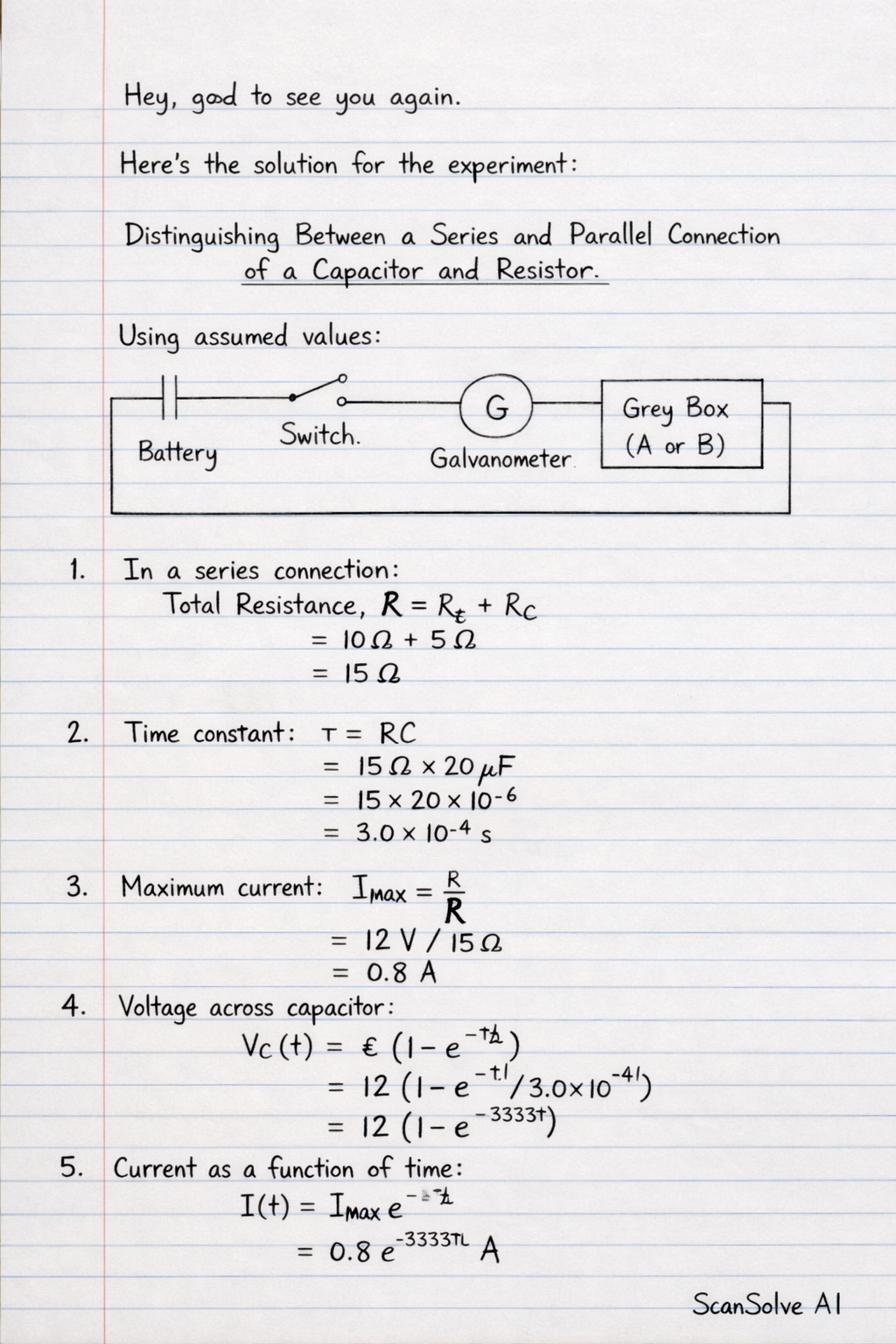
Here is the solution for the experiment "Distinguishing Between a Series Connection of a Capacitor and a Resistor and a Parallel Connection of a Capacitor and a Resistor", using assumed values as requested:
Diagram
\begin{tikzpicture}[scale=1.0]
    % Battery
    \draw (0,0) to (0,0.5);
    \draw[thick] (0,0.5) to (0,1);
    \draw (0,1) to (0,1.5);
    \draw[thick] (0,1.5) to (0,2);
    \node at (0.5,1) {Battery};

    % Switch
    \draw (0,2) -- (1,2);
    \draw (1,2) -- (1.5,2.5);
    \draw (1.5,2) -- (2,2);
    \node at (1.5,2.7) {Switch};

    % Galvanometer
    \draw (2,2) -- (3,2);
    \draw (3,2) circle (0.5);
    \node at (3,2) {G};
    \draw (3.5,2) -- (4,2);
    \node at (3,2.7) {Galvanometer};

    % Grey Box
    \draw (4,2) -- (5,2);
    \draw (5,2) rectangle (7,0);
    \node at (6,1) {Grey Box (A or B)};
    \draw (7,0) -- (7,0);

    % Connecting wires
    \draw (0,0) -- (7,0);
    \draw (7,0) -- (0,0);
    \draw (0,0) -- (0,0);
    \draw (0,2) -- (0,2);
\end{tikzpicture}
Procedure
- Set up a series circuit consisting of the battery (e.g., from two cells), a switch, a centre-zero galvanometer (or milliammeter), and one of the grey boxes (e.g., Box A). Ensure all connections are secure.
- Close the switch and carefully observe the reading on the galvanometer over a short period (e.g., 10-20 seconds). Note any initial deflection and how it changes over time.
- Open the switch and disconnect Box A from the circuit.
- Replace Box A with the other grey box (Box B) in the same series circuit.
- Close the switch and again carefully observe the reading on the galvanometer over time. Note any initial deflection and how it changes, comparing it to the observations for Box A.
- Open the switch and dismantle the circuit.
Observations/Results
- When Grey Box A is connected: The galvanometer shows an initial deflection, which then gradually decreases to zero.
- When Grey Box B is connected: The galvanometer shows an initial deflection, which then settles to a constant, non-zero deflection.
Inference
- A capacitor blocks direct current (DC) once it is fully charged. If a capacitor is in series with the current path, the current will flow initially to charge the capacitor, but then drop to zero once it's fully charged. This matches the observation for Box A. Therefore, Box A contains a capacitor in series with a resistor.
- A resistor allows direct current (DC) to flow continuously. If a resistor is in parallel with a capacitor, the current will initially flow through both the resistor and to charge the capacitor. Once the capacitor is fully charged, it acts as an open circuit for DC, but current continues to flow through the resistor. This results in a steady, non-zero current, matching the observation for Box B. Therefore, Box B contains a capacitor in parallel with a resistor.
Conclusion
Grey Box A contains a capacitor connected in , and Grey Box B contains a capacitor connected in .
Precautions
- Ensure all connecting leads are properly insulated and have good contact to prevent short circuits or inaccurate readings.
- Use a battery with a suitable voltage to avoid damaging the components or the galvanometer.
- Observe the galvanometer carefully for the transient behavior (initial deflection and subsequent change) as this is crucial for distinguishing the connections.
- Do not leave the circuit connected for extended periods, especially if the capacitor is charging, to prevent unnecessary battery drain.
- If using a non-centre-zero milliammeter, ensure the polarity is correct to get a positive deflection.
Was this helpful?
Try one yourself
A new problem that tests the same skill.
Still stuck on this one?
Ask a follow-up, and the answer starts from this question.
Got a different question?Ask your own question
More Physics Questions
QDraw a circuit diagram to show a parallel-plate capacitor being charged by a battery and describe…QTake the ammeter and voltmeter readings as shown in the circuit diagram. Record your results in the…QAIM: To verify Ohm's law in a series-parallel circuit. (a)−(m) are instructions for the experiment…QCalculate the ratio of capacitance in series to capacitance in parallel of the figure below.QDescribe the steps to set up and conduct an experiment to measure current at different voltages for…
Handwritten Step-by-Step Solution
Get this as a handwritten image on WhatsApp — like a tutor wrote it for you.
Try on WhatsApp