
We read your photo as:
Explain the phenomena observed in b) i) and b) ii). Describe the steps to create a graduated thermometer using the given apparatus in c).
ScanSolve AI Answer
Step-by-step solution
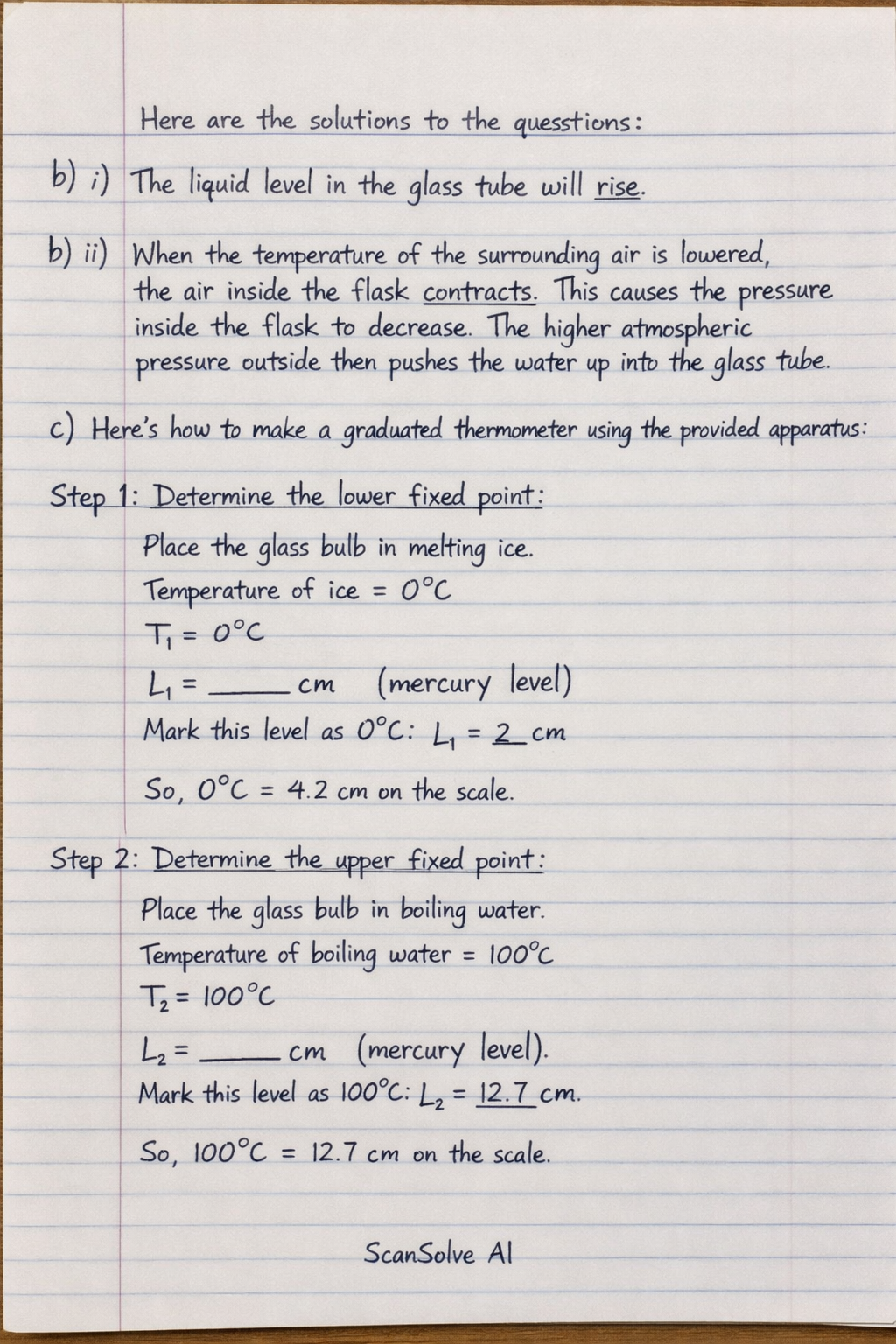
3 stepsHere are the solutions to the questions:
b) i)
The liquid level in the glass tube will rise.
b) ii)
When the temperature of the surrounding air is lowered, the air inside the flask contracts. This causes the pressure inside the flask to decrease. The higher atmospheric pressure outside then pushes the water up into the glass tube.
c)
Here's how to make a graduated thermometer using the provided apparatus:
Determine the lower fixed point.
Place the glass bulb filled with mercury into a beaker containing melting ice. Allow the mercury level to stabilize. Mark this level on the hollow stem as .
Determine the upper fixed point.
Place the glass bulb into the boiling water in a can. Allow the mercury level to stabilize. Mark this level on the hollow stem as .
Graduate the scale*.
Using the grid of equal squares or a ruler, measure the distance between the mark and the mark. Divide this distance into 100 equal parts. Each division represents . Extend the scale above and below using the same divisions if desired.
Still stuck on this one?
Ask a follow-up, and the answer starts from this question.
More Physics Questions
Handwritten Step-by-Step Solution
Get this as a handwritten image on WhatsApp — like a tutor wrote it for you.
Try on WhatsApp