
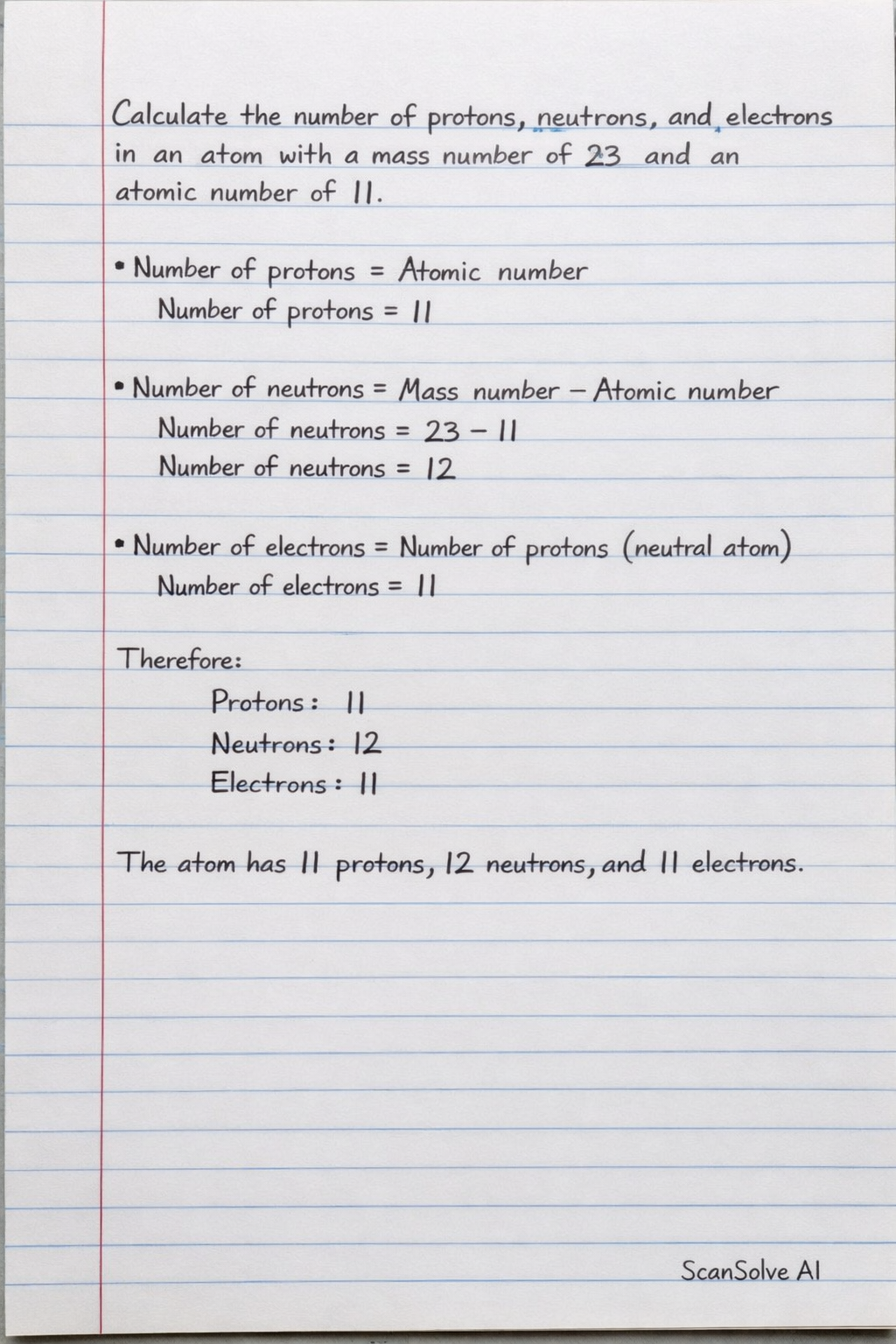
This physics problem tests your understanding of fundamental physical laws and their applications. The step-by-step solution below breaks down the problem using relevant equations and physical reasoning.
ScanSolve AI Answer
Here's a summary of electrons, protons, and neutrons: An electron is a subatomic particle with a negative elementary charge (-1.602 × 10^-19 C). It has a very small mass, approximately 9.109 × 10^-31 kg, and orbits the atomic nucleus in electron shells. A proton is a subatomic particle found in the atomic nucleus. It carries a positive elementary charge (+1.602 × 10^-19 C) and has a mass of approximately 1.672 × 10^-27 kg, which is about 1836 times greater than an electron's mass. The number of protons defines the atomic number of an element. A neutron is a subatomic particle also located in the atomic nucleus. It has no net electric charge (it is neutral) and a mass very similar to that of a proton, approximately 1.674 × 10^-27 kg. Neutrons contribute to the atomic mass and help stabilize the nucleus.