
Q61. You are performing MT (Magnetic Particle Test) on a HAZ of a low-alloy steel weld in a power-plant application. The surface cleaning indicates residual mill scale remains (~0.2 mm thick). The quality engineer should: Proceed – as long as indications are not found the test is valid. Proceed – mill scale doesn’t matter for MT. Stop and instruct to remove mill scale fully before MT. Switch to UT instead of MT because of the surface condition. (For answer & explanation, please click: https://www.weldingandndt.com/interview-questions-for-mechanical-qa-qc-engineer-and-third-party-inspector-jobs/)
ScanSolve AI Answer
Answer
Step-by-step solution
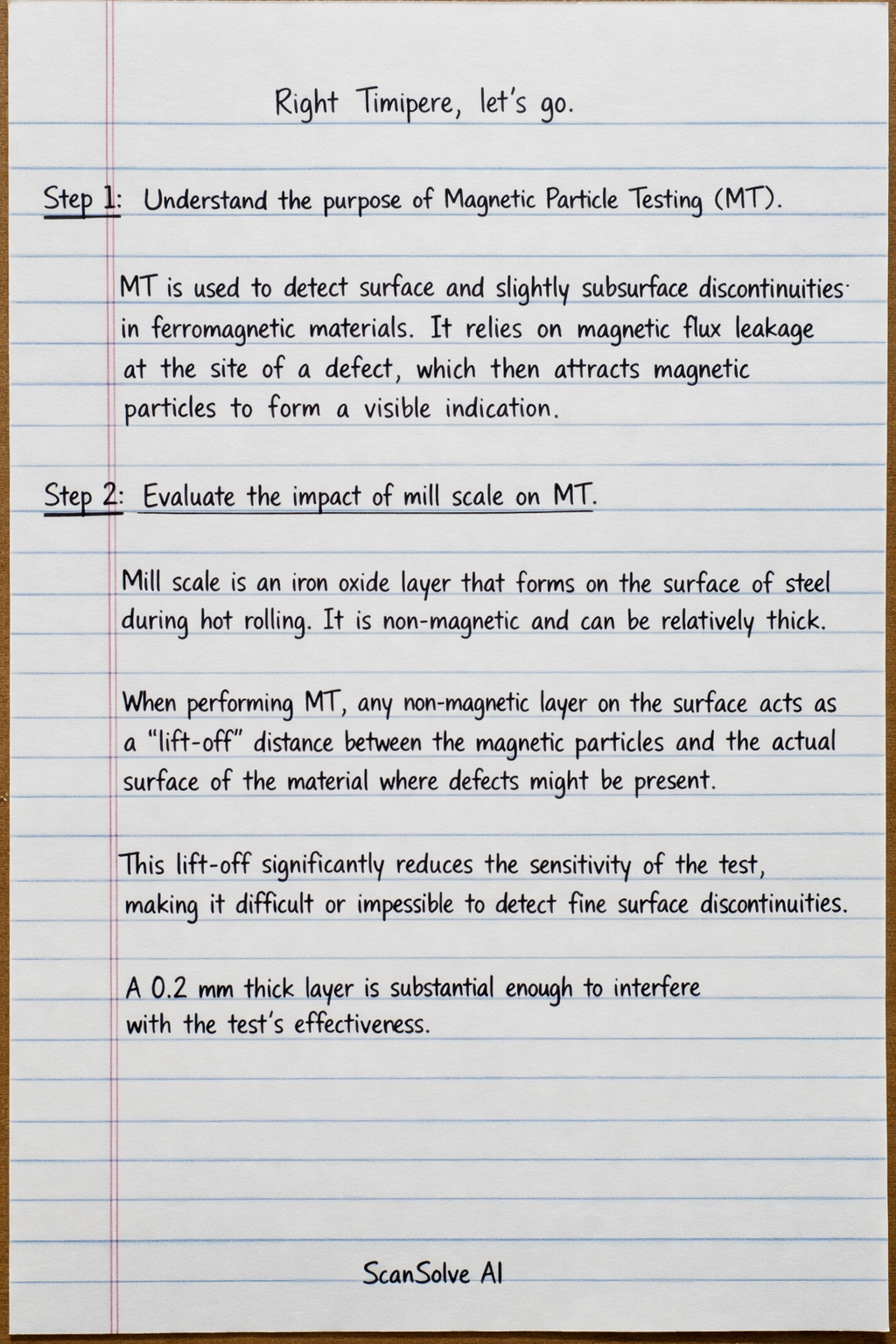
4 stepsUnderstand the purpose of Magnetic Particle Testing (MT).
MT is used to detect surface and slightly subsurface discontinuities in ferromagnetic materials. It relies on magnetic flux leakage at the site of a defect, which then attracts magnetic particles to form a visible indication.
Evaluate the impact of mill scale on MT.
Mill scale is an iron oxide layer that forms on the surface of steel during hot rolling. It is non-magnetic and can be relatively thick. When performing MT, any non-magnetic layer on the surface acts as a "lift-off" distance between the magnetic particles and the actual surface of the material where defects might be present. This lift-off significantly reduces the sensitivity of the test, making it difficult or impossible to detect fine surface discontinuities. A 0.2 mm thick layer is substantial enough to interfere with the test's effectiveness.
Assess the given options based on MT principles and best practices.
-
- Proceeding without removing the mill scale would lead to an unreliable test. The absence of indications might not mean the absence of defects, but rather that the test was ineffective.
-
- Mill scale does matter for MT because it reduces sensitivity and can mask defects.
-
- Standard NDT procedures, including those for MT (e.g., ASTM E1444), require the test surface to be clean, dry, and free from any contaminants, coatings, or scale that could interfere with the test. Removing the mill scale ensures the test's reliability and sensitivity.
-
- While Ultrasonic Testing (UT) is another NDT method, it is primarily used for internal defects and thickness measurement. MT is specifically designed for surface and near-surface defects. The correct action for an ineffective MT due to surface condition is to rectify the surface condition, not necessarily switch to a different method that might not be as sensitive to the specific type of defect MT is intended to find.
-
Conclude the correct action.
The presence of 0.2 mm thick residual mill scale will severely compromise the effectiveness and reliability of the Magnetic Particle Test. Therefore, the quality engineer must ensure its complete removal before proceeding with the MT.
The final answer is
Try one yourself
A new problem that tests the same skill.
Still stuck on this one?
Ask a follow-up, and the answer starts from this question.
More Physics Questions
Handwritten Step-by-Step Solution
Get this as a handwritten image on WhatsApp — like a tutor wrote it for you.
Try on WhatsApp