
We read your photo as:
Explain the rectilinear propagation of light and provide examples of luminous and non-luminous sources, as well as transparent, translucent, and opaque media.
ScanSolve AI Answer
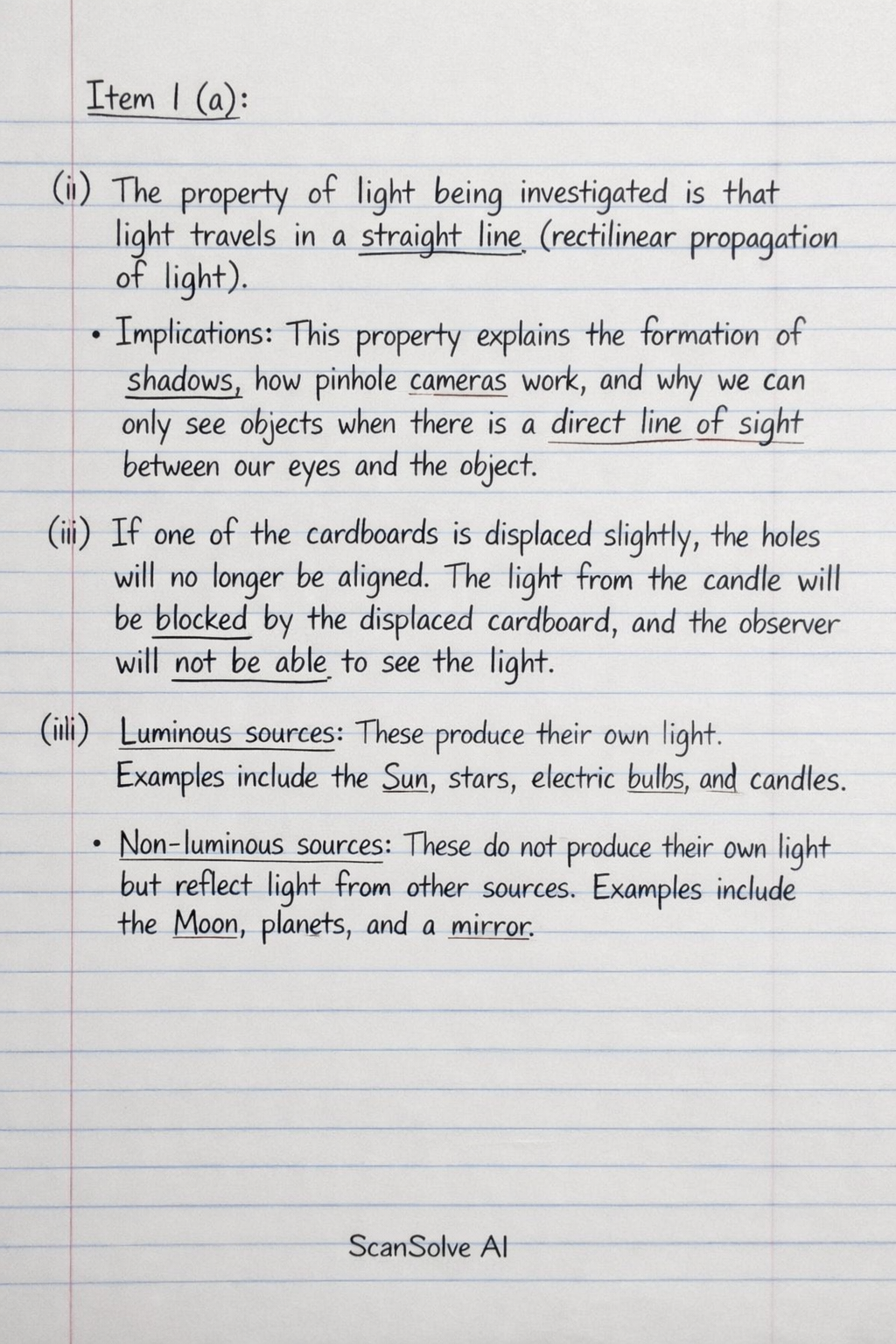
Item 1 (a):
-
(i) The property of light being investigated is that light travels in a straight line (rectilinear propagation of light).
- Implications: This property explains the formation of shadows, how pinhole cameras work, and why we can only see objects when there is a direct line of sight between our eyes and the object.
-
(ii) If one of the cardboards is displaced slightly, the holes will no longer be aligned. The light from the candle will be blocked by the displaced cardboard, and the observer will not be able to see the light.
-
(iii)
- Luminous sources: These produce their own light. Examples include the Sun, stars, electric bulbs, and candles.
- Non-luminous sources: These do not produce their own light but reflect light from other sources. Examples include the Moon, planets, and a mirror.
-
(iv)
- Transparent media: Allow light to pass through completely, enabling clear vision through them. Examples: air, clear glass, pure water.
- Translucent media: Allow some light to pass through but scatter it, making objects appear blurry or indistinct. Examples: frosted glass, tracing paper, oiled paper.
- Opaque media: Do not allow any light to pass through them, blocking light completely. Examples: wood, metal, cardboard.
-
(v)
- Parallel beam: A collection of light rays that travel parallel to each other. This occurs when the light source is very far away, like sunlight.
- Convergent beam: A collection of light rays that come together and meet at a single point (focus). This is produced by a convex lens or concave mirror.
- Divergent beam: A collection of light rays that spread out from a single point. This is produced by a point source of light or a concave lens.
-
(vi) Two evidences that prove the existence of rectilinear propagation of light are:
- The formation of sharp shadows when an opaque object blocks light.
- The formation of inverted images in a pinhole camera.
-
(vii)
- Umbra: The darkest, innermost part of a shadow where the light source is completely blocked by an opaque object. No direct light from the source reaches this region.
- Penumbra: The lighter, outer part of a shadow where the light source is only partially blocked by the opaque object. Some light from the source reaches this region.
Item 1 (b):
-
(i) An eclipse is caused by the alignment of three celestial bodies (the Sun, Earth, and Moon) in a straight or nearly straight line. This alignment causes one body to block the light from another, casting a shadow.
-
(ii)
- Solar eclipse: Occurs when the Moon passes between the Sun and Earth, blocking the Sun's light and casting a shadow on Earth.
- Lunar eclipse: Occurs when the Earth passes between the Sun and Moon, casting a shadow on the Moon and making it appear dim or reddish.
-
(iii) The eclipse of the Moon (lunar eclipse) lasts longer than the eclipse of the Sun (solar eclipse) because the Earth's shadow is much larger than the Moon's shadow. The Moon takes a longer time to pass through Earth's wider shadow during a lunar eclipse compared to the relatively narrow path of the Moon's shadow across Earth during a solar eclipse.
-
(iv)
- To watch a solar eclipse safely, people should use certified solar eclipse glasses or viewers, a pinhole projector, or view it through telescopes or binoculars fitted with special solar filters. Never look directly at the Sun without proper eye protection.
- A lunar eclipse is safe to watch with the naked eye as it involves looking at the Moon, which only reflects sunlight and is not dangerously bright.
Still stuck on this one?
Ask a follow-up, and the answer starts from this question.
More Physics Questions
Handwritten Step-by-Step Solution
Get this as a handwritten image on WhatsApp — like a tutor wrote it for you.
Try on WhatsApp