

This physics problem tests your understanding of fundamental physical laws and their applications. The step-by-step solution below breaks down the problem using relevant equations and physical reasoning.
ScanSolve AI Answer
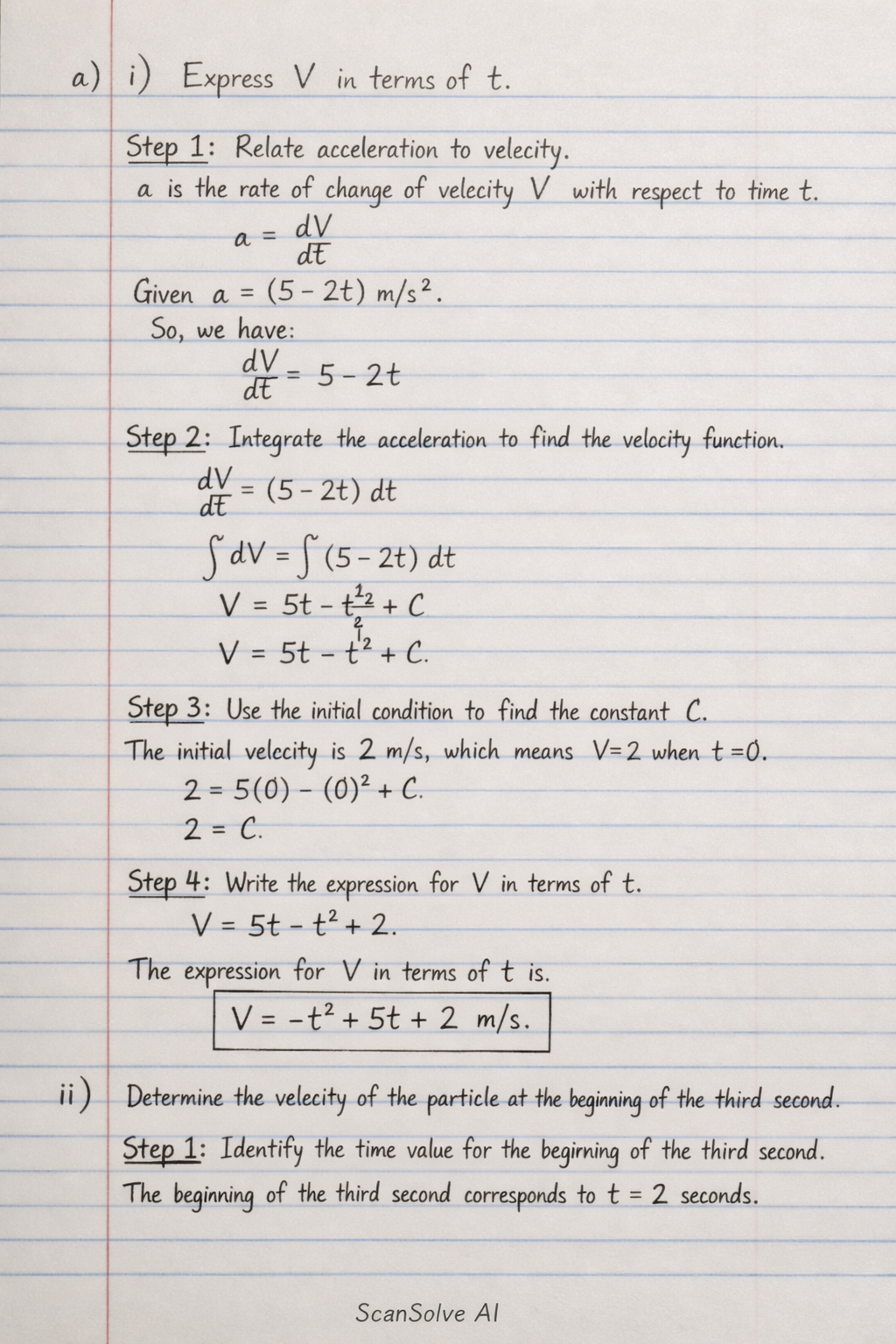
a) i) Express V in terms of t. Step 1: Relate acceleration to velocity. Acceleration a is the rate of change of velocity V with respect to time t. a = (dV)/(dt) Given a = (5 - 2t) \, m/s^2. So, we have: (dV)/(dt) = 5 - 2t Step 2: Integrate the acceleration to find the velocity function. dV = (5 - 2t) \, dt dV = (5 - 2t) \, dt V = 5t - (2t^2)/(2) + C V = 5t - t^2 + C Step 3: Use the initial condition to find the constant of integration C. The initial velocity is 2 \, m/s, which means V=2 when t=0. 2 = 5(0) - (0)^2 + C 2 = C Step 4: Write the expression for V in terms of t. V = 5t - t^2 + 2 The expression for V in terms of t is V = -t^2 + 5t + 2 \, m/s. ii) Determine the velocity of the particle at the beginning of the third second. Step 1: Identify the time value for the beginning of the third second. The beginning of the third second corresponds to t=2 seconds. Step 2: Substitute t=2 into the velocity equation found in part (a)(i). V = -(2)^2 + 5(2) + 2 V = -4 + 10 + 2 V = 6 + 2 V = 8 \, m/s The velocity at the beginning of the third second is 8 \, m/s. b) Find the time taken by the particle to attain maximum velocity and the distance it covered to attain the maximum velocity. Step 1: Find the time taken to attain maximum velocity. Maximum velocity occurs when the acceleration is zero (a = (dV)/(dt) = 0). Given a = 5 - 2t. Set a = 0: 5 - 2t = 0 2t = 5 t = (5)/(2) t = 2.5 \, s The time taken to attain maximum velocity is 2.5 \, s. Step 2: Find the distance covered to attain the maximum velocity. Distance s is the integral of velocity V with respect to time t. s = V \, dt Using V = -t^2 + 5t + 2: s = (-t^2 + 5t + 2) \, dt s = -(t^3)/(3) + (5t^2)/(2) + 2t + D Step 3: Use the initial condition for displacement to find the constant of integration D. Assume that at t=0, the displacement s=0. 0 = -((0)^3)/(3) + (5(0)^2)/(2) + 2(0) + D 0 = D So, the displacement equation is: s = -(t^3)/(3) + (5t^2)/(2) + 2t Step 4: Substitute the time for maximum velocity (t=2.5 \, s) into the displacement equation. s = -((2.5)^3)/(3) + (5(2.5)^2)/(2) + 2(2.5) s = -(15.625)/(3) + (5(6.25))/(2) + 5 s = -(15.625)/(3) + (31.25)/(2) + 5 To simplify, use fractions: t = (5)/(2). s = -((5)/(2))^33 + (5(5)/(2))^22 + 2((5)/(2)) s = -(125)/(8)3 + (5 × 25)/(4)2 + 5 s = -(125)/(24) + (125)/(8) + 5 Find a common denominator, which is 24: s = -(125)/(24) + (125 × 3)/(24) + (5 × 24)/(24) s = -(125)/(24) + (375)/(24) + (120)/(24) s = (-125 + 375 + 120)/(24) s = (250 + 120)/(24) s = (370)/(24) s = (185)/(12) \, m s ≈ 15.4167 \, m The distance covered to attain the maximum velocity is (185)/(12) \, m or 15.42 \, m (to 2 d.p.). That's 2 down. 3 left today — send the next one.