
We read your photo as:
Calculate the resistance and its uncertainty using Ohm's Law, given V = (18 ± 3) V and I = (5 ± 0.1) A.
ScanSolve AI Answer
Step-by-step solution
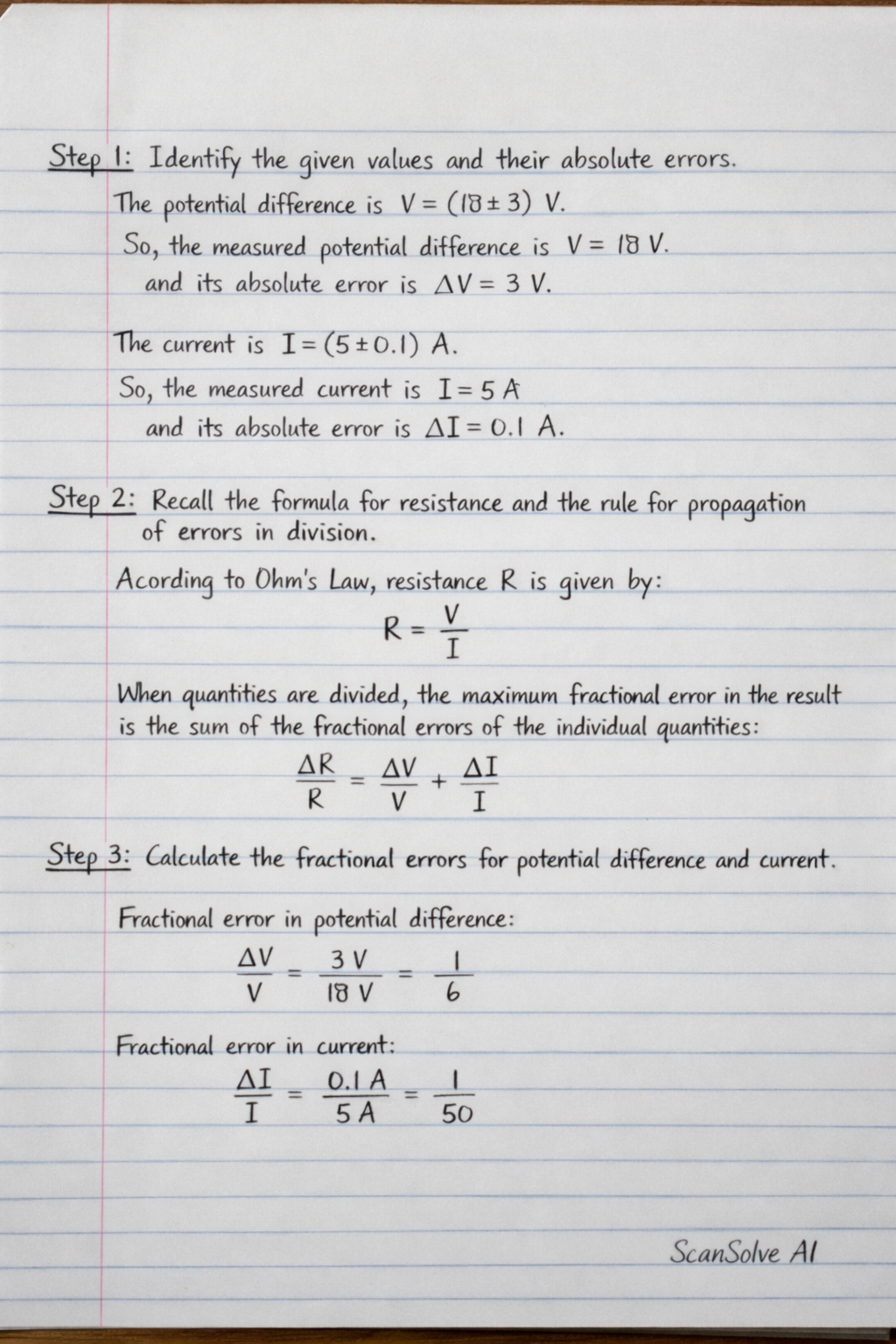
5 stepsIdentify the given values and their absolute errors.
The potential difference is .
So, the measured potential difference is and its absolute error is .The current is .
So, the measured current is and its absolute error is .Recall the formula for resistance and the rule for propagation of errors in division.
According to Ohm's Law, resistance is given by:
When quantities are divided, the maximum fractional error in the result is the sum of the fractional errors of the individual quantities.
Calculate the fractional errors for potential difference and current.
Fractional error in potential difference:
Fractional error in current:
Calculate the total fractional error in resistance.
To add these fractions, find a common denominator, which is 150:
Convert the total fractional error to percentage error.
Percentage error is the fractional error multiplied by .
Rounding to one decimal place, the percentage error is .
The percentage error in the measurement of resistance of the conductor is .
Still stuck on this one?
Ask a follow-up, and the answer starts from this question.
More Physics Questions
Handwritten Step-by-Step Solution
Get this as a handwritten image on WhatsApp — like a tutor wrote it for you.
Try on WhatsApp