This physics problem tests your understanding of fundamental physical laws and their applications. The step-by-step solution below breaks down the problem using relevant equations and physical reasoning.
ScanSolve AI Answer
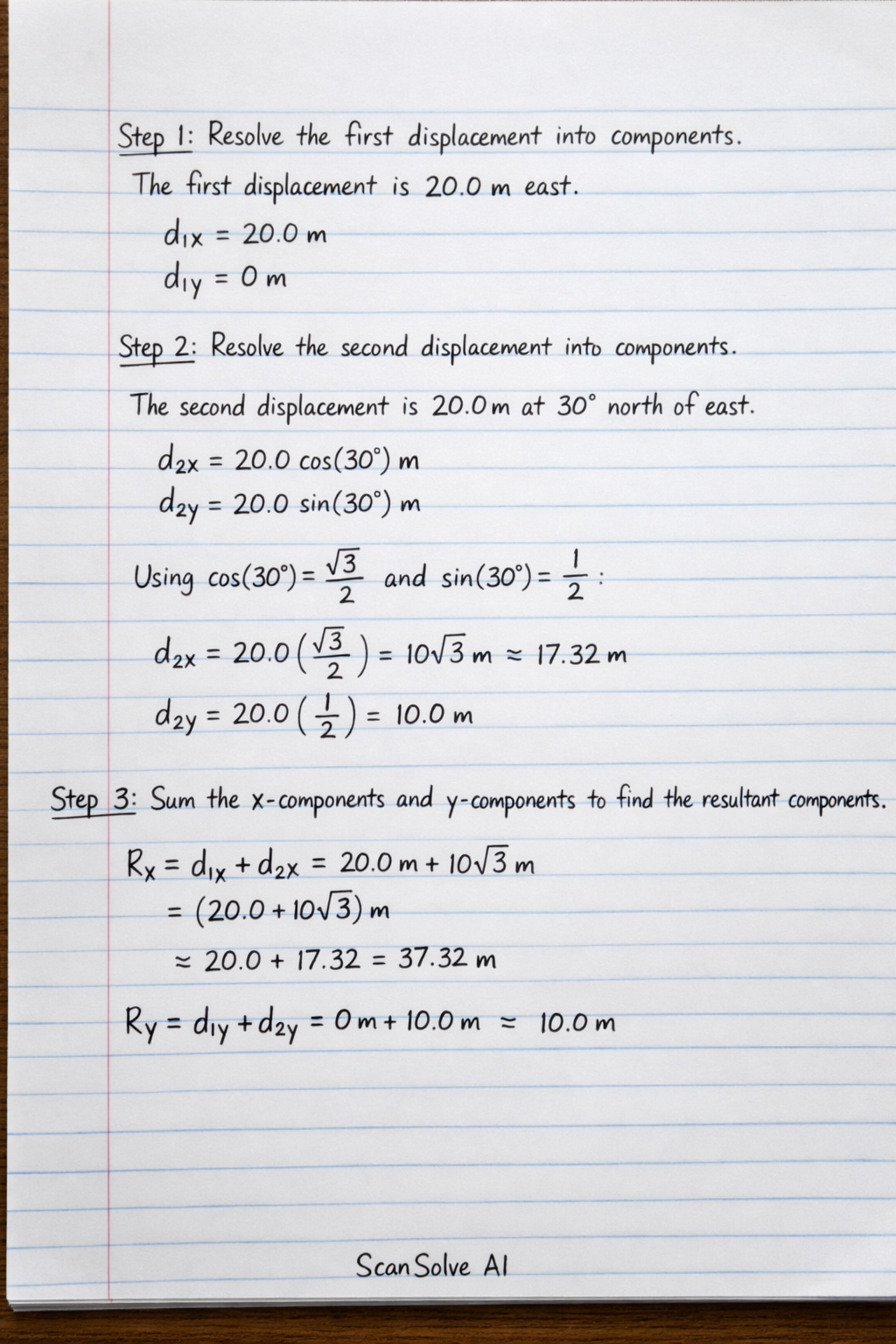
Step 1: Resolve the first displacement into components.
The first displacement is $20.0 \text{ m}$ east.
$$d_{1x} = 20.0 \text{ m}$$
$$d_{1y} = 0 \text{ m}$$
Step 2: Resolve the second displacement into components.
The second displacement is $20.0 \text{ m}$ at $30^\circ$ north of east.
$$d_{2x} = 20.0 \cos(30^\circ) \text{ m}$$
$$d_{2y} = 20.0 \sin(30^\circ) \text{ m}$$
Using $\cos(30^\circ) = \frac{\sqrt{3}}{2}$ and $\sin(30^\circ) = \frac{1}{2}$:
$$d_{2x} = 20.0 \left(\frac{\sqrt{3}}{2}\right) = 10\sqrt{3} \text{ m} \approx 17.32 \text{ m}$$
$$d_{2y} = 20.0 \left(\frac{1}{2}\right) = 10.0 \text{ m}$$
Step 3: Sum the x-components and y-components to find the resultant components.
$$R_x = d_{1x} + d_{2x} = 20.0 \text{ m} + 10\sqrt{3} \text{ m} = (20.0 + 10\sqrt{3}) \text{ m}$$
$$R_x \approx 20.0 + 17.32 = 37.32 \text{ m}$$
$$R_y = d_{1y} + d_{2y} = 0 \text{ m} + 10.0 \text{ m} = 10.0 \text{ m}$$
Step 4: Calculate the magnitude of the resultant displacement.
The magnitude $R$ is given by the Pythagorean theorem:
$$R = \sqrt{R_x^2 + R_y^2}$$
$$R = \sqrt{(20.0 + 10\sqrt{3})^2 + (10.0)^2}$$
$$R = \sqrt{(400 + 400\sqrt{3} + 300) + 100}$$
$$R = \sqrt{800 + 400\sqrt{3}}$$
Using $\sqrt{3} \approx 1.732$:
$$R = \sqrt{800 + 400(1.732)}$$
$$R = \sqrt{800 + 692.8}$$
$$R = \sqrt{1492.8}$$
$$R \approx 38.637 \text{ m}$$
Rounding to one decimal place, the magnitude is $38.6 \text{ m}$.
Comparing with the given options:
A. 28.3 m
B. 40.0 m
C. 38.6 m
D. 10.4 m
The closest option is C.
The final answer is $\boxed{\text{C. } 38.6 \text{ m}}$.
Send me the next one πΈ
Resolve the first displacement into components.
|Physics
Resolve the first displacement into components.
ScanSolve AI Answer
Step 1: Resolve the first displacement into components.
The first displacement is 20.0Β m east.
d1xβ=20.0Β md1yβ=0Β m
Step 2: Resolve the second displacement into components.
The second displacement is 20.0Β m at 30β north of east.
d2xβ=20.0cos(30β)Β md2yβ=20.0sin(30β)Β m
Using cos(30β)=23ββ and sin(30β)=21β:
d2xβ=20.0(23ββ)=103βmβ17.32Β md2yβ=20.0(21β)=10.0Β m
Step 3: Sum the x-components and y-components to find the resultant components.
Rxβ=d1xβ+d2xβ=20.0m+103βm=(20.0+103β)Β mRxββ20.0+17.32=37.32Β mRyβ=d1yβ+d2yβ=0m+10.0m=10.0Β m
Step 4: Calculate the magnitude of the resultant displacement.
The magnitude R is given by the Pythagorean theorem:
R=Rx2β+Ry2ββR=(20.0+103β)2+(10.0)2βR=(400+4003β+300)+100βR=800+4003ββ
Using 3ββ1.732:
R=800+400(1.732)βR=800+692.8βR=1492.8βRβ38.637Β m
Rounding to one decimal place, the magnitude is 38.6Β m.
Comparing with the given options:
A. 28.3 m
B. 40.0 m
C. 38.6 m
D. 10.4 m
The closest option is C.
The final answer is C.38.6mβ.
Send me the next one πΈ
Need help with your own homework?
Get instant step-by-step solutions to any question. Free to start.