
This physics problem tests your understanding of fundamental physical laws and their applications. The step-by-step solution below breaks down the problem using relevant equations and physical reasoning.
ScanSolve AI Answer
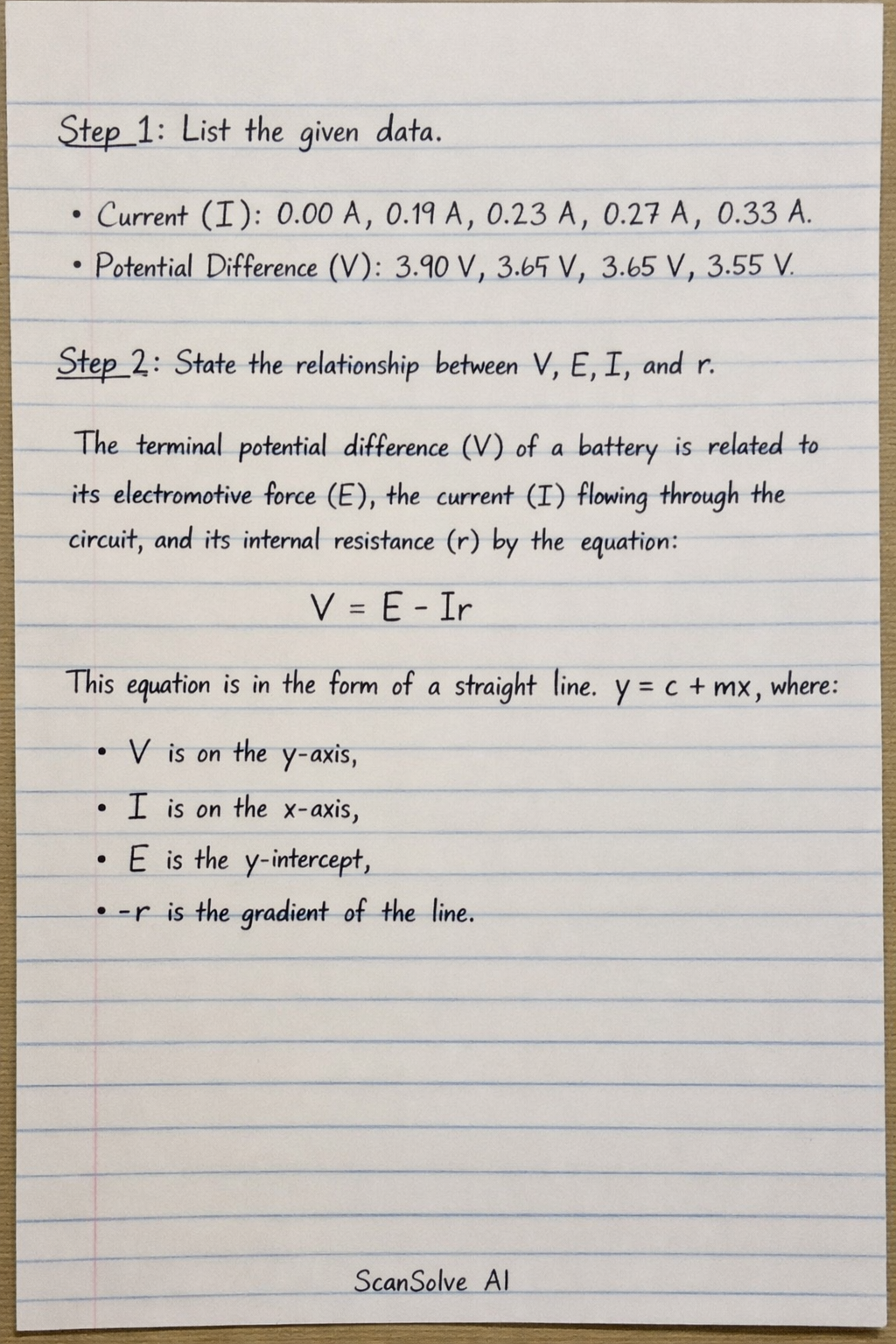
Step 1: List the given data. The provided data for current (I) and potential difference (V) are: • Current (I): 0.00 A, 0.19 A, 0.23 A, 0.27 A, 0.33 A • Potential Difference (V): 3.90 V, 3.69 V, 3.65 V, 3.61 V, 3.55 V Step 2: State the relationship between V, E, I, and r. The terminal potential difference (V) of a battery is related to its electromotive force (E), the current (I) flowing through the circuit, and its internal resistance (r) by the equation: V = E - Ir This equation is in the form of a straight line y = c + mx, where V is on the y-axis, I is on the x-axis, E is the y-intercept, and -r is the gradient of the line. Step 3: Determine the Electromotive Force (E). From the equation V = E - Ir, when the current I = 0 A (i.e., the circuit is open), the terminal potential difference V is equal to the electromotive force E. Looking at the given data, the first data point is (I=0.00 A, V=3.90 V). Therefore, the electromotive force (E) of the battery is: E = 3.90 V E = 3.90 V Step 4: Determine the Internal Resistance (r). The internal resistance r is the negative of the gradient of the V versus I graph. We can calculate the gradient (m) using two points from the data. Let's use the first point (I_1, V_1) = (0.00 A, 3.90 V) and the last point (I_2, V_2) = (0.33 A, 3.55 V) to determine the gradient of the best-fit line. The gradient m is calculated as: m = ( V)/( I) = (V_2 - V_1)/(I_2 - I_1) Substitute the values: m = 3.55 V - 3.90 V0.33 A - 0.00 A m = -0.35 V0.33 A m ≈ -1.0606 Since m = -r, the internal resistance r is: r = -m r = -(-1.0606 ) r ≈ 1.06 Rounding to two decimal places, the internal resistance (r) is: r = 1.06 3 done, 2 left today. You're making progress.