
We read your photo as:
Draw the circuit diagram.
Physics
ScanSolve AI Answer
This answer stops before the end.
It was cut off when it was first written. Ask ScanSolve this question again for the full working.
Step 1: Draw the circuit diagram.
The circuit diagram for the experiment, as described and partially shown in the provided image, consists of:
- A battery of three cells in series, representing the electromotive force (Emf) and internal resistance ().
- A voltmeter (V) connected in parallel across the terminals of the battery to measure the potential difference.
- An ammeter (A) connected in series with the external circuit to measure the current ().
- A variable resistor () connected in series with the ammeter.
- An open switch (S) connected in series with the ammeter and variable resistor.
\begin{tikzpicture}[
    circuit ee,
    scale=0.8,
    transform shape
Was this helpful?
Still stuck on this one?
Ask a follow-up, and the answer starts from this question.
Got a different question?Ask your own question
More Physics Questions
QI) Draw a circuit diagram for the arrangement.QSketch the vector diagram.QDraw the wiring diagram of the circuit. Install and wire the circuit for correct operation to…QDraw a wiring diagram for the bell circuit shown in Figure 2.QDraw the circuit diagram of your chosen scale model/prototype. Refer to Worksheet 34 (Informal)
Browse by topic:Electrical Engineering
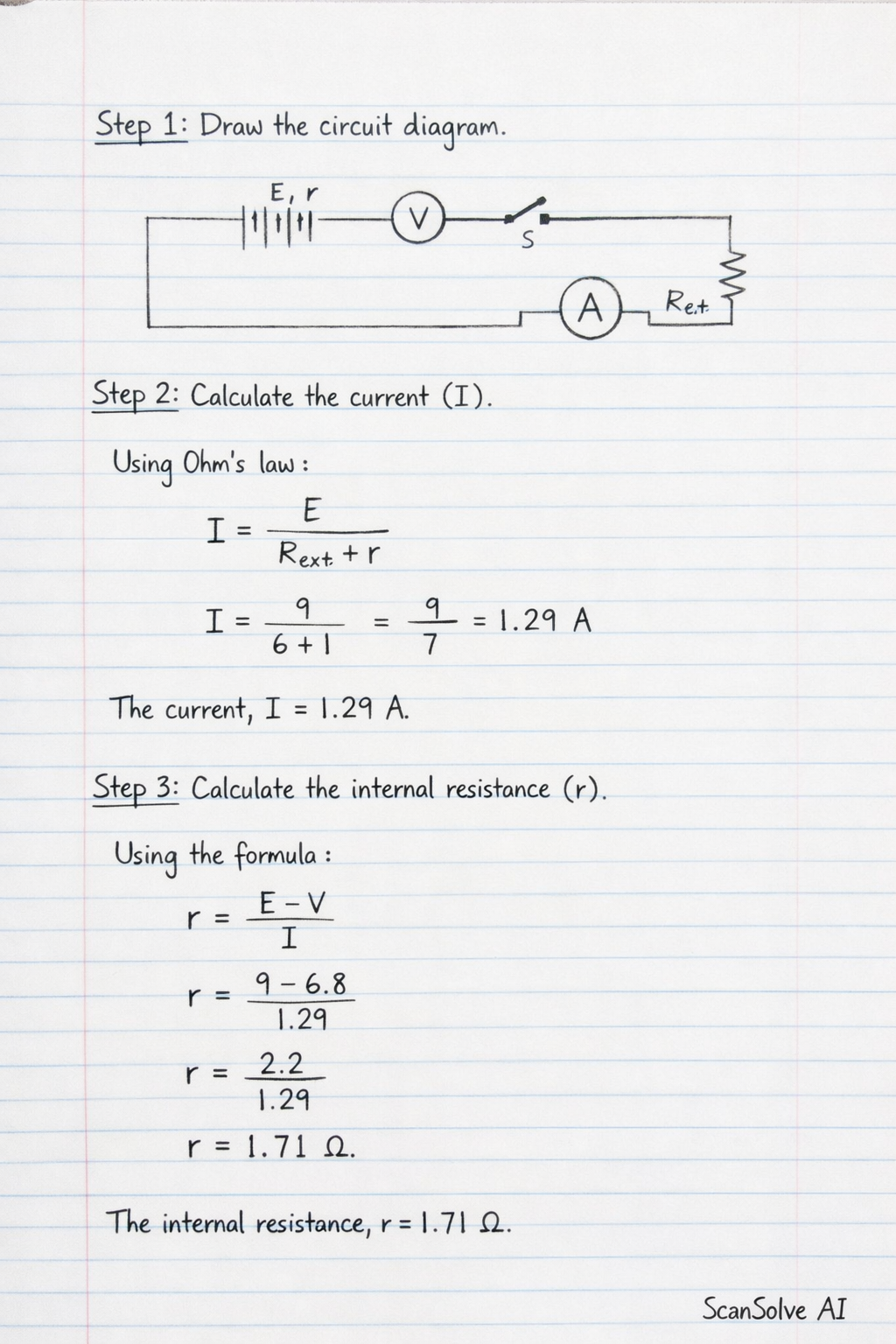
Handwritten Step-by-Step Solution
Get this as a handwritten image on WhatsApp — like a tutor wrote it for you.
Try on WhatsApp