
We read your photo as:
Determine the resultant force using the law of cosines.
ScanSolve AI Answer
This answer stops before the end.
It was cut off when it was first written. Ask ScanSolve this question again for the full working.
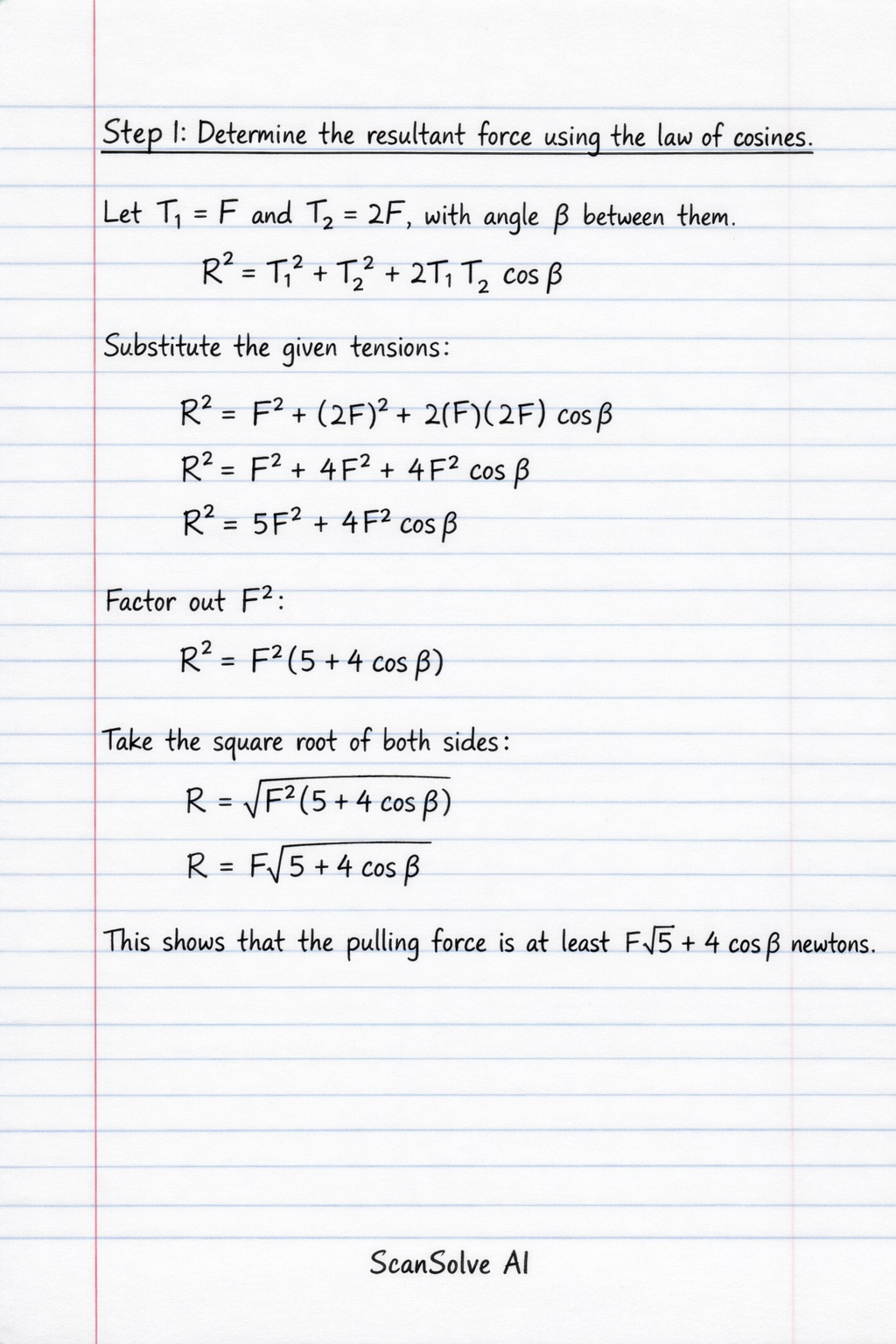
Step 1: Determine the resultant force using the law of cosines.
Let the magnitudes of the two tensions be and . Let the angle between the chains be . The magnitude of the resultant force is given by:
Substitute the given tensions:
Factor out :
Take the square root of both sides:
This shows that the pulling force is at least newtons.
b) Step 1: Resolve the forces into components.
Let the stronger force, , lie along the positive x-axis. The components of the forces are:
Step 2: Calculate the components of the resultant force.
The resultant force has components:
Step 3: Determine the angle of the resultant force.
Let be the angle the resultant force makes with the stronger force . This angle is given by:
Still stuck on this one?
Ask a follow-up, and the answer starts from this question.
More Physics Questions
Handwritten Step-by-Step Solution
Get this as a handwritten image on WhatsApp — like a tutor wrote it for you.
Try on WhatsApp