

This physics problem tests your understanding of fundamental physical laws and their applications. The step-by-step solution below breaks down the problem using relevant equations and physical reasoning.
ScanSolve AI Answer
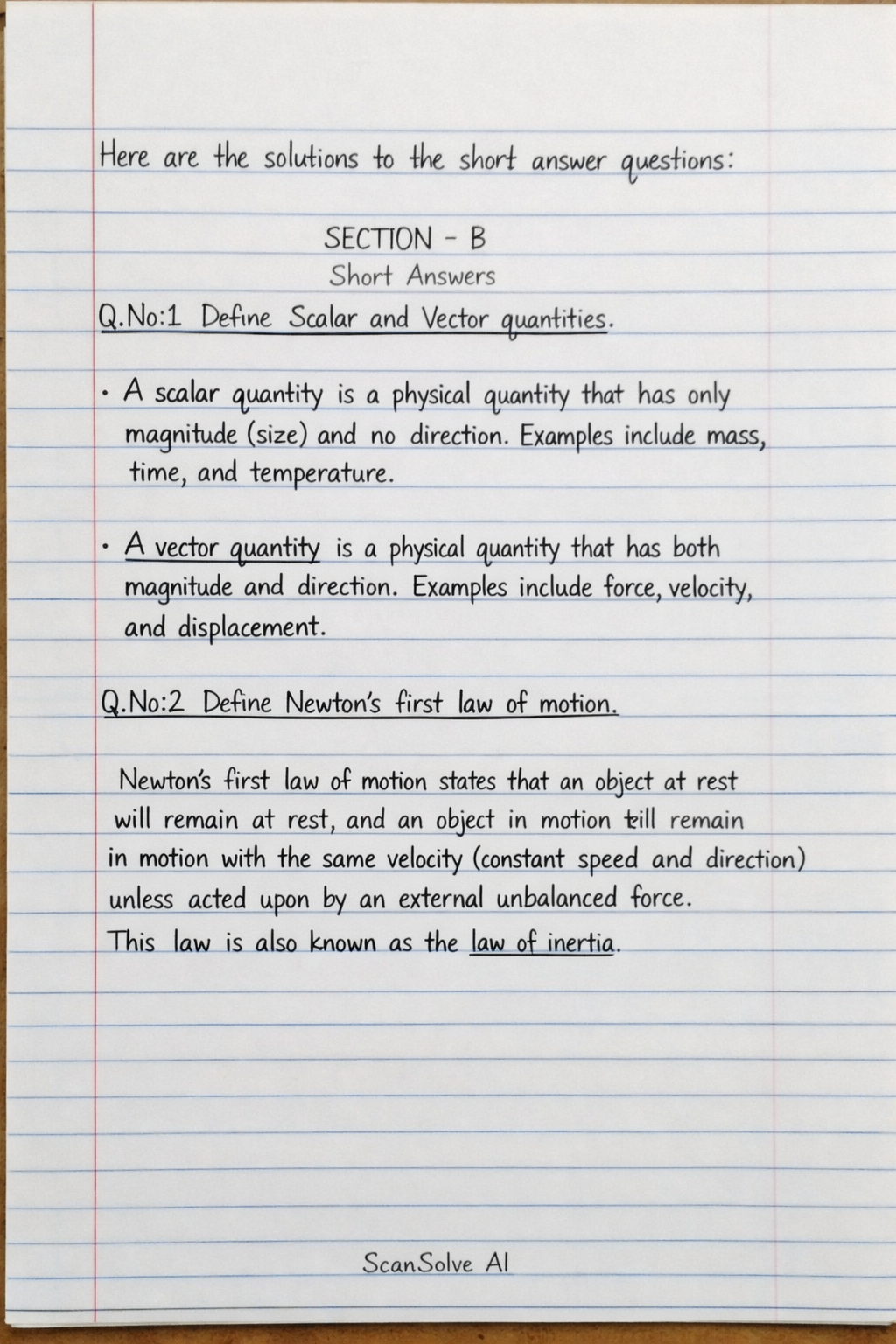
Here are the solutions to the short answer questions: SECTION - B Short Answers Q.No:1 Define Scalar and Vector quantities. A scalar quantity* is a physical quantity that has only magnitude (size) and no direction. Examples include mass, time, and temperature. A vector quantity* is a physical quantity that has both magnitude and direction. Examples include force, velocity, and displacement. Q.No:2 Define Newton's first law of motion. Newton's first law of motion states that an object at rest will remain at rest, and an object in motion will remain in motion with the same velocity (constant speed and direction) unless acted upon by an external unbalanced force. This law is also known as the law of inertia. Q.No:3 A pair of like parallel forces 15N each are acting on a body. Find their resultant. Step 1: Identify the given forces. The forces are like parallel forces, meaning they act in the same direction. F_1 = 15 N F_2 = 15 N Step 2: Calculate the resultant force. For like parallel forces, the resultant force is the sum of the individual forces. F_resultant = F_1 + F_2 F_resultant = 15 N + 15 N F_resultant = 30 N The resultant force is 30 N in the direction of the forces. Q.No:4 Calculate the spring constant for a spring which extends by a distance of 3.5cm when a load of 14N is hung from its end. Step 1: Identify the given values. Force applied, F = 14 N Extension of the spring, x = 3.5 cm Step 2: Convert the extension to meters. x = 3.5 cm × 1 m100 cm = 0.035 m Step 3: Apply Hooke's Law to find the spring constant (k). Hooke's Law states F = kx. Rearranging for k: k = (F)/(x) k = 14 N0.035 m k = 400 N/m The spring constant is 400 N/m. Q.No:5 Define the term pressure and write down the S.I unit of pressure. Pressure* is defined as the force exerted perpendicularly per unit area on a surface. The S.I. unit of pressure is the Pascal (Pa)*, which is equivalent to one Newton per square meter (N/m^2). Q.No:6 Why weight of an object does not remain same everywhere on earth? The weight of an object is the force of gravity acting on it, given by the formula W = mg, where m is the mass and g is the acceleration due to gravity. The mass of an object is constant, but the value of g varies slightly across the Earth's surface. This variation is due to factors such as altitude (distance from Earth's center), latitude (Earth's equatorial bulge), and local geological variations, causing an object's weight to differ slightly from one location to another on Earth. Q.No:7 Write a note on non-renewable energy sources. Non-renewable energy sources are natural resources that exist in finite quantities and are consumed much faster than they can be naturally replenished. Once used, they are depleted and cannot be replaced on a human timescale. The primary examples include fossil fuels (such as coal, petroleum, and natural gas), which are formed from the remains of ancient organisms over millions of years, and nuclear fuels (like uranium), which are mined from the Earth. Q.No:8 2 kg of copper requires 2050J of heat to raise its temperature through 10^ C. Calculate the heat capacity of the sample. Step 1: Identify the given values. Mass of copper, m = 2 kg Heat absorbed, Q = 2050 J Change in temperature, T = 10^ C Step 2: Calculate the heat capacity (C) of the sample. Heat capacity is defined as the amount of heat required to raise the temperature of an entire sample by one degree Celsius (or Kelvin). C = (Q)/( T) C = 2050 J10^ C C = 205 J/^ The heat capacity of the copper sample is 205 J/^.