Sebuah benda yang beratnya w meluncur ke bawah dengan kecepatan tetap pada suatu bidang miring yang kasar. Bidang miring tersebut membentuk sudut 30° dengan horizontal. Berapa koefisien gesekan antara benda dan bidang miring tersebut?

Physics
Sebuah benda yang beratnya w meluncur ke bawah dengan kecepatan tetap pada suatu bidang miring yang kasar. Bidang miring tersebut membentuk sudut 30° dengan horizontal. Berapa koefisien gesekan antara benda dan bidang miring tersebut?

ScanSolve AI Answer

Answer

μk=33\mu_k = \frac{\sqrt{3}}{3}

Here's the solution to question 3:

The problem describes an object of weight ww sliding down a rough inclined plane at a constant velocity. The inclined plane makes an angle of 3030^\circ with the horizontal. We need to find the coefficient of friction between the object and the inclined plane.

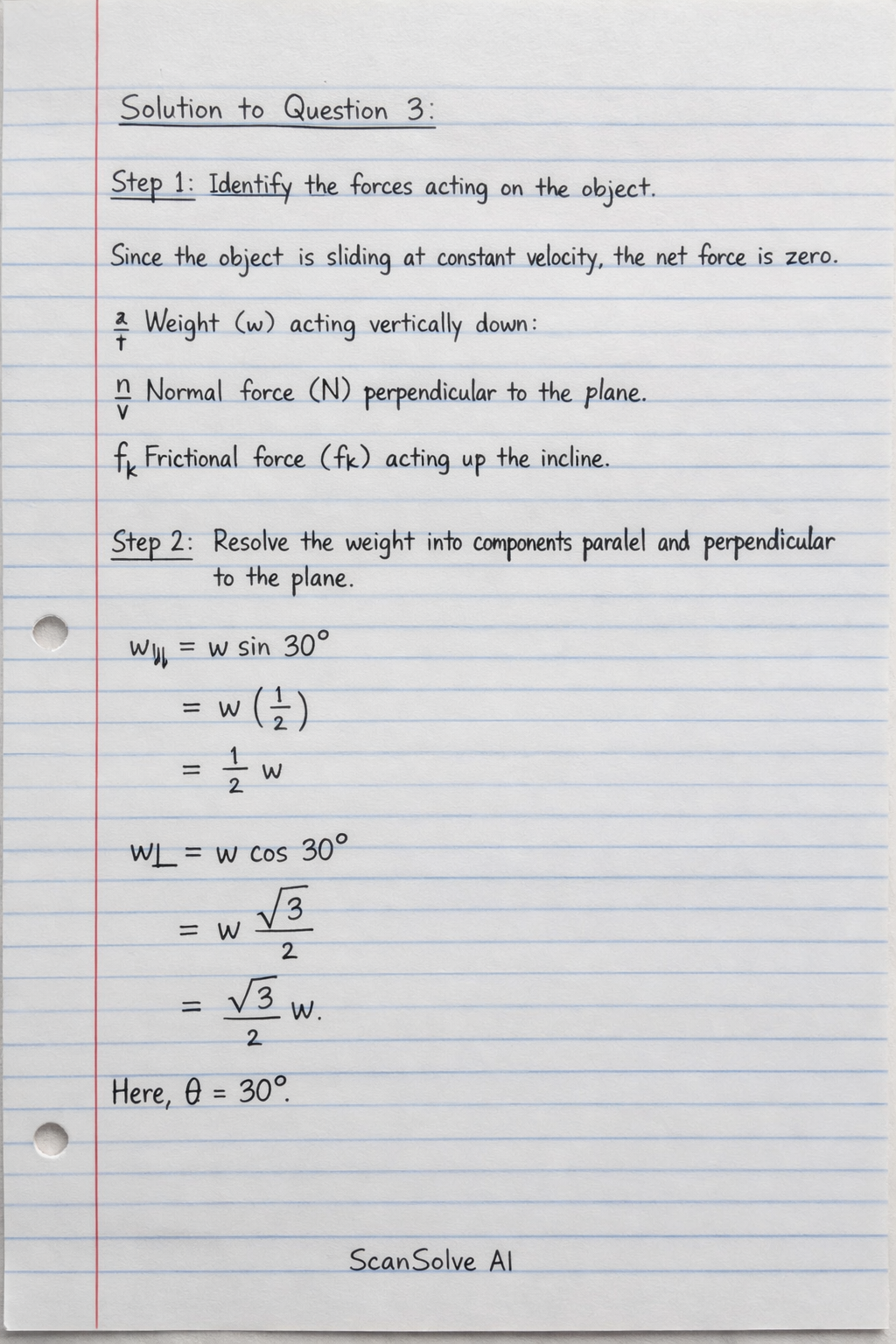
Step 1: Identify the forces acting on the object. Since the object is sliding down at a constant velocity, the net force on it is zero. The forces acting on the object are: • Weight (ww) acting vertically downwards. • Normal force (NN) acting perpendicular to the inclined plane. • Frictional force (fkf_k) acting parallel to the inclined plane, opposing the motion (up the incline).

Step 2: Resolve the weight into components parallel and perpendicular to the inclined plane. The component of weight parallel to the incline is wsinθw \sin \theta. The component of weight perpendicular to the incline is wcosθw \cos \theta. Here, θ=30\theta = 30^\circ.

Step 3: Apply Newton's First Law in the direction perpendicular to the inclined plane. Since there is no acceleration perpendicular to the plane, the normal force balances the perpendicular component of the weight. N=wcosθN = w \cos \theta

Step 4: Apply Newton's First Law in the direction parallel to the inclined plane. Since the object moves at a constant velocity, the net force parallel to the plane is zero. The component of weight pulling the object down the incline is balanced by the kinetic friction force acting up the incline. wsinθ=fkw \sin \theta = f_k We know that the kinetic friction force is given by fk=μkNf_k = \mu_k N, where μk\mu_k is the coefficient of kinetic friction. Substituting fkf_k: wsinθ=μkNw \sin \theta = \mu_k N

Step 5: Substitute the expression for NN from Step 3 into the equation from Step 4. wsinθ=μk(wcosθ)w \sin \theta = \mu_k (w \cos \theta)

Step 6: Solve for the coefficient of kinetic friction, μk\mu_k. Divide both sides by wcosθw \cos \theta: μk=wsinθwcosθ\mu_k = \frac{w \sin \theta}{w \cos \theta} μk=sinθcosθ\mu_k = \frac{\sin \theta}{\cos \theta} μk=tanθ\mu_k = \tan \theta Substitute the given angle θ=30\theta = 30^\circ: μk=tan30\mu_k = \tan 30^\circ μk=13\mu_k = \frac{1}{\sqrt{3}} μk=33\mu_k = \frac{\sqrt{3}}{3}

The coefficient of friction between the object and the inclined plane is 33\frac{\sqrt{3}}{3}.

μk=33\boxed{\mu_k = \frac{\sqrt{3}}{3}}

Send me the next one 📸

Was this helpful?

Need help with your own homework?

Get instant step-by-step solutions to any question. Free to start.

Ask Your Question
Handwritten step-by-step solution preview

Handwritten Step-by-Step Solution

Get this as a handwritten image on WhatsApp — like a tutor wrote it for you.

Try on WhatsApp

Still have questions?

Quick Answer

Here's the solution to question 3: The problem describes an object of weight w sliding down a rough inclined plane at a constant velocity.

Sebuah benda yang beratnya w meluncur ke bawah dengan kecepatan tetap pada suatu bidang miring yang kasar. Bidang miring tersebut membentuk sudut 30° dengan horizontal. Berapa koefisien gesekan antara benda dan bidang miring tersebut?
Physics

This physics problem tests your understanding of fundamental physical laws and their applications. The step-by-step solution below breaks down the problem using relevant equations and physical reasoning.

ScanSolve AI Answer
Here's the solution to question 3: The problem describes an object of weight w sliding down a rough inclined plane at a constant velocity. The inclined plane makes an angle of 30^ with the horizontal. We need to find the coefficient of friction between the object and the inclined plane. Step 1: Identify the forces acting on the object. Since the object is sliding down at a constant velocity, the net force on it is zero. The forces acting on the object are: • Weight (w) acting vertically downwards. • Normal force (N) acting perpendicular to the inclined plane. • Frictional force (f_k) acting parallel to the inclined plane, opposing the motion (up the incline). Step 2: Resolve the weight into components parallel and perpendicular to the inclined plane. The component of weight parallel to the incline is w . The component of weight perpendicular to the incline is w . Here, = 30^. Step 3: Apply Newton's First Law in the direction perpendicular to the inclined plane. Since there is no acceleration perpendicular to the plane, the normal force balances the perpendicular component of the weight. N = w Step 4: Apply Newton's First Law in the direction parallel to the inclined plane. Since the object moves at a constant velocity, the net force parallel to the plane is zero. The component of weight pulling the object down the incline is balanced by the kinetic friction force acting up the incline. w = f_k We know that the kinetic friction force is given by f_k = _k N, where _k is the coefficient of kinetic friction. Substituting f_k: w = _k N Step 5: Substitute the expression for N from Step 3 into the equation from Step 4. w = _k (w ) Step 6: Solve for the coefficient of kinetic friction, _k. Divide both sides by w : _k = (w )/(w ) _k = ( )/( ) _k = Substitute the given angle = 30^: _k = 30^ _k = (1)/(sqrt(3)) _k = sqrt(3)3 The coefficient of friction between the object and the inclined plane is sqrt(3)3. _k = sqrt(3)3 Send me the next one 📸