Which statement about forces best explains what happens to Anya when Diego lets go?

Physics
Which statement about forces best explains what happens to Anya when Diego lets go?

ScanSolve AI Answer

Answer

D

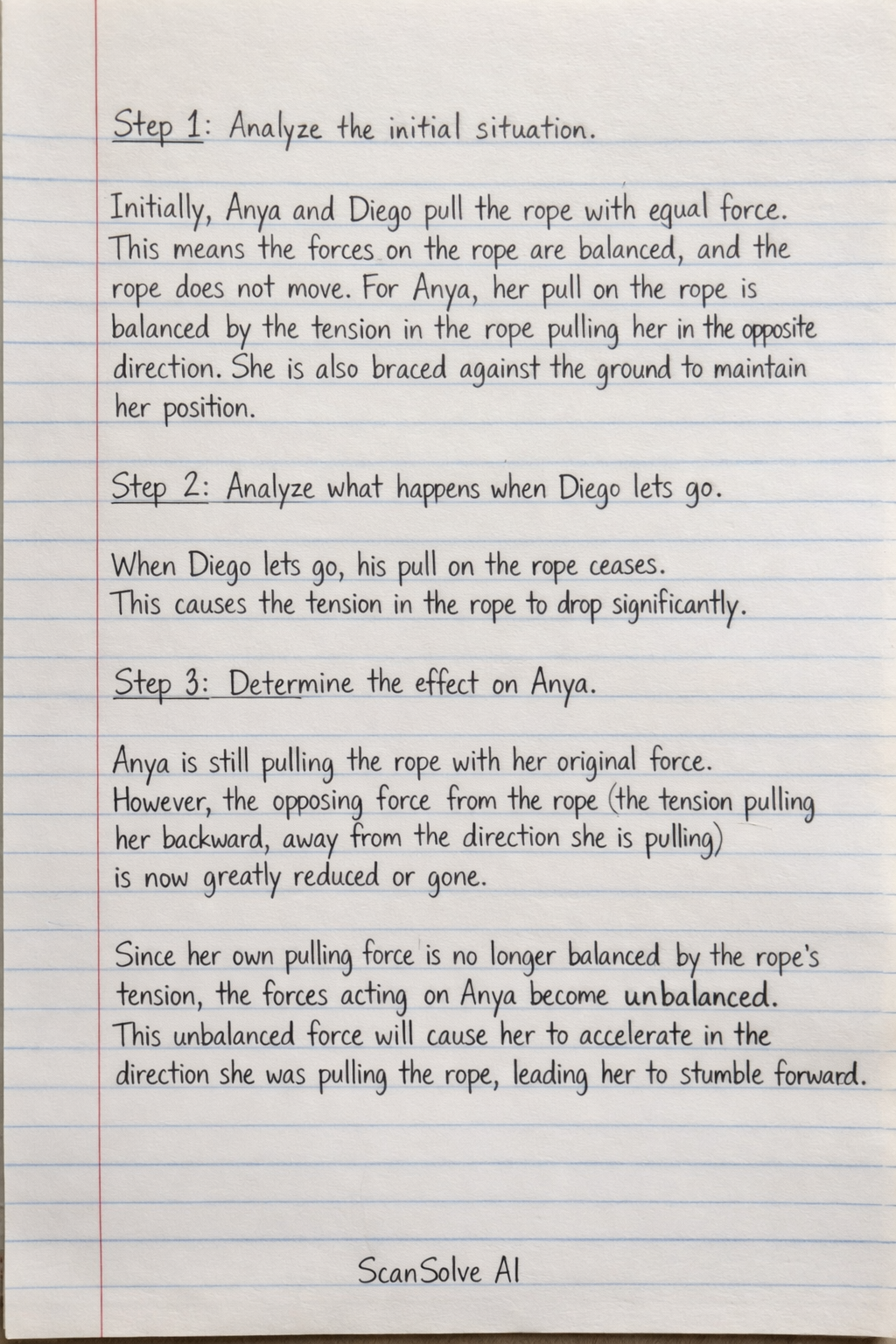
Step 1: Analyze the initial situation. Initially, Anya and Diego pull the rope with equal force. This means the forces on the rope are balanced, and the rope does not move. For Anya, her pull on the rope is balanced by the tension in the rope pulling her in the opposite direction. She is also braced against the ground to maintain her position.

Step 2: Analyze what happens when Diego lets go. When Diego lets go, his pull on the rope ceases. This causes the tension in the rope to drop significantly.

Step 3: Determine the effect on Anya. Anya is still pulling the rope with her original force. However, the opposing force from the rope (the tension pulling her backward, away from the direction she is pulling) is now greatly reduced or gone. Since her own pulling force is no longer balanced by the rope's tension, the forces acting on Anya become unbalanced. This unbalanced force will cause her to accelerate in the direction she was pulling the rope, leading her to stumble forward.

Step 4: Evaluate the given options.

  • A. "While both students pulled, no forces acted because nothing was moving." This is incorrect. Forces did act; they were simply balanced, resulting in no net movement.
  • B. "The rope gives Anya a push in the opposite direction when it goes slack." This is incorrect. A rope pulls, it does not push. When it goes slack, it exerts very little force.
  • C. "Gravity starts to pull Anya backward as soon as the rope is released." This is incorrect. Gravity always pulls downwards, not backward, and it doesn't suddenly "start" acting.
  • D. "The rope no longer pulls Anya forward, so the forces on Anya are unbalanced." The first part of this statement, "The rope no longer pulls Anya forward," is awkwardly phrased, as the rope typically pulls Anya backward (opposite to her pulling direction). However, the crucial and correct part of this statement is "so the forces on Anya are unbalanced." This is the fundamental reason Anya moves: her own pulling force is no longer counteracted by an equal and opposite force from the rope, leading to a net force in the direction of her pull.

Considering that options A, B, and C are definitively incorrect based on physics principles, option D provides the most accurate explanation, despite the slightly confusing phrasing of its first clause. The core concept that "the forces on Anya are unbalanced" is correct and explains her subsequent movement.

The final answer is D\boxed{D} That's 2 down. 3 left today — send the next one.

Was this helpful?

Need help with your own homework?

Get instant step-by-step solutions to any question. Free to start.

Ask Your Question
Handwritten step-by-step solution preview

Handwritten Step-by-Step Solution

Get this as a handwritten image on WhatsApp — like a tutor wrote it for you.

Try on WhatsApp

Still have questions?

Quick Answer

Analyze the initial situation. Initially, Anya and Diego pull the rope with equal force.

Which statement about forces best explains what happens to Anya when Diego lets go?
Physics

This physics problem tests your understanding of fundamental physical laws and their applications. The step-by-step solution below breaks down the problem using relevant equations and physical reasoning.

ScanSolve AI Answer
Step 1: Analyze the initial situation. Initially, Anya and Diego pull the rope with equal force. This means the forces on the rope are balanced, and the rope does not move. For Anya, her pull on the rope is balanced by the tension in the rope pulling her in the opposite direction. She is also braced against the ground to maintain her position. Step 2: Analyze what happens when Diego lets go. When Diego lets go, his pull on the rope ceases. This causes the tension in the rope to drop significantly. Step 3: Determine the effect on Anya. Anya is still pulling the rope with her original force. However, the opposing force from the rope (the tension pulling her backward, away from the direction she is pulling) is now greatly reduced or gone. Since her own pulling force is no longer balanced by the rope's tension, the forces acting on Anya become unbalanced. This unbalanced force will cause her to accelerate in the direction she was pulling the rope, leading her to stumble forward. Step 4: Evaluate the given options. A. "While both students pulled, no forces acted because nothing was moving." This is incorrect. Forces did* act; they were simply balanced, resulting in no net movement. B. "The rope gives Anya a push in the opposite direction when it goes slack." This is incorrect. A rope pulls, it does not push. When it goes slack, it exerts very little force. C. "Gravity starts to pull Anya backward as soon as the rope is released." This is incorrect. Gravity always pulls downwards, not backward, and it doesn't suddenly "start" acting. D. "The rope no longer pulls Anya forward, so the forces on Anya are unbalanced." The first part of this statement, "The rope no longer pulls Anya forward," is awkwardly phrased, as the rope typically pulls Anya backward* (opposite to her pulling direction). However, the crucial and correct part of this statement is "so the forces on Anya are unbalanced." This is the fundamental reason Anya moves: her own pulling force is no longer counteracted by an equal and opposite force from the rope, leading to a net force in the direction of her pull. Considering that options A, B, and C are definitively incorrect based on physics principles, option D provides the most accurate explanation, despite the slightly confusing phrasing of its first clause. The core concept that "the forces on Anya are unbalanced" is correct and explains her subsequent movement. The final answer is D That's 2 down. 3 left today — send the next one.