
We read your photo as:
Study the crystal drawing provided below and answer the questions that follow: a) Insert and label the element of symmetry.
Physics
ScanSolve AI Answer
Gobte, I'll address the next available questions from the exam paper, assuming "d, e, and f" refers to continuing the sequence.
Here are the answers for Question 2 (crystal drawing) and Question 4 (which requires a photograph not provided):
Question 2: Study the crystal drawing provided below and answer the questions that follow
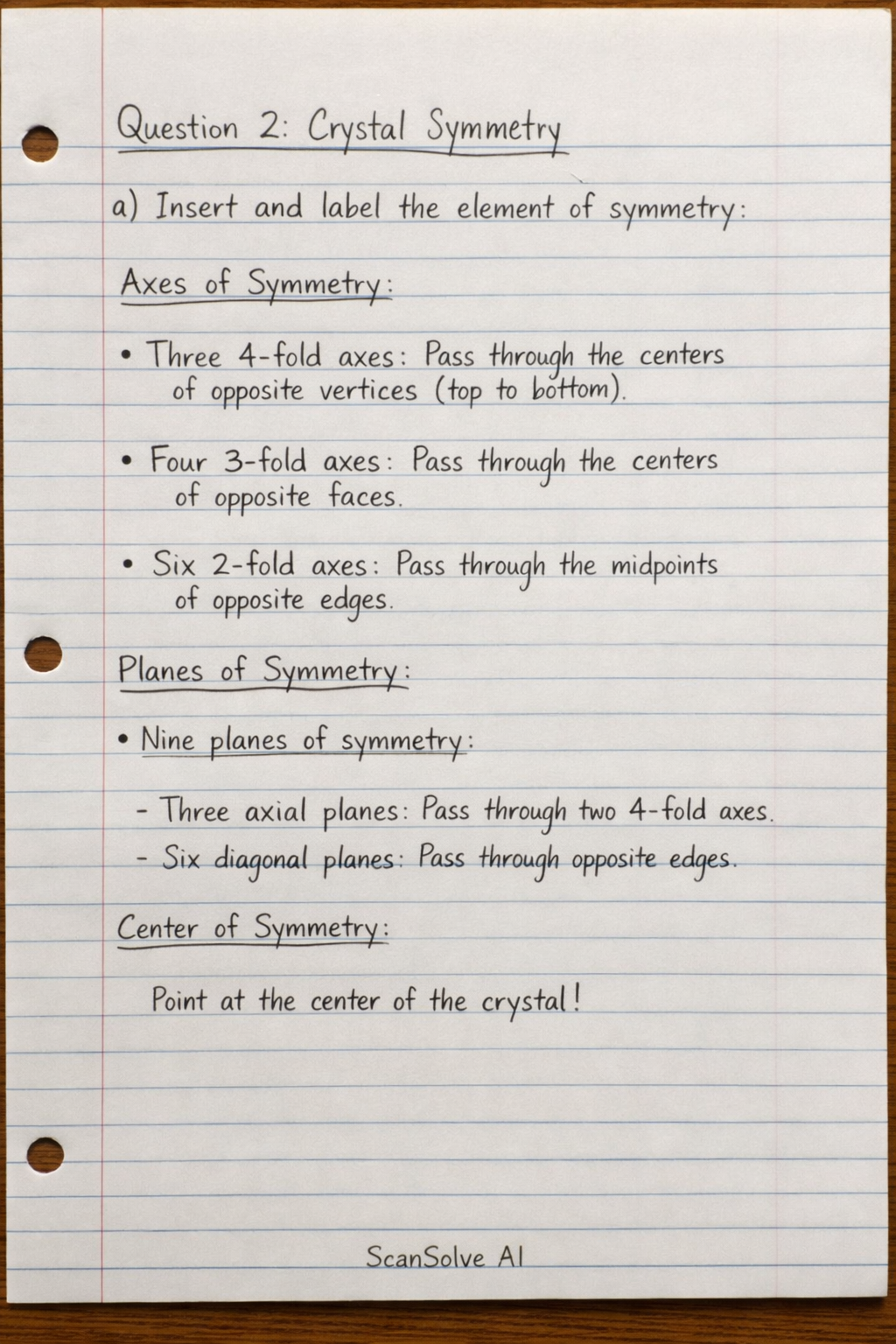
a) Insert and label the element of symmetry
Since I cannot directly insert into the image, I will describe the elements of symmetry for the depicted crystal (an octahedron):
- Axes of Symmetry:
- Three 4-fold axes: These pass through the centers of opposite vertices (e.g., top to bottom).
- Four 3-fold axes: These pass through the centers of opposite faces.
- Six 2-fold axes: These pass through the midpoints of opposite edges.
- Planes of Symmetry:
- Nine planes of symmetry: Three are axial (passing through two axes), and six are diagonal (passing through opposite edges).
- Center of Symmetry:
Was this helpful?
Still stuck on this one?
Ask a follow-up, and the answer starts from this question.
Got a different question?Ask your own question
More Physics Questions
QComplete the figure and draw its lines of symmetry.QWhich of the following lines is a line of symmetry on the figure below?QStudy the diagrams below and answer the questions that follow.QDescribe the elements of symmetry.QThe diagram below shows the net of a solid. (a) Sketch the solid. (b) State the order of rotational…
Handwritten Step-by-Step Solution
Get this as a handwritten image on WhatsApp — like a tutor wrote it for you.
Try on WhatsApp