
We read your photo as:
Calculate the surface tension of a liquid using a capillary tube. Given radius, liquid density, and gravity, find the surface tension using the formula γ = (rhρg) / 2.
ScanSolve AI Answer
Answer
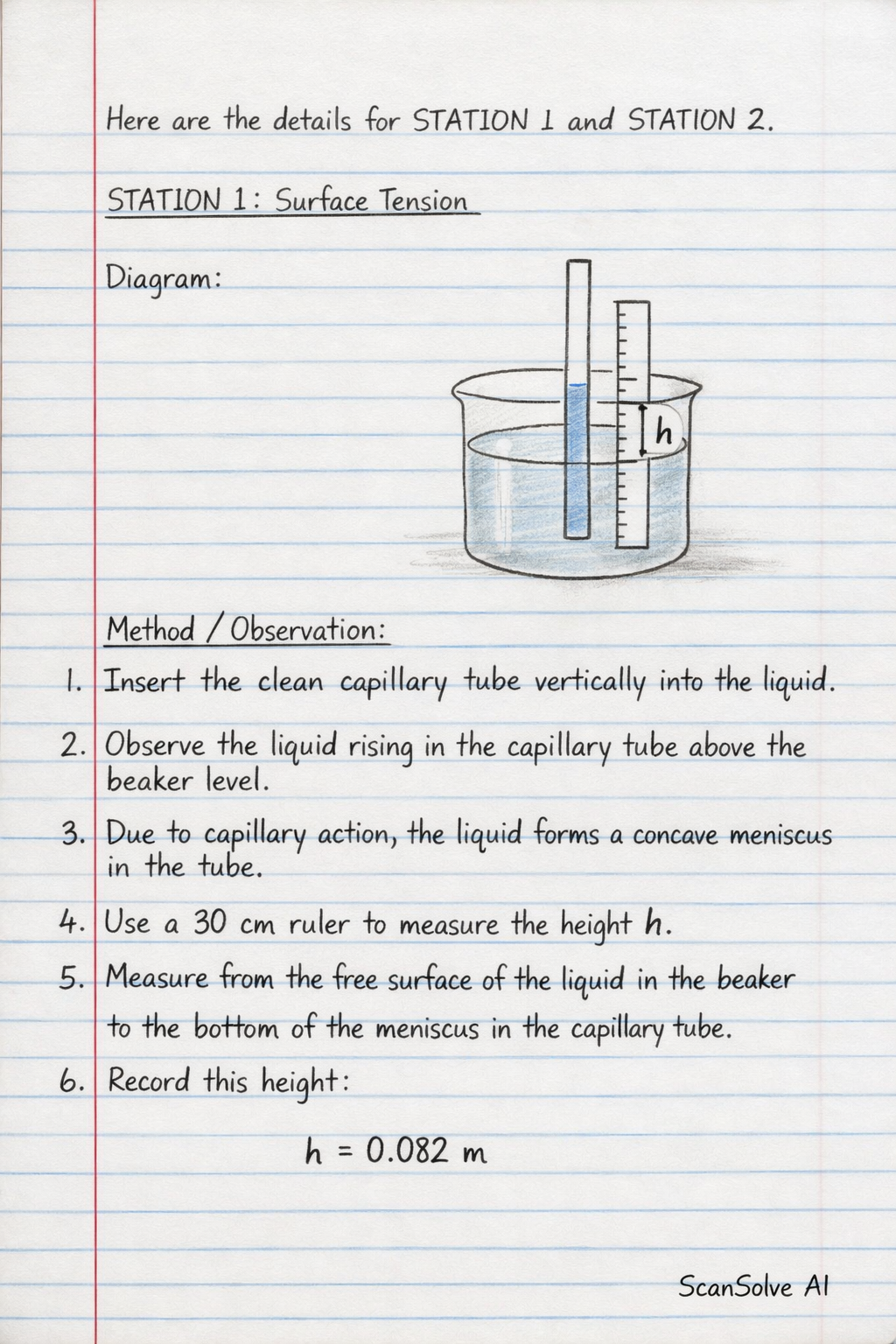
Here are the details for STATION 1 and STATION 2.
STATION 1: Surface Tension
-
Diagram: A beaker containing a liquid with a capillary tube inserted vertically. The liquid level inside the capillary tube is higher than the liquid level in the beaker, forming a concave meniscus. A ruler is placed alongside the capillary tube to measure the height of the liquid column from the free surface in the beaker to the bottom of the meniscus in the tube.
-
Method / Observation: Insert the clean capillary tube vertically into the liquid in the beaker. Observe that the liquid rises inside the capillary tube above the level of the liquid in the beaker due to capillary action. Using the ruler, measure the height of the liquid column from the free surface of the liquid in the beaker to the bottom of the meniscus in the capillary tube. Record this height in meters.
-
Calculation: The surface tension is given by the formula:
Given values: Radius of capillary tube, Density of the liquid, Acceleration due to gravity, (standard value)
Substitute the known values into the formula:
where is the measured height of the liquid column in meters.
-
Inference / Conclusion: The experiment demonstrates that surface tension causes a liquid to rise in a narrow capillary tube. The calculated value of represents the surface tension of the liquid, which is directly proportional to the height of the liquid column.
-
Precaution:
- Ensure the capillary tube is thoroughly clean and dry to prevent contamination affecting the surface tension.
- Avoid parallax error when reading the height from the ruler by ensuring the eye is level with the meniscus.
- Ensure the capillary tube is held perfectly vertical to obtain an accurate measurement of .
- Take multiple readings of and calculate the average to minimize random errors.
STATION 2: Voltage variation across a resistor
-
Diagram: A series circuit consisting of a DC power supply (battery), a switch, a capacitor, and a resistor. A voltmeter is connected in parallel across the resistor.
-
Method / Observations: Connect the resistor and capacitor in series with a battery and a switch. Connect the voltmeter in parallel across the resistor. Close the switch to begin charging the capacitor and simultaneously start a stopwatch. Record the initial potential difference across the resistor at . Continue to record the potential difference across the resistor at regular time intervals (e.g., every 10 seconds) for one minute. Observe that the voltage across the resistor decreases over time.
-
Findings: At the instant the switch is closed (), the capacitor acts as a short circuit, and the voltage across the resistor is at its maximum, equal to the battery voltage. As time progresses, the capacitor charges, and the voltage across the resistor decreases exponentially. After a sufficiently long time, the capacitor becomes fully charged, and the voltage across the resistor approaches zero.
-
Inference: When a capacitor charges through a resistor, the current in the circuit decreases exponentially with time. According to Ohm's Law (), the voltage across the resistor also decreases exponentially as the current diminishes. This demonstrates the transient behavior of an RC circuit during charging.
-
Precaution:
- Ensure all electrical connections are secure and tight to prevent intermittent contact and inaccurate readings.
- Connect the voltmeter correctly in parallel across the resistor to measure its potential difference accurately.
- If using an electrolytic capacitor, ensure it is connected with the correct polarity to avoid
Try one yourself
A new problem that tests the same skill.
Still stuck on this one?
Ask a follow-up, and the answer starts from this question.
More Physics Questions
Handwritten Step-by-Step Solution
Get this as a handwritten image on WhatsApp — like a tutor wrote it for you.
Try on WhatsApp