

This physics problem tests your understanding of fundamental physical laws and their applications. The step-by-step solution below breaks down the problem using relevant equations and physical reasoning.
ScanSolve AI Answer
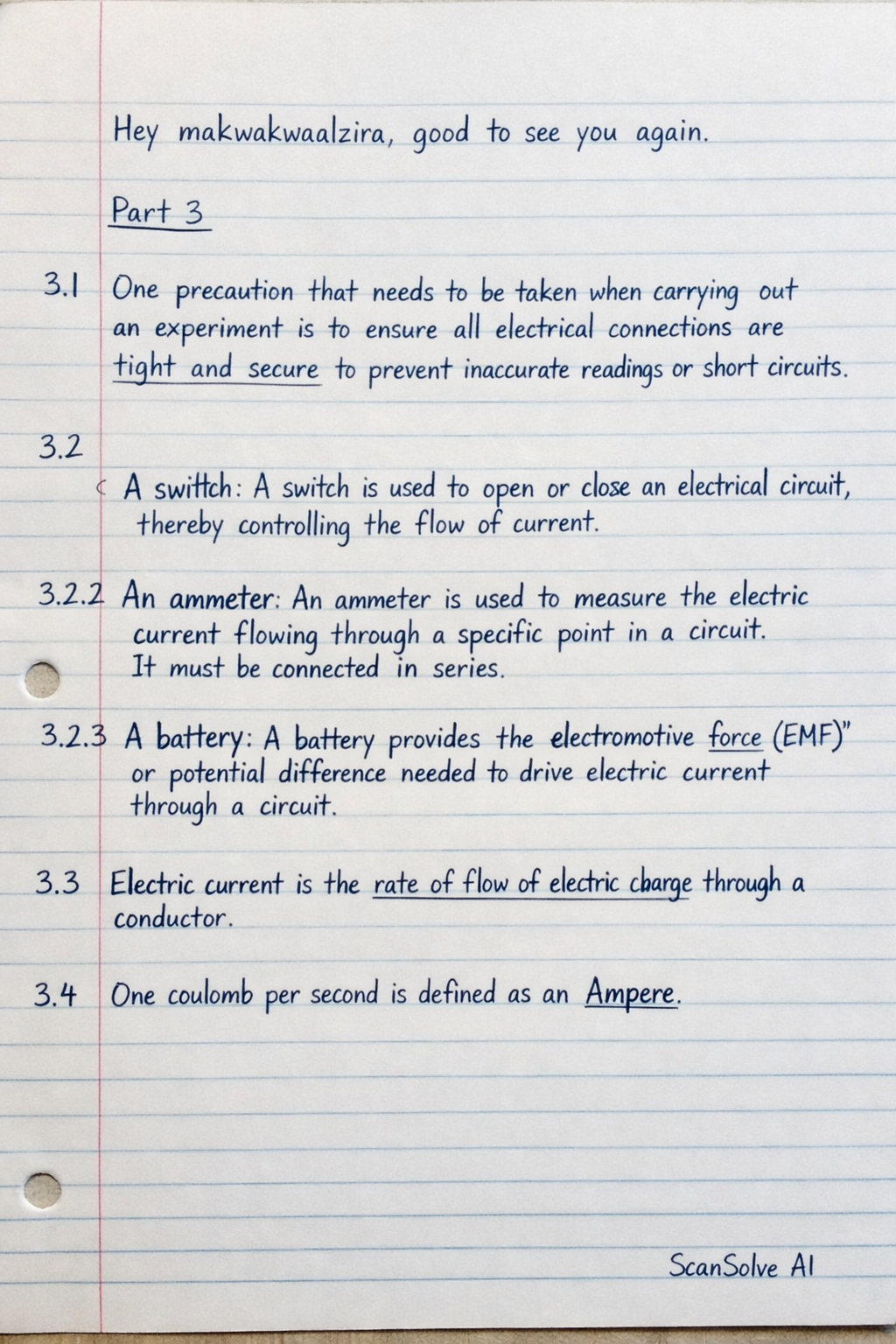
Part 3 3.1 One precaution that needs to be taken when carrying out an experiment is to ensure all electrical connections are tight and secure to prevent inaccurate readings or short circuits. 3.2 3.2.1 A switch: A switch is used to open or close* an electrical circuit, thereby controlling the flow of current. 3.2.2 An ammeter: An ammeter is used to measure the electric current* flowing through a specific point in a circuit. It must be connected in series. 3.2.3 A battery: A battery provides the electromotive force (EMF)* or potential difference needed to drive electric current through a circuit. 3.3 Electric current is the rate of flow of electric charge through a conductor. 3.4 One coulomb per second is defined as an Ampere. 3.5 Step 1: Convert the time from minutes to seconds. t = 20 minutes × 60 secondsminute = 1200 s Step 2: Use the formula for current, I = (Q)/(t), where Q is charge and t is time. I = 360 C1200 s Step 3: Calculate the current. I = 0.3 A The current flowing through the bulb is 0.3 A. 3.6 The question is incomplete as it describes an experiment and provides data but does not state what needs to be done with the data or what question needs to be answered. However, based on the provided data for the nichrome wire: Current (A): 0.2, 0.4, 0.6, 0.8, 1.0 Potential difference (V): 0.8, 1.6, 2.4, 3.2, 4.0 We can observe that for the nichrome wire, as the current increases, the potential difference across it also increases proportionally. If we calculate the ratio of potential difference to current (V/I), we get: 0.8 V / 0.2 A = 4 1.6 V / 0.4 A = 4 2.4 V / 0.6 A = 4 3.2 V / 0.8 A = 4 4.0 V / 1.0 A = 4 This shows that the resistance of the nichrome wire is constant at 4 , which is consistent with Ohm's Law for an ohmic conductor at constant temperature. To compare the effect of the type of conductor (nichrome vs. copper) on current strength, we would need the potential difference readings for the copper wire at the same current values. Send me the next one 📸