
Describe temperature and thermal equilibrium as topic in university
ScanSolve AI Answer
Answer
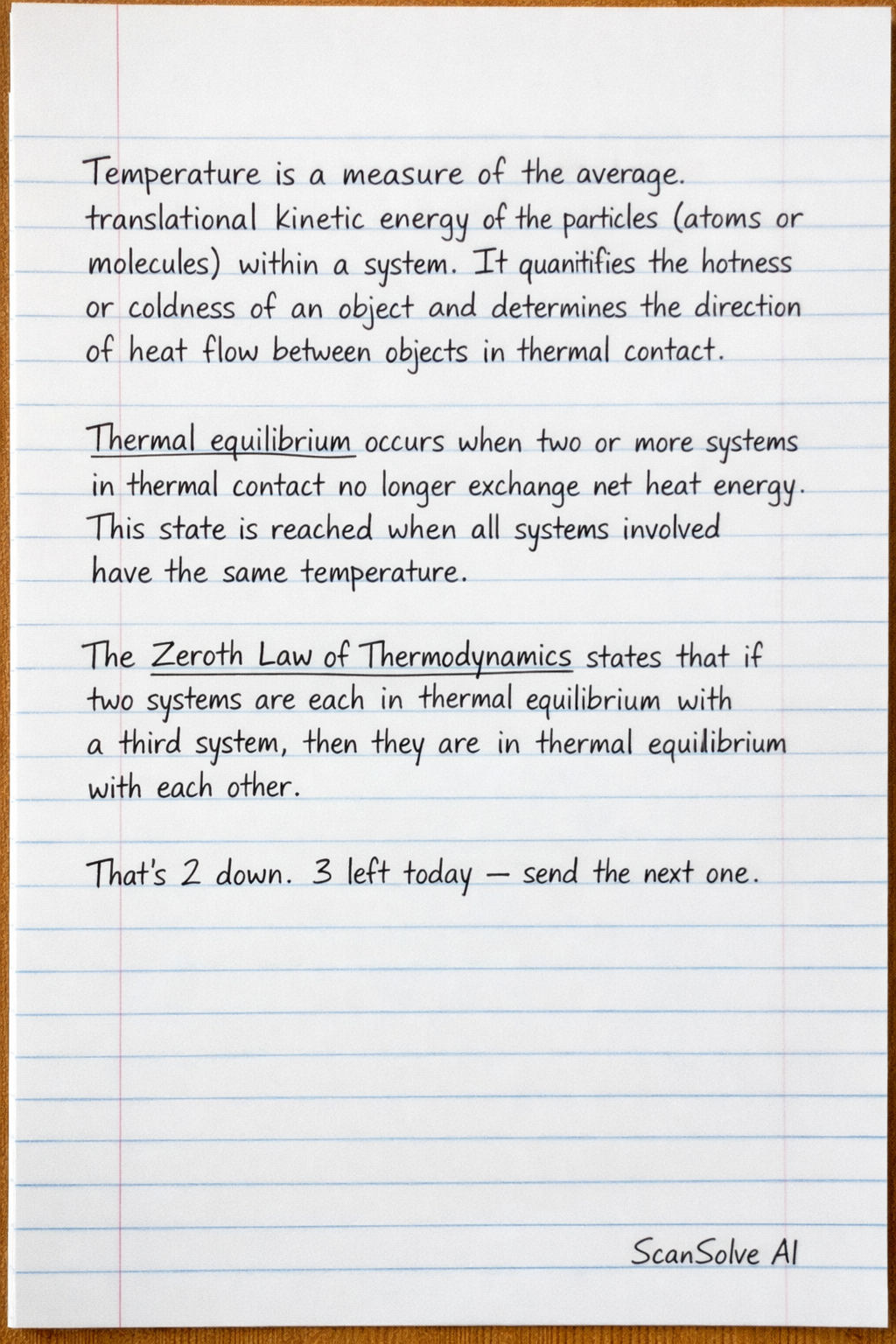
Temperature is a measure of the average translational kinetic energy of the particles (atoms or molecules) within a system. It quantifies the hotness or coldness of an object and determines the direction of heat flow between objects in thermal contact.
Thermal equilibrium occurs when two or more systems in thermal contact no longer exchange net heat energy. This state is reached when all systems involved have the same temperature. The Zeroth Law of Thermodynamics states that if two systems are each in thermal equilibrium with a third system, then they are in thermal equilibrium with each other.
Still stuck on this one?
Ask a follow-up, and the answer starts from this question.
More Physics Questions
Handwritten Step-by-Step Solution
Get this as a handwritten image on WhatsApp — like a tutor wrote it for you.
Try on WhatsApp