The car started to move along a straight road.

Physics
The car started to move along a straight road.

ScanSolve AI Answer

Answer

1.2 , \text{m}$

D) Car start to move along straight road.

Step 1: Analyze the change in distance over equal time intervals. The car starts from rest (0m0 \, \text{m} at 0s0 \, \text{s}). We observe the distance covered in successive 3s3 \, \text{s} intervals: • From 0s0 \, \text{s} to 3s3 \, \text{s}: 0.8m0.8 \, \text{m} • From 3s3 \, \text{s} to 6s6 \, \text{s}: 2.00.8=1.2m2.0 - 0.8 = 1.2 \, \text{m} • From 6s6 \, \text{s} to 9s9 \, \text{s}: 4.32.0=2.3m4.3 - 2.0 = 2.3 \, \text{m} • From 9s9 \, \text{s} to 12s12 \, \text{s}: 8.04.3=3.7m8.0 - 4.3 = 3.7 \, \text{m} • From 12s12 \, \text{s} to 15s15 \, \text{s}: 11.58.0=3.5m11.5 - 8.0 = 3.5 \, \text{m} • From 15s15 \, \text{s} to 18s18 \, \text{s}: 14.011.5=2.5m14.0 - 11.5 = 2.5 \, \text{m} • From 18s18 \, \text{s} to 21s21 \, \text{s}: 14.814.0=0.8m14.8 - 14.0 = 0.8 \, \text{m}

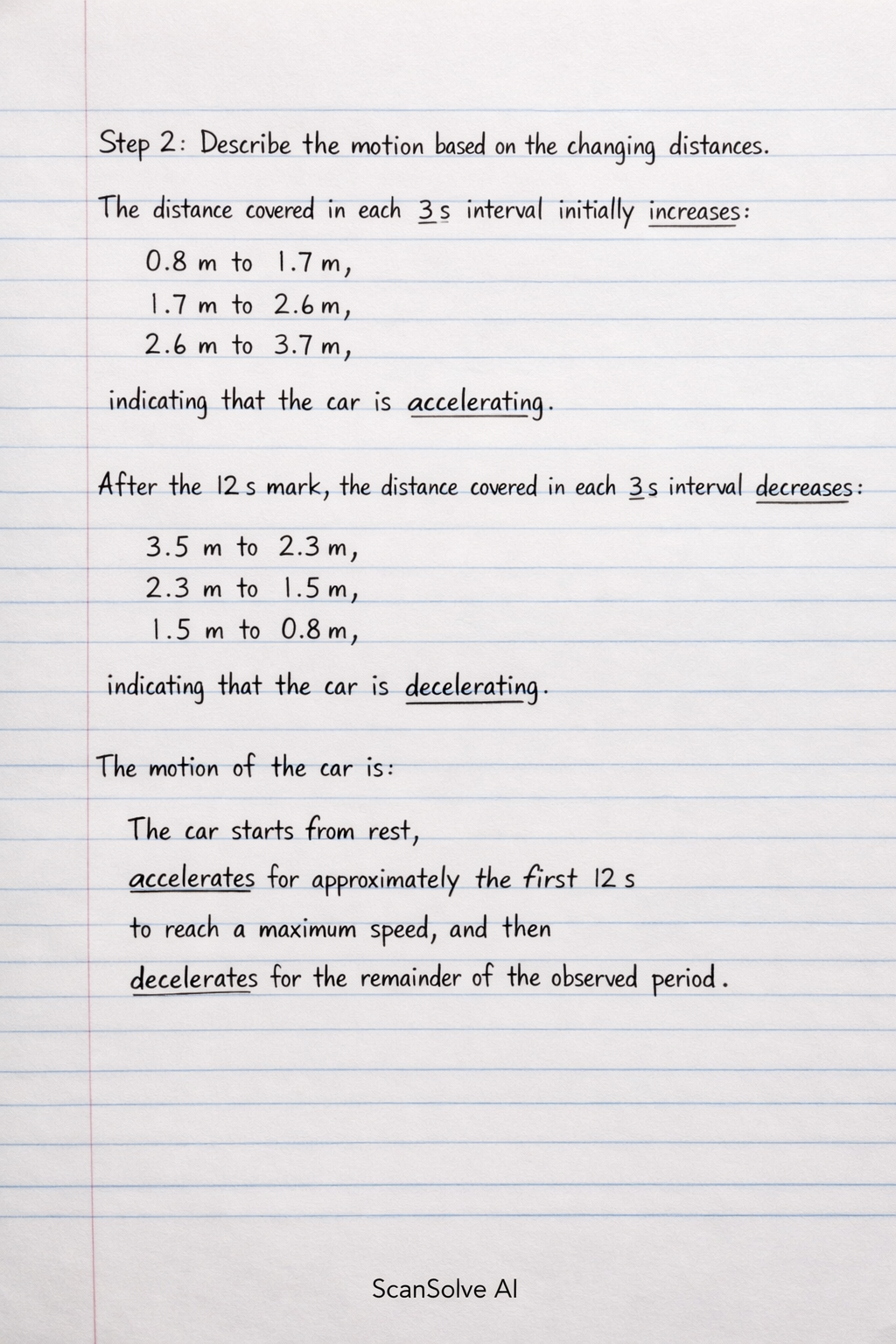
Step 2: Describe the motion based on the changing distances. The distance covered in each 3s3 \, \text{s} interval initially increases (from 0.8m0.8 \, \text{m} to 3.7m3.7 \, \text{m}), indicating that the car is accelerating. After the 12s12 \, \text{s} mark, the distance covered in each 3s3 \, \text{s} interval decreases (from 3.5m3.5 \, \text{m} to 0.8m0.8 \, \text{m}), indicating that the car is decelerating.

The motion of the car is: The car starts from rest, accelerates for approximately the first 12s12 \, \text{s} to reach a maximum speed, and then decelerates for the remainder of the observed period.

That's 4 down. 1 left today — send the next one.

Was this helpful?

Need help with your own homework?

Get instant step-by-step solutions to any question. Free to start.

Ask Your Question
Handwritten step-by-step solution preview

Handwritten Step-by-Step Solution

Get this as a handwritten image on WhatsApp — like a tutor wrote it for you.

Try on WhatsApp

Still have questions?

Quick Answer

D) Car start to move along straight road. Step 1: Analyze the change in distance over equal time intervals.

The car started to move along a straight road.
Physics

This physics problem tests your understanding of fundamental physical laws and their applications. The step-by-step solution below breaks down the problem using relevant equations and physical reasoning.

ScanSolve AI Answer
D) Car start to move along straight road. Step 1: Analyze the change in distance over equal time intervals. The car starts from rest (0 \, m at 0 \, s). We observe the distance covered in successive 3 \, s intervals: • From 0 \, s to 3 \, s: 0.8 \, m • From 3 \, s to 6 \, s: 2.0 - 0.8 = 1.2 \, m • From 6 \, s to 9 \, s: 4.3 - 2.0 = 2.3 \, m • From 9 \, s to 12 \, s: 8.0 - 4.3 = 3.7 \, m • From 12 \, s to 15 \, s: 11.5 - 8.0 = 3.5 \, m • From 15 \, s to 18 \, s: 14.0 - 11.5 = 2.5 \, m • From 18 \, s to 21 \, s: 14.8 - 14.0 = 0.8 \, m Step 2: Describe the motion based on the changing distances. The distance covered in each 3 \, s interval initially increases (from 0.8 \, m to 3.7 \, m), indicating that the car is accelerating. After the 12 \, s mark, the distance covered in each 3 \, s interval decreases (from 3.5 \, m to 0.8 \, m), indicating that the car is decelerating. The motion of the car is: The car starts from rest, accelerates for approximately the first 12 \, s to reach a maximum speed, and then decelerates for the remainder of the observed period. That's 4 down. 1 left today — send the next one.