

This physics problem tests your understanding of fundamental physical laws and their applications. The step-by-step solution below breaks down the problem using relevant equations and physical reasoning.
ScanSolve AI Answer
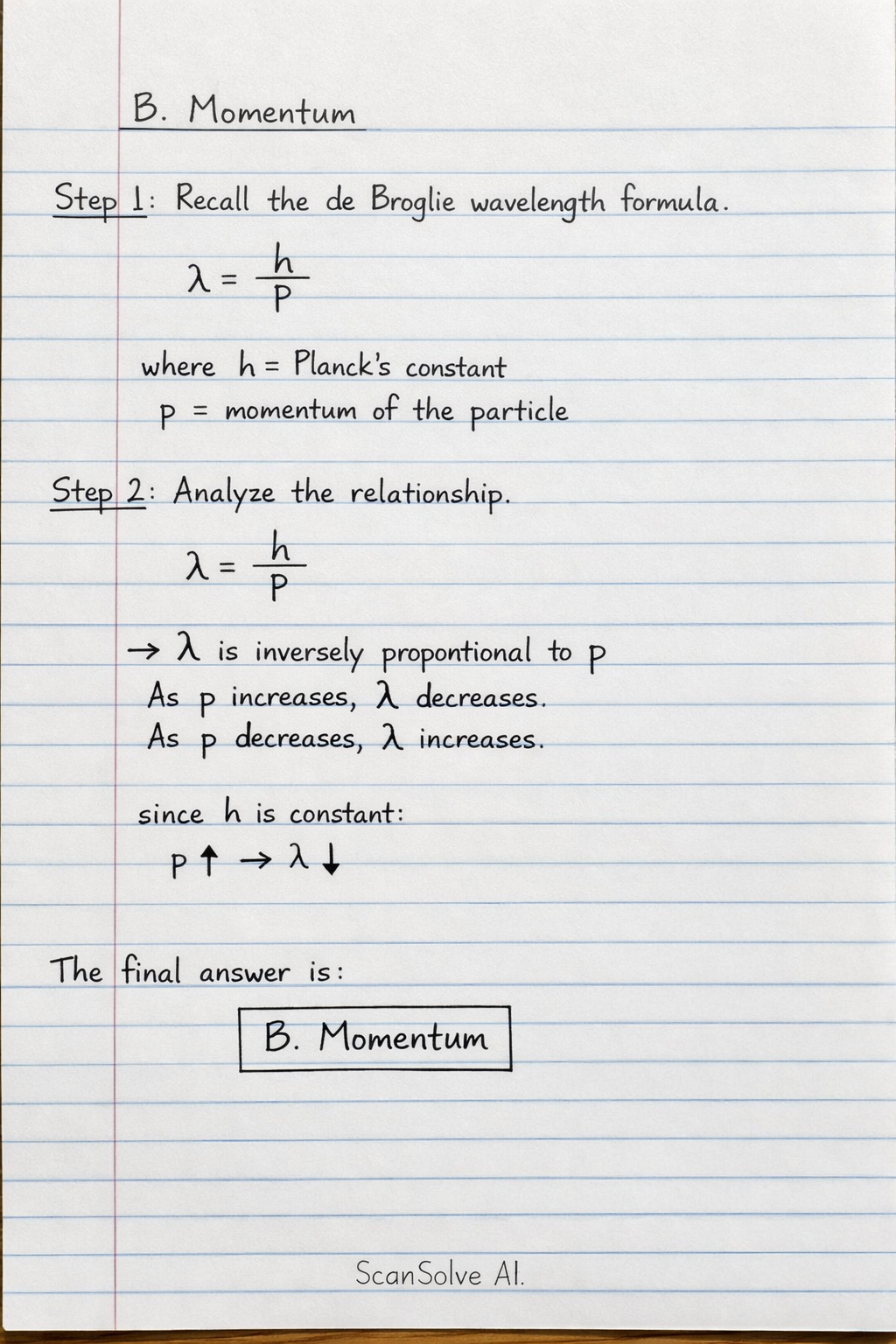
B. Momentum Step 1: Recall the de Broglie wavelength formula. The de Broglie wavelength () of a moving particle is given by the formula: = (h)/(p) where h is Planck's constant and p is the momentum of the particle. Step 2: Analyze the relationship. From the formula, it is clear that the de Broglie wavelength () is inversely proportional to the momentum (p). As momentum increases, the wavelength decreases, and vice versa, assuming Planck's constant is a fixed value. The final answer is B. Momentum. 3 done, 2 left today. You're making progress.