

This physics problem tests your understanding of fundamental physical laws and their applications. The step-by-step solution below breaks down the problem using relevant equations and physical reasoning.
ScanSolve AI Answer
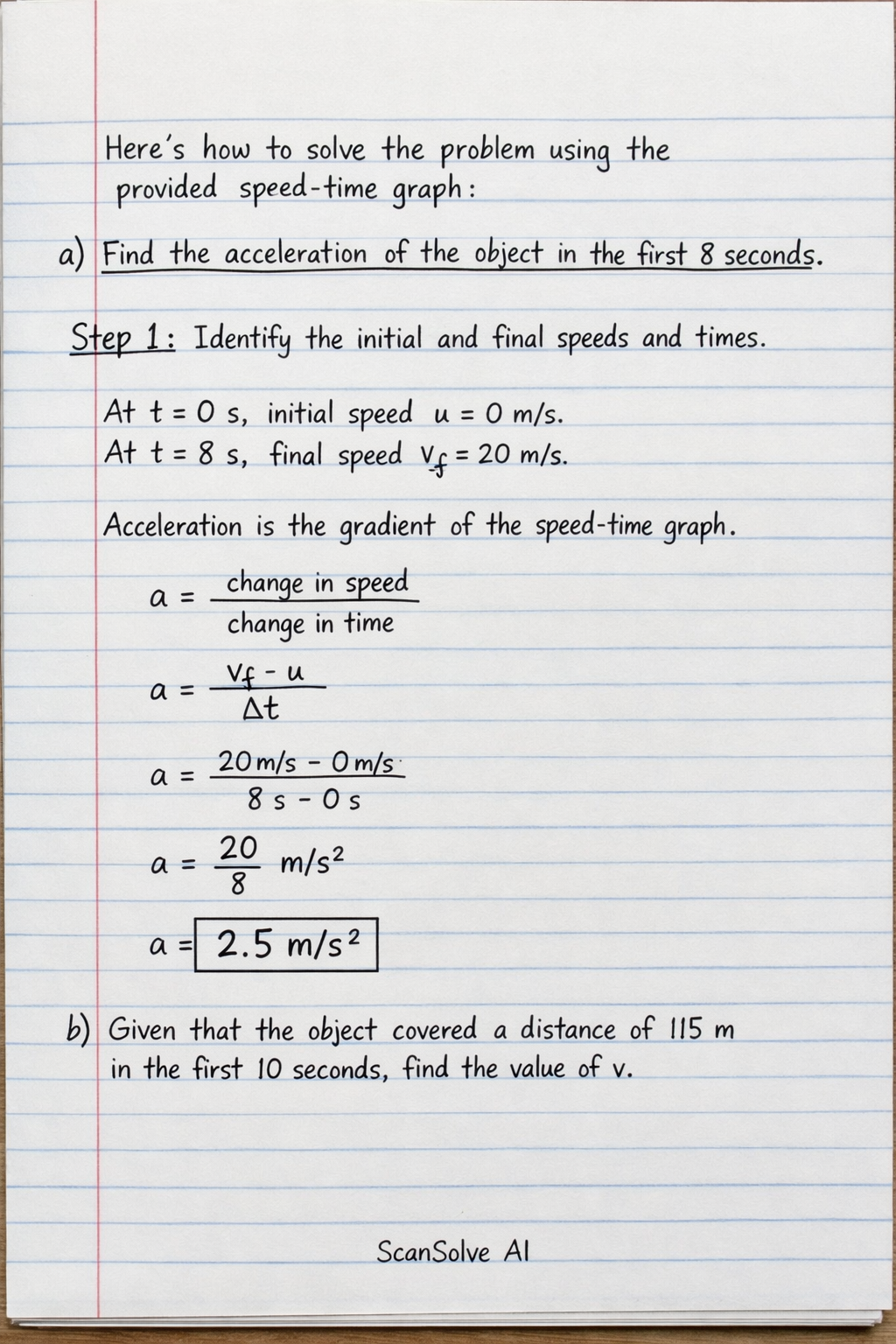
Here's how to solve the problem using the provided speed-time graph: a) Find the acceleration of the object in the first 8 seconds. Step 1: Identify the initial and final speeds and times. From the graph, at t=0 s, the initial speed is u=0 m/s. At t=8 s, the final speed is v_f=20 m/s. Acceleration is the gradient of the speed-time graph. a = change in speedchange in time a = (v_f - u)/( t) a = 20 m/s - 0 m/s8 s - 0 s a = (20)/(8) m/s^2 a = 2.5 m/s^2 b) Given that the object covered a distance of 115m in the first 10 seconds, find the value of v. Step 2: Calculate the area under the graph for the first 10 seconds. The distance covered is the area under the speed-time graph. The area from t=0 s to t=10 s consists of a triangle (0-8s) and a trapezium (8-10s). Distance for the first 8 seconds (triangle): D_1 = (1)/(2) × base × height = (1)/(2) × 8 s × 20 m/s = 80 m Distance from 8 s to 10 s (trapezium): At t=8 s, speed is 20 m/s. At t=10 s, speed is v m/s. D_2 = (1)/(2) × (sum of parallel sides) × height D_2 = (1)/(2) × (20 m/s + v m/s) × (10 s - 8 s) D_2 = (1)/(2) × (20 + v) × 2 = (20 + v) m The total distance in the first 10 seconds is D_1 + D_2. 115 m = 80 m + (20 + v) m 115 = 100 + v v = 115 - 100 v = 15 m/s c) Calculate the average speed of the object in the first 14 seconds. Step 3: Calculate the total distance in the first 14 seconds and then the average speed. Average speed is total distance divided by total time. Total time is 14 s. The total distance in the first 14 seconds is the sum of the areas: triangle (0-8s), trapezium (8-10s), and rectangle (10-14s). We know D_1 = 80 m. Using v=15 m/s from part b, D_2 = (20 + 15) m = 35 m. Distance from 10 s to 14 s (rectangle): The speed is constant at v=15 m/s from t=10 s to t=14 s. D_3 = base × height = (14 s - 10 s) × 15 m/s D_3 = 4 s × 15 m/s = 60 m Total distance in the first 14 seconds: D_total = D_1 + D_2 + D_3 = 80 m + 35 m + 60 m = 175 m Now, calculate the average speed: Average speed = D_totalTotal time Average speed = 175 m14 s Average speed = 12.5 m/s