

This physics problem tests your understanding of fundamental physical laws and their applications. The step-by-step solution below breaks down the problem using relevant equations and physical reasoning.
ScanSolve AI Answer
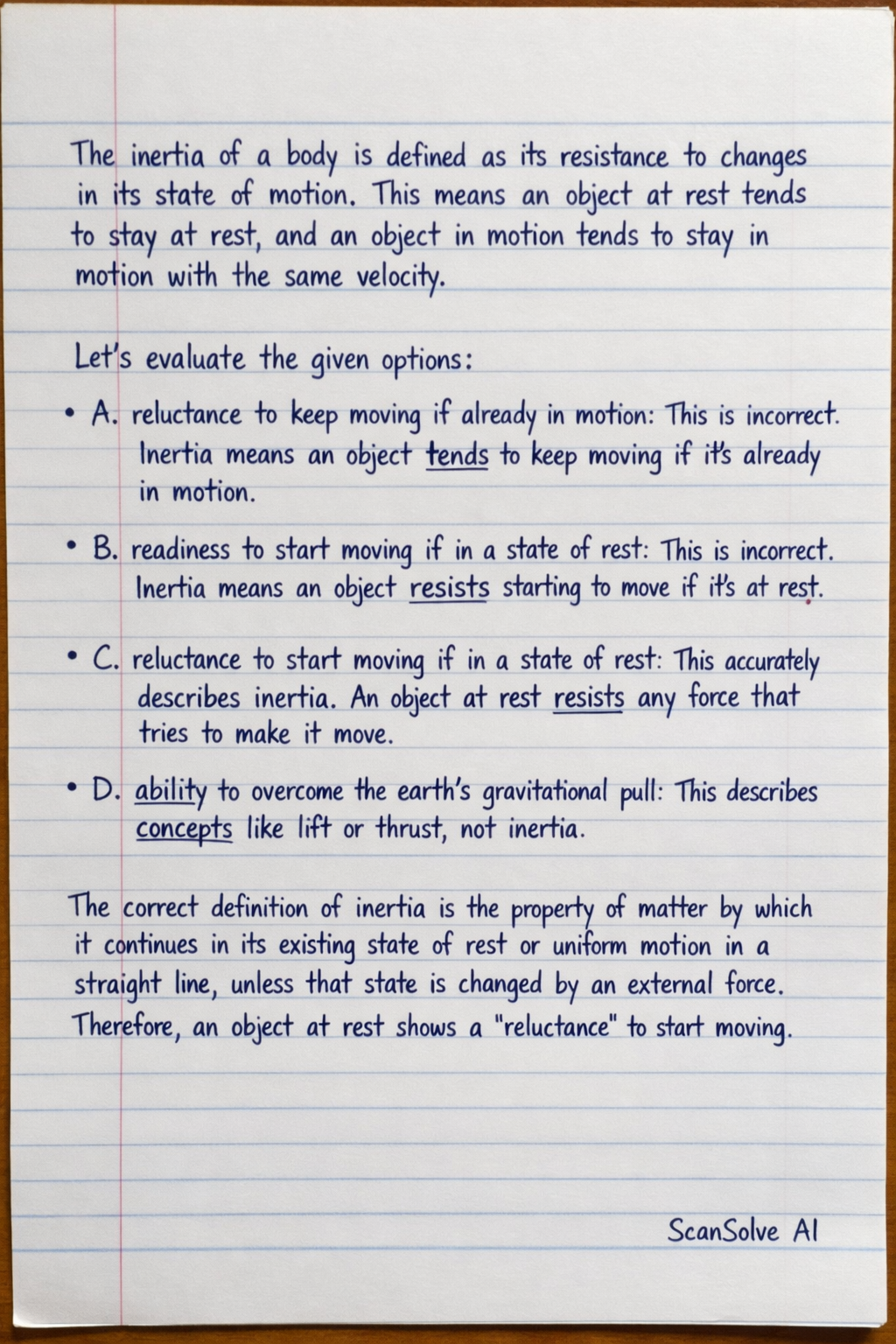
The inertia of a body is defined as its resistance to changes in its state of motion. This means an object at rest tends to stay at rest, and an object in motion tends to stay in motion with the same velocity. Let's evaluate the given options: A. reluctance to keep moving if already in motion: This is incorrect. Inertia means an object tends* to keep moving if it's already in motion. B. readiness to start moving if in a state of rest: This is incorrect. Inertia means an object resists* starting to move if it's at rest. C. reluctance to start moving if in a state of rest: This accurately describes inertia. An object at rest resists any force that tries to make it move. D. ability to overcome the earth's gravitational pull: This describes concepts like lift or thrust, not inertia. The correct definition of inertia is the property of matter by which it continues in its existing state of rest or uniform motion in a straight line, unless that state is changed by an external force. Therefore, an object at rest shows a "reluctance" to start moving. The final answer is C