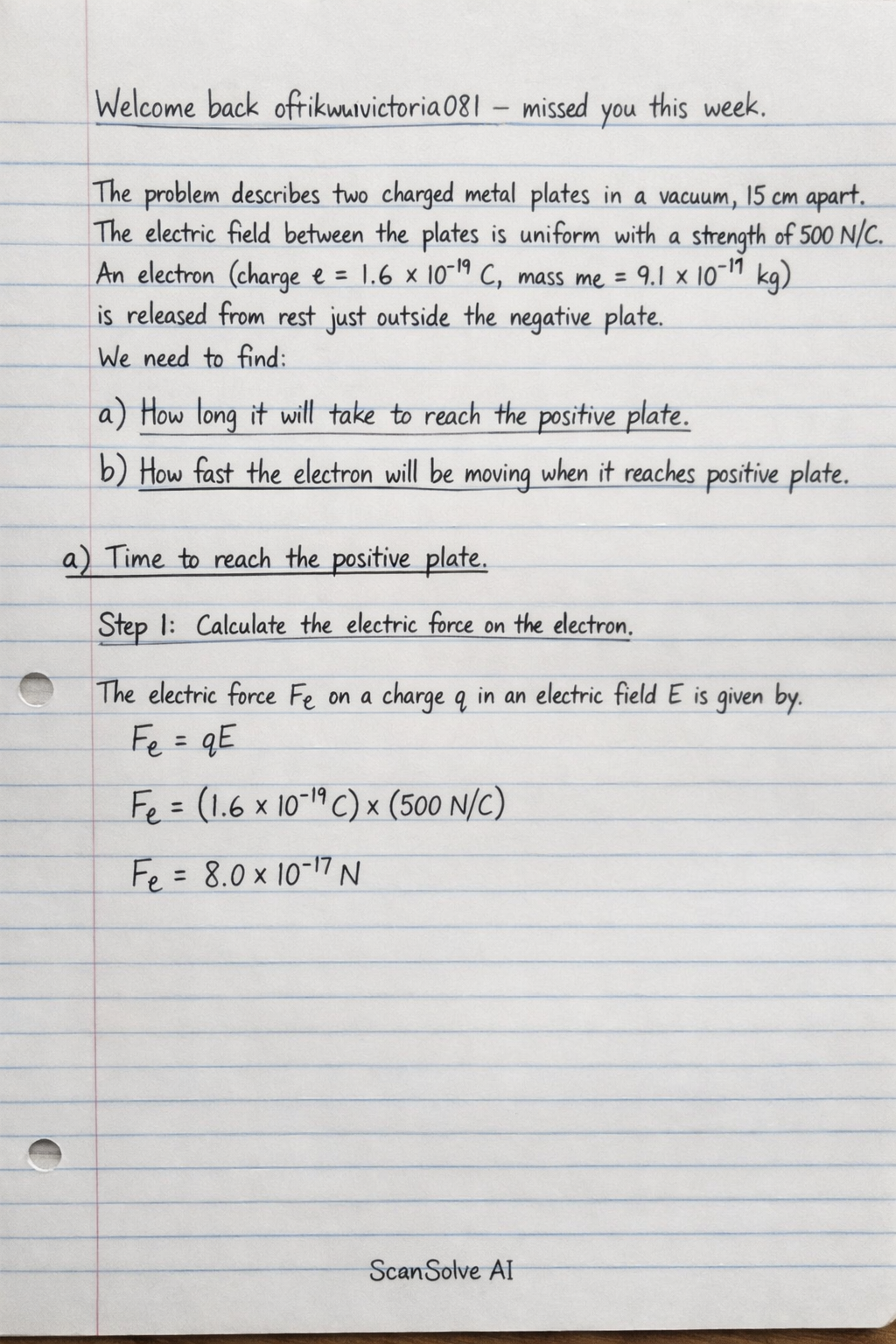
The problem describes two charged metal plates in a vacuum, 15 cm apart. The electric field between the plates is uniform and has a strength of 500 N/C. An electron (charge $e = 1.6 x
This physics problem tests your understanding of fundamental physical laws and their applications. The step-by-step solution below breaks down the problem using relevant equations and physical reasoning.
ScanSolve AI Answer
Welcome back offikwuvictoria081 β missed you this week.
The problem describes two charged metal plates in a vacuum, 15 cm apart. The electric field between the plates is uniform and has a strength of $500 \, \text{N/C}$. An electron (charge $e = 1.6 \times 10^{-19} \, \text{C}$, mass $m_e = 9.1 \times 10^{-31} \, \text{kg}$) is released from rest just outside the negative plate. We need to find:
a) How long it will take to reach the positive plate.
b) How fast the electron will be moving when it reaches the positive plate.
a) Time to reach the positive plate
Step 1: Calculate the electric force on the electron.
The electric force $F_e$ on a charge $q$ in an electric field $E$ is given by $F_e = qE$.
$$F_e = (1.6 \times 10^{-19} \, \text{C}) \times (500 \, \text{N/C})$$
$$F_e = 8.0 \times 10^{-17} \, \text{N}$$
Step 2: Calculate the acceleration of the electron.
According to Newton's second law, $F_e = m_e a$, where $a$ is the acceleration.
$$a = \frac{F_e}{m_e}$$
$$a = \frac{8.0 \times 10^{-17} \, \text{N}}{9.1 \times 10^{-31} \, \text{kg}}$$
$$a \approx 8.79 \times 10^{13} \, \text{m/s}^2$$
Step 3: Calculate the time taken to travel the distance.
The distance $d$ between the plates is $15 \, \text{cm} = 0.15 \, \text{m}$. Since the electron starts from rest, we can use the kinematic equation $d = v_0 t + \frac{1}{2}at^2$. Here, $v_0 = 0$.
$$d = \frac{1}{2}at^2$$
$$t^2 = \frac{2d}{a}$$
$$t = \sqrt{\frac{2d}{a}}$$
$$t = \sqrt{\frac{2 \times 0.15 \, \text{m}}{8.79 \times 10^{13} \, \text{m/s}^2}}$$
$$t = \sqrt{\frac{0.30}{8.79 \times 10^{13}}} \, \text{s}$$
$$t = \sqrt{3.413 \times 10^{-15}} \, \text{s}$$
$$t \approx 5.84 \times 10^{-8} \, \text{s}$$
The time taken is $\boxed{\text{5.84} \times 10^{-8} \, \text{s}}$.
b) Final speed of the electron
Step 1: Use the kinematic equation to find the final velocity.
We can use the equation $v = v_0 + at$. Since $v_0 = 0$:
$$v = at$$
$$v = (8.79 \times 10^{13} \, \text{m/s}^2) \times (5.84 \times 10^{-8} \, \text{s})$$
$$v \approx 5.13 \times 10^6 \, \text{m/s}$$
The final speed of the electron is $\boxed{\text{5.13} \times 10^6 \, \text{m/s}}$.
Send me the next one πΈ
The problem describes two charged metal plates in a vacuum, 15 cm apart. The electric field between the plates is uniform and has a strength of 500 N/C. An electron (charge $e = 1.6 x
|Physics
The problem describes two charged metal plates in a vacuum, 15 cm apart. The electric field between the plates is uniform and has a strength of 500 N/C. An electron (charge $e = 1.6 x
ScanSolve AI Answer
Welcome back offikwuvictoria081 β missed you this week.
The problem describes two charged metal plates in a vacuum, 15 cm apart. The electric field between the plates is uniform and has a strength of 500N/C. An electron (charge e=1.6Γ10β19C, mass meβ=9.1Γ10β31kg) is released from rest just outside the negative plate. We need to find:
a) How long it will take to reach the positive plate.
b) How fast the electron will be moving when it reaches the positive plate.
a) Time to reach the positive plate
Step 1: Calculate the electric force on the electron.
The electric force Feβ on a charge q in an electric field E is given by Feβ=qE.
Feβ=(1.6Γ10β19C)Γ(500N/C)Feβ=8.0Γ10β17N
Step 2: Calculate the acceleration of the electron.
According to Newton's second law, Feβ=meβa, where a is the acceleration.
a=meβFeββa=9.1Γ10β31kg8.0Γ10β17Nβaβ8.79Γ1013m/s2
Step 3: Calculate the time taken to travel the distance.
The distance d between the plates is 15cm=0.15m. Since the electron starts from rest, we can use the kinematic equation d=v0βt+21βat2. Here, v0β=0.
d=21βat2t2=a2dβt=a2dββt=8.79Γ1013m/s22Γ0.15mββt=8.79Γ10130.30ββst=3.413Γ10β15βstβ5.84Γ10β8s
The time taken is 5.84Γ10β8sβ.
b) Final speed of the electron
Step 1: Use the kinematic equation to find the final velocity.
We can use the equation v=v0β+at. Since v0β=0:
v=atv=(8.79Γ1013m/s2)Γ(5.84Γ10β8s)vβ5.13Γ106m/s
The final speed of the electron is 5.13Γ106m/sβ.
Send me the next one πΈ
Need help with your own homework?
Get instant step-by-step solutions to any question. Free to start.