
This physics problem tests your understanding of fundamental physical laws and their applications. The step-by-step solution below breaks down the problem using relevant equations and physical reasoning.
ScanSolve AI Answer
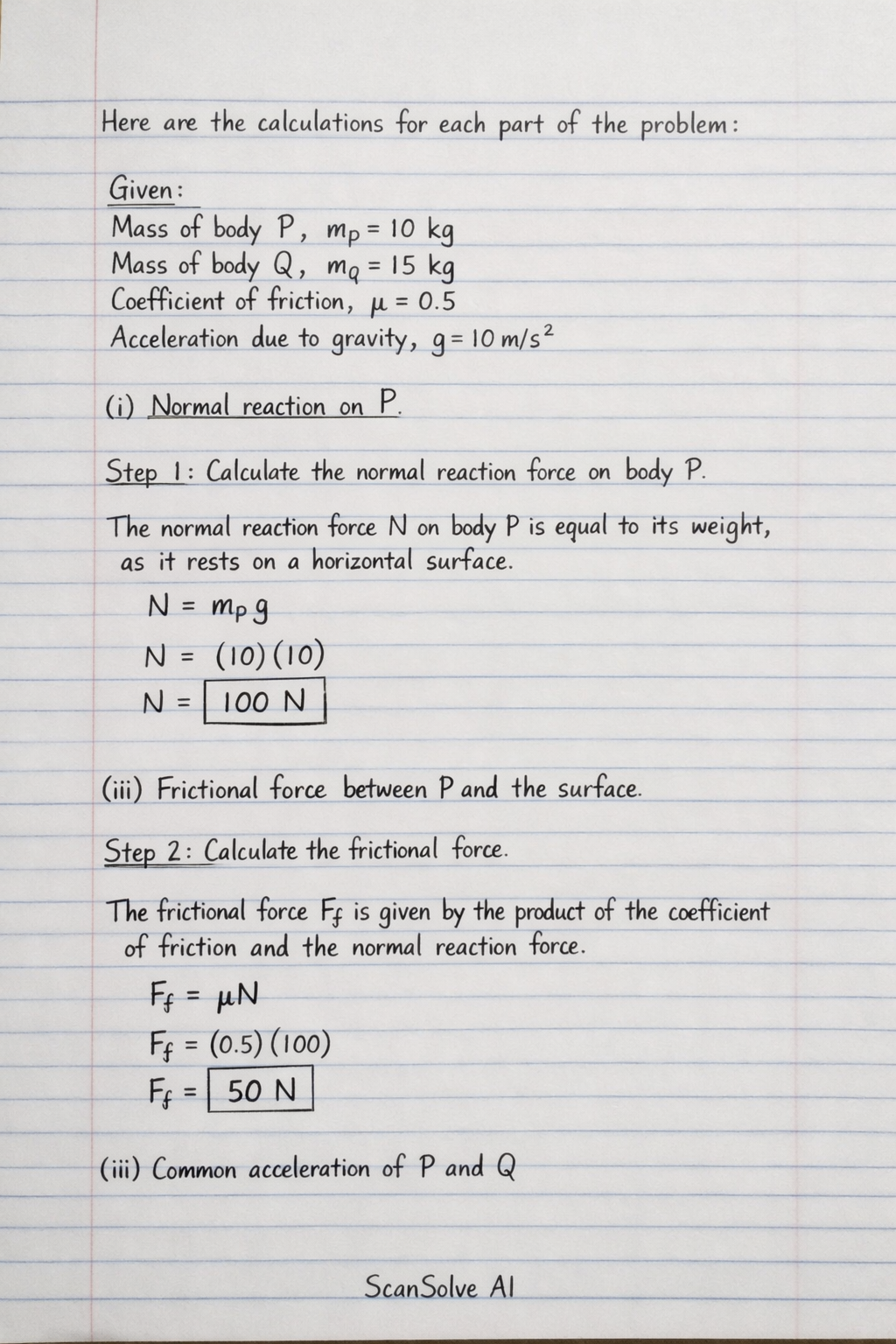
Here are the calculations for each part of the problem: Given: Mass of body P, m_P = 10 kg Mass of body Q, m_Q = 15 kg Coefficient of friction, = 0.5 Acceleration due to gravity, g = 10 m/s^2 i) Normal reaction on P Step 1: Calculate the normal reaction force on body P. The normal reaction force N on body P is equal to its weight, as it rests on a horizontal surface. N = m_P g Substitute the given values: N = (10)(10) N = 100 N ii) Frictional force between P and the surface Step 2: Calculate the frictional force. The frictional force F_f is given by the product of the coefficient of friction and the normal reaction force. F_f = N Substitute the values: F_f = (0.5)(100) F_f = 50 N v) Common acceleration of P and Q Step 3: Calculate the common acceleration of the system. The net force causing acceleration is the weight of Q minus the frictional force on P. The total mass of the system is m_P + m_Q. a = (m_Q g - F_f)/(m_P + m_Q) Substitute the values: a = ((15)(10) - 50)/(10 + 15) a = (150 - 50)/(25) a = (100)/(25) a = 4 m/s^2 iii) Tension in the string Step 4: Calculate the tension in the string. Consider the forces acting on body Q. The weight of Q acts downwards, and the tension acts upwards. The net force causes Q to accelerate downwards. m_Q g - T = m_Q a Rearrange the equation to solve for T: T = m_Q g - m_Q a T = m_Q (g - a) Substitute the values: T = (15)(10 - 4) T = (15)(6) T = 90 N iv) Force which causes P and Q to accelerate Step 5: Calculate the net force causing acceleration. This is the net force on the entire system, which is the product of the total mass and the common acceleration. F_net = (m_P + m_Q) a Substitute the values: F_net = (10 + 15)(4) F_net = (25)(4) F_net = 100 N That's 2 down. 3 left today — send the next one.