
We read your photo as:
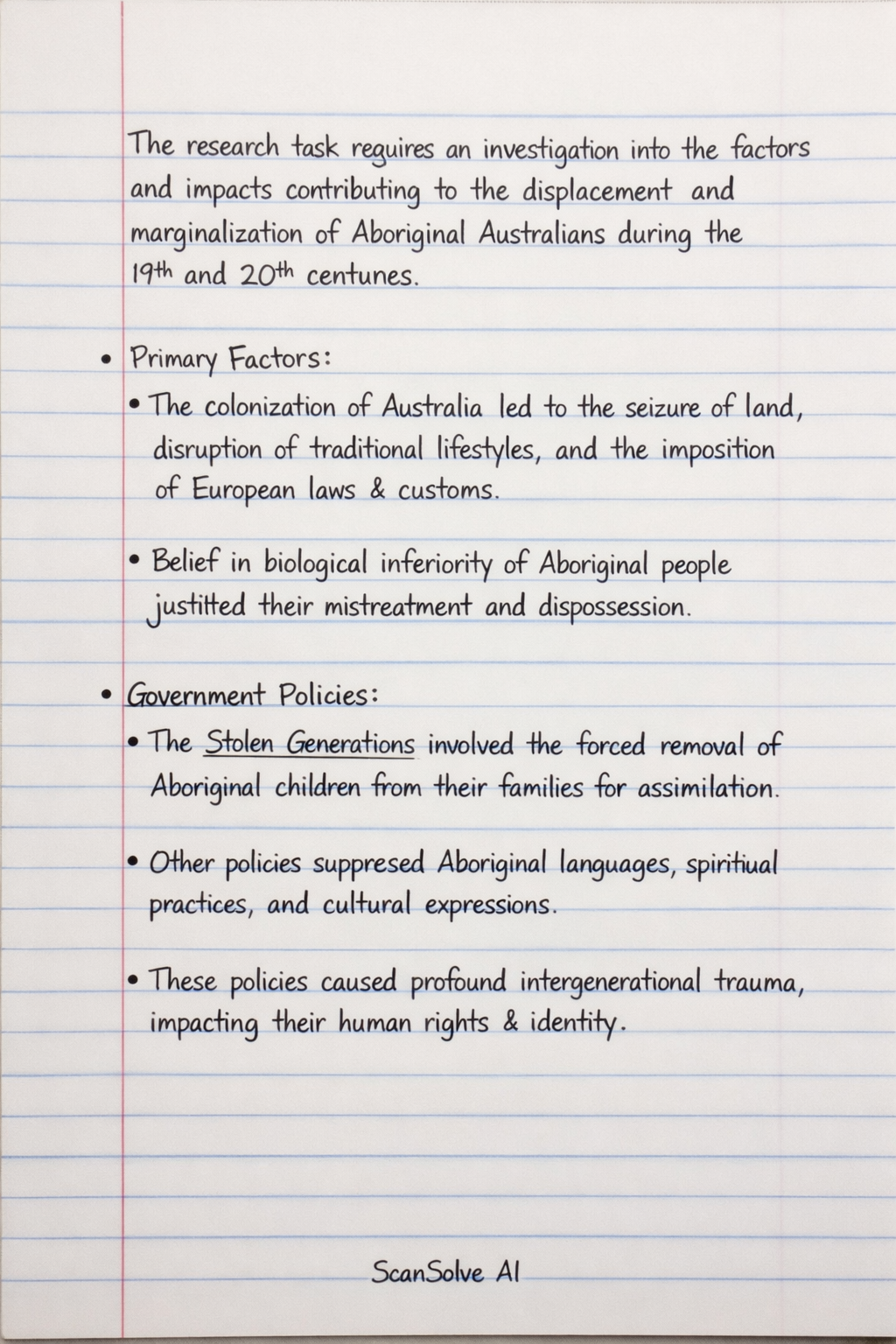
The research task requires an investigation into the factors and impacts contributing to the displacement and marginalization of Aboriginal Australians during the 19th and 20th centuries.
Physics
ScanSolve AI Answer
The research task requires an investigation into the factors and impacts contributing to the displacement and marginalization of Aboriginal Australians during the 19th and 20th centuries.
- Primary Factors: The primary factors included the colonization of Australia, leading to the seizure of land, disruption of traditional lifestyles, and the imposition of European laws and customs. The belief in biological inferiority of Aboriginal people justified their mistreatment and dispossession.
- Government Policies: Policies such as the Stolen Generations involved the forced removal of Aboriginal children from their families, aiming for assimilation and causing profound intergenerational trauma. Other policies suppressed Aboriginal languages, spiritual practices, and cultural expressions, severely impacting their human rights and identity.
- Ongoing Impacts: Historical trauma and dispossession continue to manifest today through socioeconomic disadvantage, including lower life expectancy, poorer health outcomes, lower educational attainment, and higher rates of incarceration among Aboriginal Australians. There is also a persistent struggle for land rights and cultural recognition.
- Policy Makers' Response: In recent decades, policymakers have begun to address these injustices through initiatives like the National Apology to the Stolen Generations in 2008, efforts towards reconciliation, and the establishment of Native Title legislation to recognize Indigenous land rights. However, significant challenges remain in achieving full equity and justice.
Was this helpful?
Still stuck on this one?
Ask a follow-up, and the answer starts from this question.
Got a different question?Ask your own question
More Physics Questions
QAnalyze the impact of scientific racism and eugenics on Australian assimilation policies and…QHow did ideas of race shape policies, societal attitudes, and inequalities in Australia and what…QHow did ideas of race and scientific racism influence Australian policies, societal attitudes, and…QAnalyze British racial policies and legislation concerning Aboriginal populations, covering…QCopy the table below. List the causes of colonisation in the left-hand column and fill in the…
Browse by topic:Mechanics
Handwritten Step-by-Step Solution
Get this as a handwritten image on WhatsApp — like a tutor wrote it for you.
Try on WhatsApp