

This physics problem tests your understanding of fundamental physical laws and their applications. The step-by-step solution below breaks down the problem using relevant equations and physical reasoning.
ScanSolve AI Answer
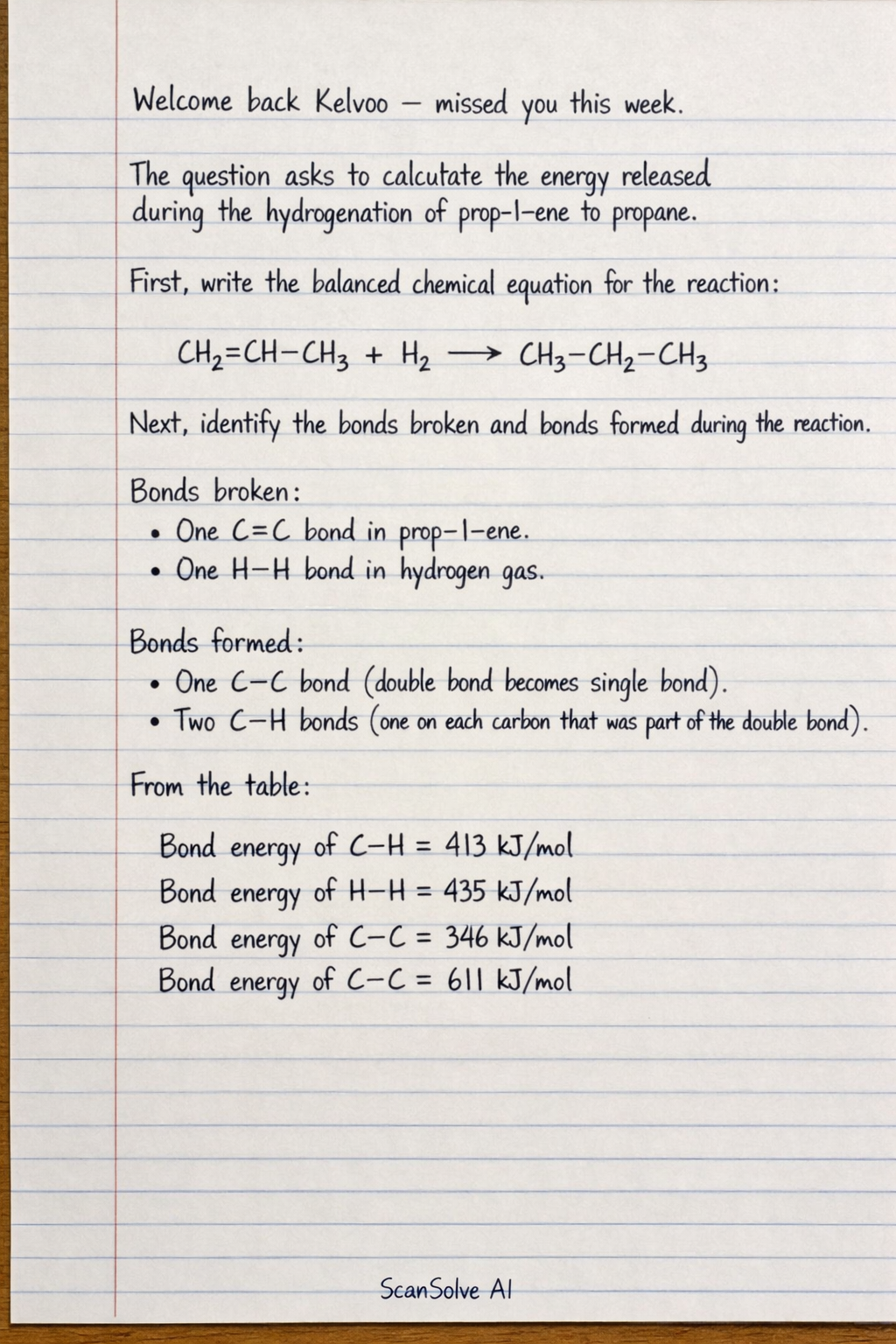
Welcome back Kelvoo — missed you this week. The question asks to calculate the energy released during the hydrogenation of prop-1-ene to propane. First, write the balanced chemical equation for the reaction: CH_2=CH-CH_3 + H_2 CH_3-CH_2-CH_3 Next, identify the bonds broken and bonds formed during the reaction. Bonds broken: • One C=C bond in prop-1-ene. • One H-H bond in hydrogen gas. Bonds formed: • One C-C bond (the double bond becomes a single bond). • Two C-H bonds (one on each carbon that was part of the double bond). From the table: • Bond energy of C-H = 413 kJ/mol • Bond energy of H-H = 435 kJ/mol • Bond energy of C-C = 346 kJ/mol • Bond energy of C=C = 611 kJ/mol Step 1: Calculate the total energy required to break bonds. Energy (broken) = Bond energy(C=C) + Bond energy(H-H) Energy (broken) = 611 kJ/mol + 435 kJ/mol Energy (broken) = 1046 kJ/mol Step 2: Calculate the total energy released when new bonds are formed. Energy (formed) = Bond energy(C-C) + 2 × Bond energy(C-H) Energy (formed) = 346 kJ/mol + 2 × 413 kJ/mol Energy (formed) = 346 kJ/mol + 826 kJ/mol Energy (formed) = 1172 kJ/mol Step 3: Calculate the overall energy change (enthalpy of reaction). The energy released during the reaction is the difference between the energy released from forming bonds and the energy absorbed for breaking bonds. H = Energy (broken) - Energy (formed) H = 1046 kJ/mol - 1172 kJ/mol H = -126 kJ/mol The negative sign indicates that energy is released. The energy released during the hydrogenation of prop-1-ene to propane is 126 kJ/mol. Send me the next one 📸