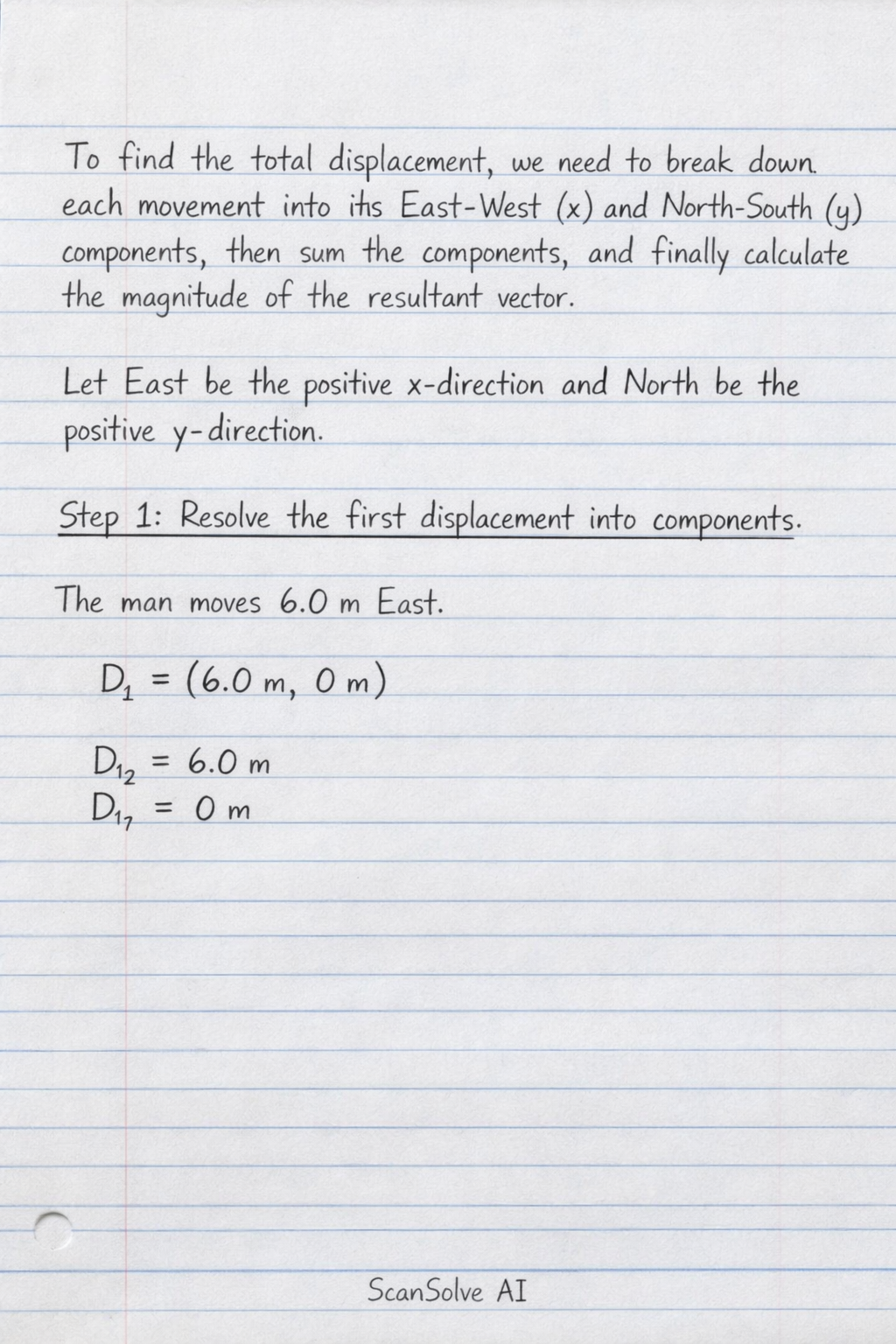
To find the total displacement, we need to break down each movement into its East-West (x) and North-South (y) components, then sum the components, and finally calculate the magnitude of the resultant
This physics problem tests your understanding of fundamental physical laws and their applications. The step-by-step solution below breaks down the problem using relevant equations and physical reasoning.
ScanSolve AI Answer
To find the total displacement, we need to break down each movement into its East-West (x) and North-South (y) components, then sum the components, and finally calculate the magnitude of the resultant vector.
Let East be the positive x-direction and North be the positive y-direction.
Step 1: Resolve the first displacement into components.
The man moves $6.0 \text{ m}$ East.
$$D_1 = (6.0 \text{ m}, 0 \text{ m})$$
So, $D_{1x} = 6.0 \text{ m}$ and $D_{1y} = 0 \text{ m}$.
Step 2: Resolve the second displacement into components.
The man moves $10.0 \text{ m}$ in the direction N30°E. This means $30^\circ$ East of North.
The angle with respect to the positive y-axis (North) is $30^\circ$.
The x-component (East) is $D_2 \sin(30^\circ)$.
The y-component (North) is $D_2 \cos(30^\circ)$.
$$D_{2x} = 10.0 \text{ m} \times \sin(30^\circ)$$
$$D_{2y} = 10.0 \text{ m} \times \cos(30^\circ)$$
We know that $\sin(30^\circ) = 0.5$ and $\cos(30^\circ) = \frac{\sqrt{3}}{2} \approx 0.866$.
$$D_{2x} = 10.0 \text{ m} \times 0.5 = 5.0 \text{ m}$$
$$D_{2y} = 10.0 \text{ m} \times \frac{\sqrt{3}}{2} = 5\sqrt{3} \text{ m} \approx 8.66 \text{ m}$$
Step 3: Sum the x and y components to find the total displacement.
Total x-displacement ($R_x$):
$$R_x = D_{1x} + D_{2x} = 6.0 \text{ m} + 5.0 \text{ m} = 11.0 \text{ m}$$
Total y-displacement ($R_y$):
$$R_y = D_{1y} + D_{2y} = 0 \text{ m} + 5\sqrt{3} \text{ m} = 5\sqrt{3} \text{ m}$$
Step 4: Calculate the magnitude of the resultant displacement.
The magnitude of the resultant displacement $R$ is given by the Pythagorean theorem:
$$R = \sqrt{R_x^2 + R_y^2}$$
$$R = \sqrt{(11.0 \text{ m})^2 + (5\sqrt{3} \text{ m})^2}$$
$$R = \sqrt{121 \text{ m}^2 + (25 \times 3) \text{ m}^2}$$
$$R = \sqrt{121 \text{ m}^2 + 75 \text{ m}^2}$$
$$R = \sqrt{196 \text{ m}^2}$$
$$R = 14.0 \text{ m}$$
The man is $14.0 \text{ m}$ from his starting point.
Comparing this with the given options:
A. 12.0 m
B. 17.0 m
C. 15.0 m
D. 14.0 m
The correct option is D.
The final answer is $\boxed{\text{D. 14.0 m}}$.
To find the total displacement, we need to break down each movement into its East-West (x) and North-South (y) components, then sum the components, and finally calculate the magnitude of the resultant
|Physics
To find the total displacement, we need to break down each movement into its East-West (x) and North-South (y) components, then sum the components, and finally calculate the magnitude of the resultant
ScanSolve AI Answer
To find the total displacement, we need to break down each movement into its East-West (x) and North-South (y) components, then sum the components, and finally calculate the magnitude of the resultant vector.
Let East be the positive x-direction and North be the positive y-direction.
Step 1: Resolve the first displacement into components.
The man moves 6.0 m East.
D1=(6.0m,0m)
So, D1x=6.0 m and D1y=0 m.
Step 2: Resolve the second displacement into components.
The man moves 10.0 m in the direction N30°E. This means 30∘ East of North.
The angle with respect to the positive y-axis (North) is 30∘.
The x-component (East) is D2sin(30∘).
The y-component (North) is D2cos(30∘).
D2x=10.0m×sin(30∘)D2y=10.0m×cos(30∘)
We know that sin(30∘)=0.5 and cos(30∘)=23≈0.866.
D2x=10.0m×0.5=5.0 mD2y=10.0m×23=53m≈8.66 m
Step 3: Sum the x and y components to find the total displacement.
Total x-displacement (Rx):
Rx=D1x+D2x=6.0m+5.0m=11.0 m
Total y-displacement (Ry):
Ry=D1y+D2y=0m+53m=53 m
Step 4: Calculate the magnitude of the resultant displacement.
The magnitude of the resultant displacement R is given by the Pythagorean theorem:
R=Rx2+Ry2R=(11.0m)2+(53m)2R=121m2+(25×3)m2R=121m2+75m2R=196m2R=14.0 m
The man is 14.0 m from his starting point.
Comparing this with the given options:
A. 12.0 m
B. 17.0 m
C. 15.0 m
D. 14.0 m
The correct option is D.
The final answer is D.14.0m.
Need help with your own homework?
Get instant step-by-step solutions to any question. Free to start.