
We read your photo as:
To find the value of force F, we will use the principle of moments. For the beam to be in equilibrium, the sum of the clockwise moments about the pivot must equal the sum of the anticlockwise moments
Physics
ScanSolve AI Answer
Answer
Step-by-step solution
3 stepsTo find the value of force F, we will use the principle of moments. For the beam to be in equilibrium, the sum of the clockwise moments about the pivot must equal the sum of the anticlockwise moments about the pivot.
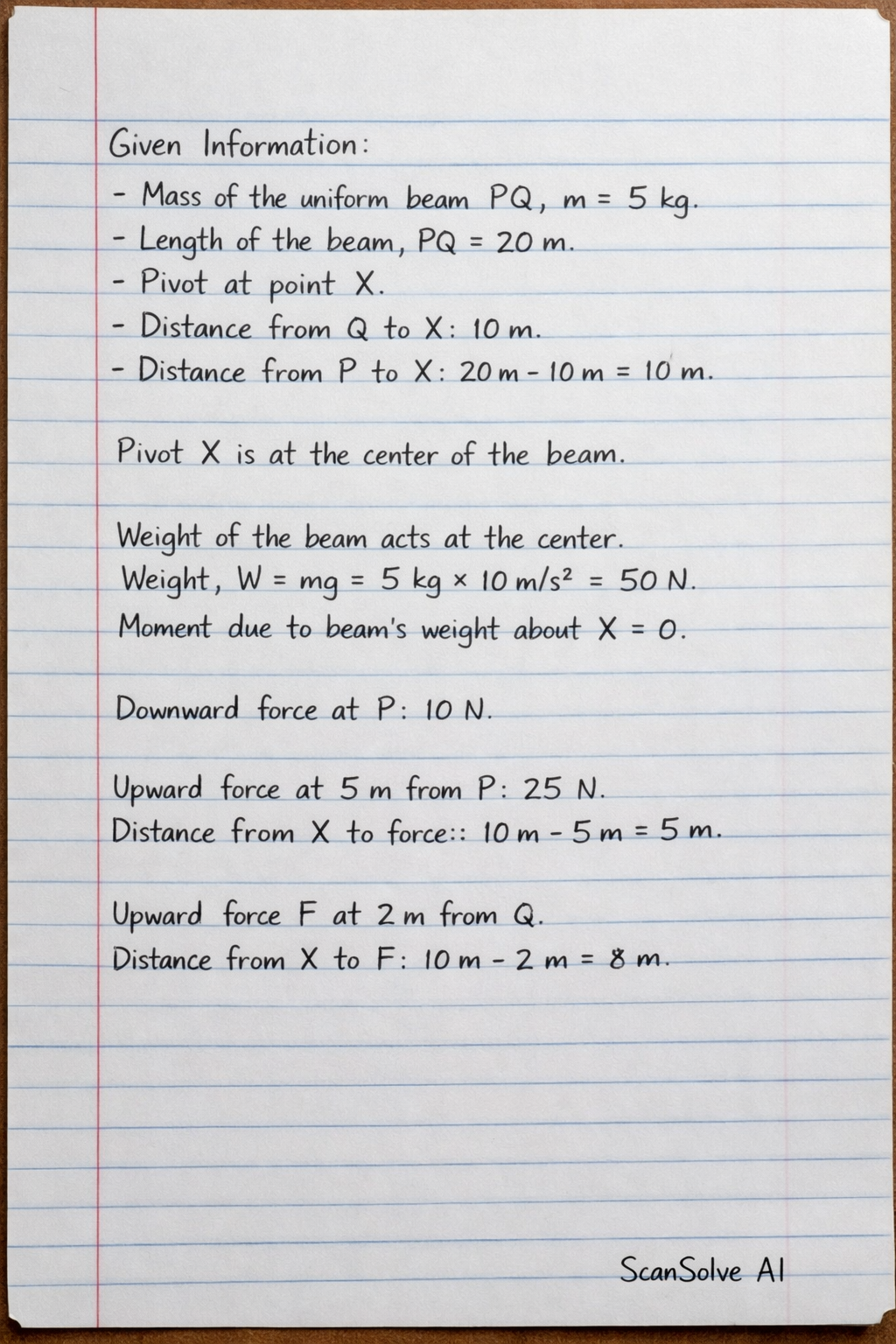
Given Information:
- Mass of the uniform beam PQ, .
- Length of the beam, .
- The beam is pivoted at point X.
- From the diagram, the pivot X is from end Q.
- Since the total length is , the distance from P to X is . This means the pivot X is at the center of the beam.
- The weight of the uniform beam acts at its center. Since the pivot X is at the center, the weight of the beam () acts directly at the pivot. Therefore, the moment due to the beam's weight about X is zero.
- A downward force of is applied at end P.
- An upward force of is applied at a point from end P.
- An upward force F is applied at a point from end Q.
Identify the forces and their perpendicular distances from the pivot X.
-
Force 1 (10 N downward at P):
- Distance from P to X = .
- This force creates an anticlockwise moment about X.
- Moment .
-
Force 2 (25 N upward at 5 m from P):
- The distance from P to this point is .
- The distance from this point to X is .
- This force creates an anticlockwise moment about X.
- Moment .
-
Force 3 (F upward at 2 m from Q):
- The distance from Q to this point is .
- The distance from this point to X is .
- This force creates a clockwise moment about X.
- Moment .
-
Apply the principle of moments.
For equilibrium, the sum of clockwise moments equals the sum of anticlockwise moments.
Set up the equation and solve for F.
The value of F is .
Was this helpful?
Try one yourself
A new problem that tests the same skill.
Still stuck on this one?
Ask a follow-up, and the answer starts from this question.
Got a different question?Ask your own question
More Physics Questions
Qb) i) State the principle of moments. ii) Determine the value of X, assuming that the beam is…QA balanced beam is pivoted at its center of gravity. A 30 N force is applied at 3 m, and a 40 N…QCalculate force on the diagram below if the beam is balanced. Write data aside.QThe uniform beam PQ of mass 5kg is pivoted at point X as shown if force F is 2m from end Q,find the…QCalculate the moment of force F about the axis AC, given the coordinates of A, B, C and the force…
Browse by topic:Mechanics
Handwritten Step-by-Step Solution
Get this as a handwritten image on WhatsApp — like a tutor wrote it for you.
Try on WhatsApp