

This physics problem tests your understanding of fundamental physical laws and their applications. The step-by-step solution below breaks down the problem using relevant equations and physical reasoning.
ScanSolve AI Answer
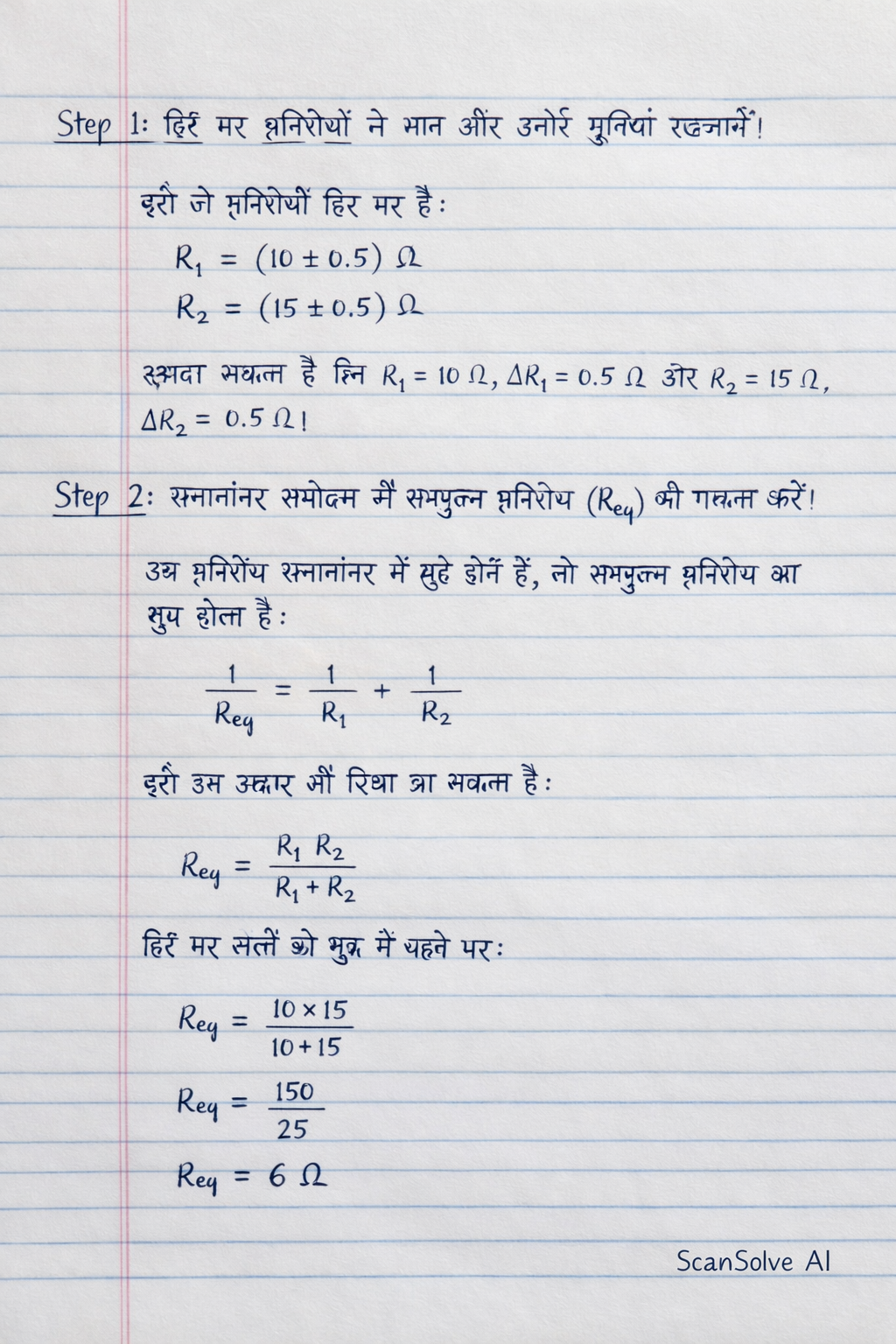
Step 1: दिए गए प्रतिरोधों के मान और उनमें त्रुटियाँ पहचानें। हमें दो प्रतिरोध दिए गए हैं: R_1 = (10 ± 0.5) R_2 = (15 ± 0.5) इसका मतलब है कि R_1 = 10 , R_1 = 0.5 और R_2 = 15 , R_2 = 0.5 । Step 2: समानांतर संयोजन में समतुल्य प्रतिरोध (R_eq) की गणना करें। जब प्रतिरोध समानांतर में जुड़े होते हैं, तो समतुल्य प्रतिरोध का सूत्र होता है: (1)/(R_eq) = (1)/(R_1) + (1)/(R_2) इसे इस प्रकार भी लिखा जा सकता है: R_eq = (R_1 R_2)/(R_1 + R_2) दिए गए मानों को सूत्र में रखने पर: R_eq = (10 × 15)/(10 + 15) R_eq = (150)/(25) R_eq = 6 \, Step 3: समानांतर संयोजन में समतुल्य प्रतिरोध में अधिकतम त्रुटि ( R_eq) की गणना करें। समानांतर संयोजन में त्रुटि प्रसार के लिए सूत्र है: R_eqR_eq^2 = ( R_1)/(R_1^2) + ( R_2)/(R_2^2) दिए गए मानों को सूत्र में रखने पर: R_eq(6)^2 = (0.5)/((10)^2) + (0.5)/((15)^2) R_eq36 = (0.5)/(100) + (0.5)/(225) R_eq36 = 0.005 + (1)/(450) R_eq36 = 0.005 + 0.002222... R_eq36 = 0.007222... अब R_eq की गणना करें: R_eq = 36 × 0.007222... R_eq = 0.259992... \, Step 4: समतुल्य प्रतिरोध में प्रतिशत त्रुटि की गणना करें। प्रतिशत त्रुटि का सूत्र है: Percentage Error = R_eqR_eq × 100\% मान रखने पर: Percentage Error = (0.259992...)/(6) × 100\% Percentage Error = 0.043332... × 100\% Percentage Error = 4.3332...\% निकटतम दो दशमलव स्थानों तक पूर्णांकित करने पर, प्रतिशत त्रुटि 4.33\% है। यह विकल्प (2) से मेल खाता है। The final answer is 4.33. अगला प्रश्न भेजें 📸