
Types of transistor define transistor
ScanSolve AI Answer
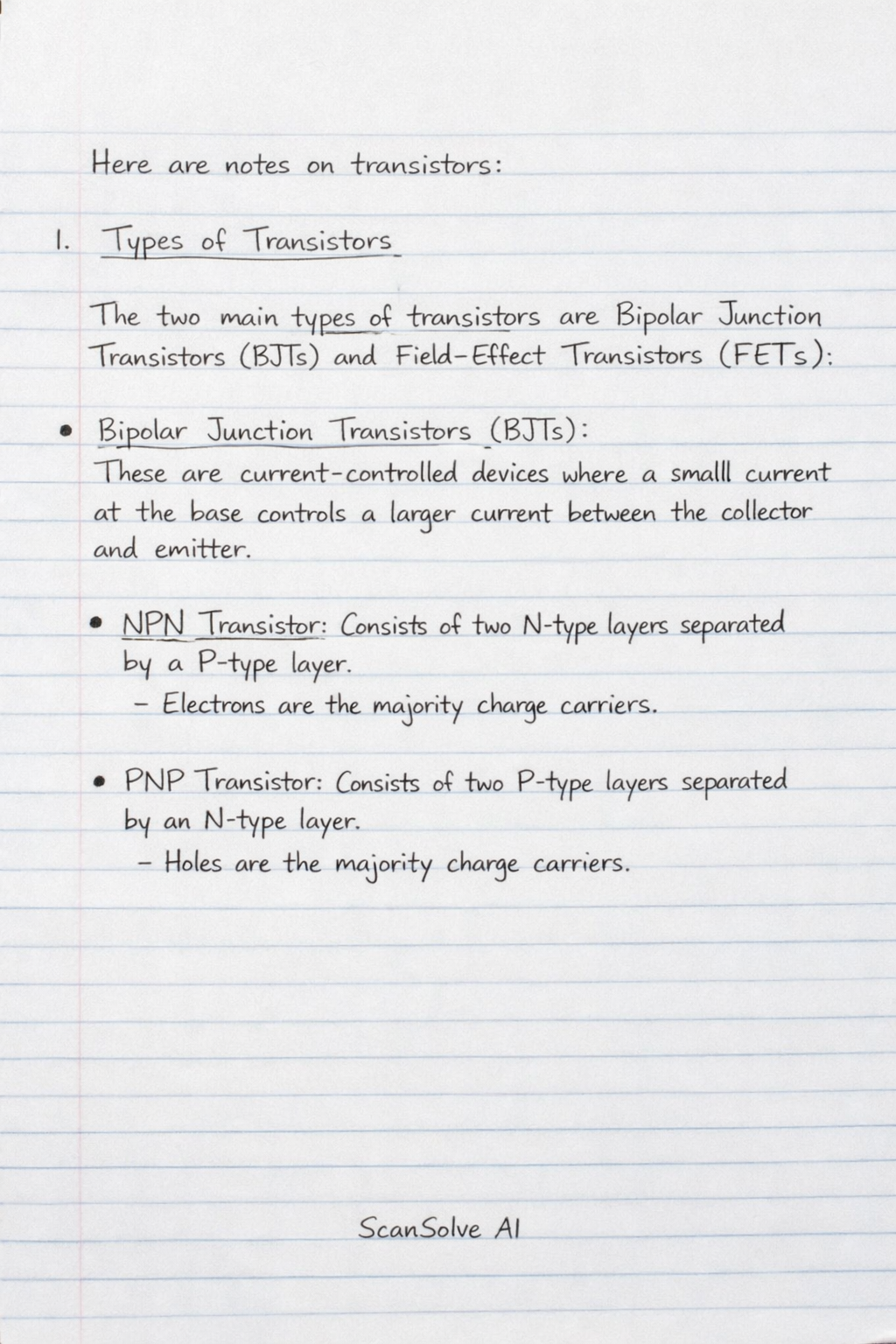
Here are notes on transistors:
-
Types of Transistors The two main types of transistors are Bipolar Junction Transistors (BJTs) and Field-Effect Transistors (FETs).
-
Bipolar Junction Transistors (BJTs): These are current-controlled devices where a small current at the base controls a larger current between the collector and emitter.
- NPN Transistor: Consists of two N-type layers separated by a P-type layer. Electrons are the majority charge carriers.
- PNP Transistor: Consists of two P-type layers separated by an N-type layer. Holes are the majority charge carriers.
-
Field-Effect Transistors (FETs): These are voltage-controlled devices where a voltage applied to the gate controls the current flow between the source and drain.
- Junction Field-Effect Transistors (JFETs): The gate forms a PN junction with the channel.
- Metal-Oxide-Semiconductor Field-Effect Transistors (MOSFETs): The gate is insulated from the channel by a thin oxide layer. They are further categorized into enhancement-mode and depletion-mode, and N-channel and P-channel types.
-
-
Definition of Transistor A transistor is a semiconductor device that can be used to amplify or switch electronic signals and electrical power. It works by using a small input signal (either current or voltage) to control a much larger output current, making it a fundamental component in almost all modern electronic circuits.
Still stuck on this one?
Ask a follow-up, and the answer starts from this question.
More Physics Questions
Handwritten Step-by-Step Solution
Get this as a handwritten image on WhatsApp — like a tutor wrote it for you.
Try on WhatsApp