
We read your photo as:
Find the values of x and y in the nuclear equation: 235/92 U + 1/0 n -> x/56 Ba + 92/y K + 3 1/0 n
ScanSolve AI Answer
Step-by-step solution
6 stepsQuestion (c): Uranium decays according to the nuclear equation below
Find the values of x and y
Apply the conservation of mass number (superscript).
The sum of mass numbers on the left side must equal the sum of mass numbers on the right side.
Apply the conservation of atomic number (subscript).
The sum of atomic numbers on the left side must equal the sum of atomic numbers on the right side.
The values are .
Question 8 (a)(i): State the domain theory of magnets
The domain theory of magnetism states that ferromagnetic materials are composed of small regions called magnetic domains. Each domain is a tiny region where the magnetic moments of atoms are aligned in the same direction, making it behave like a tiny magnet. In an unmagnetized material, these domains are randomly oriented, canceling out their magnetic effects. When an external magnetic field is applied, the domains align with the field, resulting in a net magnetization.
Question 8 (a)(ii): Explain briefly how the arms of the clock can be shielded from the effect of external magnetic field
The arms of a clock can be shielded from an external magnetic field by enclosing them within a soft iron casing. Soft iron is a ferromagnetic material that can easily be magnetized and demagnetized. It diverts the magnetic field lines through itself, preventing them from passing through the enclosed region where the clock arms are located, thus protecting them from the external field.
Question 8 (a)(iii): Explain what is observed when a magnet is freely suspended in air
When a magnet is freely suspended in air, it will align itself in a specific direction. The north pole of the magnet will point approximately towards the Earth's geographic north, and its south pole will point approximately towards the Earth's geographic south. This alignment is due to the Earth's natural magnetic field.
Question 8 (b): Define the following terms
(i) Ferromagnetic materials
Ferromagnetic materials are substances that are strongly attracted to magnets and can be permanently magnetized. They contain magnetic domains that align in the presence of an external magnetic field, leading to a strong net magnetization. Examples include iron, nickel, and cobalt.(ii) Diamagnetic materials
Diamagnetic materials are substances that are weakly repelled by magnetic fields. They do not have permanent magnetic moments, and when an external magnetic field is applied, they develop a weak induced magnetic moment that opposes the applied field. Examples include copper, water, and bismuth.(iii) Neutral point
A neutral point in a magnetic field is a location where the net magnetic field strength is zero. This occurs when the magnetic field produced by a magnet is exactly canceled out by an external magnetic field (e.g., the Earth's magnetic field) in terms of both magnitude and direction.
Question 8 (c): With the aid of a labelled diagram, explain how an electric bell works
An electric bell works on the principle of the electromagnet.
- When the switch is closed, current flows through the coil, creating an electromagnet.
- The electromagnet attracts a soft iron armature which is attached to a hammer.
- As the armature moves towards the electromagnet, the hammer strikes the gong, producing sound.
- Simultaneously, the movement of the armature breaks the electrical contact at the interrupter screw.
- Breaking the contact de-energizes the electromagnet, causing it to lose its magnetism.
- A spring then pulls the armature back to its original position, re-establishing contact with the interrupter screw.
- The circuit is completed again, and the process repeats, causing continuous ringing as long as the switch is closed.
Question 8 (d)(i): A moving coil galvanometer has a coil of resistance and gives full scale deflection when a current of passes through it. Calculate the value of the resistance required to convert it into an ammeter which reads at full scale deflection.
Identify the given values and convert units.
Galvanometer resistance,
Full scale deflection current of galvanometer,
Total current for ammeter,
We need to find the shunt resistance, .State the formula for shunt resistance.
To convert a galvanometer into an ammeter, a low resistance (shunt resistance) is connected in parallel with the galvanometer. The formula for shunt resistance is:
Substitute the values into the formula.
Calculate the shunt resistance.
The value of the resistance required is (to 3 significant figures).
Question 8 (d)(ii): State two ways of minimizing energy loss in a transformer
- Laminating the core: Using a laminated soft iron core reduces eddy current losses. The laminations are thin sheets of iron insulated from each other, which increases the resistance to eddy currents, thereby reducing the heat generated.
- Using a soft iron core: A soft iron core has high magnetic permeability and low hysteresis loss, which reduces hysteresis loss (energy lost due to repeated magnetization and demagnetization of the core).
- Using thick copper wires: Using thick copper wires for the primary and secondary coils reduces copper losses (Joule heating, loss) because thicker wires have lower resistance.
- Good insulation between coils: Ensuring good insulation and proper winding of coils minimizes flux leakage, where magnetic field lines from the primary coil do not link with the secondary coil, leading to energy loss.
Still stuck on this one?
Ask a follow-up, and the answer starts from this question.
More Physics Questions
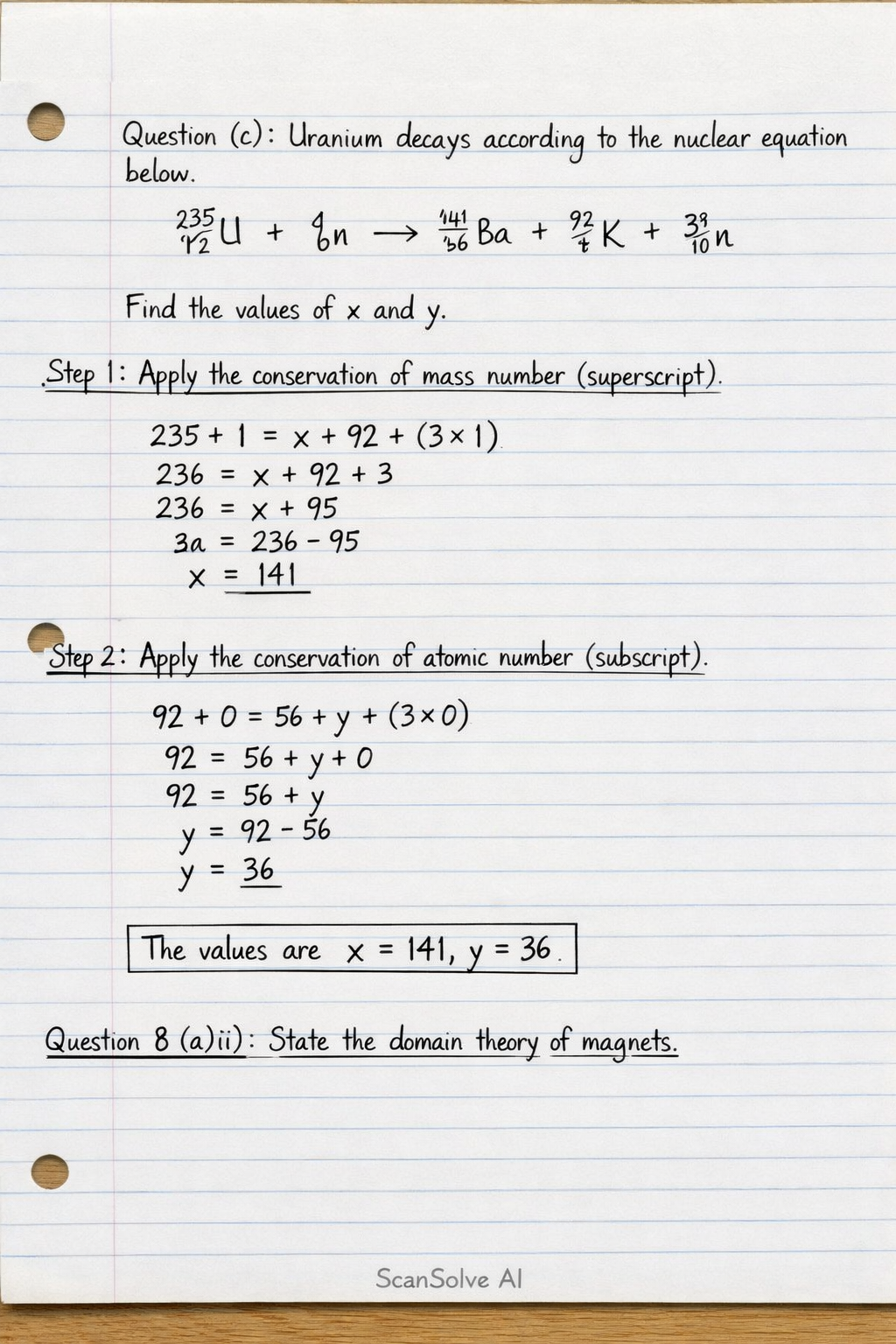
Handwritten Step-by-Step Solution
Get this as a handwritten image on WhatsApp — like a tutor wrote it for you.
Try on WhatsApp