
With a good sketch derive the equation of motion of a compound pendulum
ScanSolve AI Answer
Answer
Step-by-step solution
4 stepsHere's the derivation of the equation of motion for a compound pendulum:
Sketch Description:
Imagine a rigid body of mass pivoted at point O. Let G be the center of mass (CM) of the body, located at a distance from the pivot O. When the body is displaced by an angle from the vertical equilibrium position, the gravitational force acts vertically downwards through G.
Identify the torque acting on the pendulum.
The gravitational force creates a restoring torque about the pivot O. The perpendicular distance from the pivot to the line of action of the force is .
The negative sign indicates that the torque acts to reduce the angular displacement .
Apply Newton's second law for rotational motion.
Newton's second law for rotation states that the net torque is equal to the moment of inertia about the pivot multiplied by the angular acceleration . Here, .
Equating the two expressions for torque:
Rearrange the equation to the standard form.
Move all terms to one side to get the differential equation:
Divide by to isolate :
Apply the small angle approximation for simple harmonic motion.
For small oscillations (i.e., when is small), we can approximate .
Substituting this into the equation:This is the equation of motion for a compound pendulum under small oscillations.
The equation of motion for a compound pendulum is:
For small oscillations, it simplifies to:
Try one yourself
A new problem that tests the same skill.
Still stuck on this one?
Ask a follow-up, and the answer starts from this question.
More Physics Questions
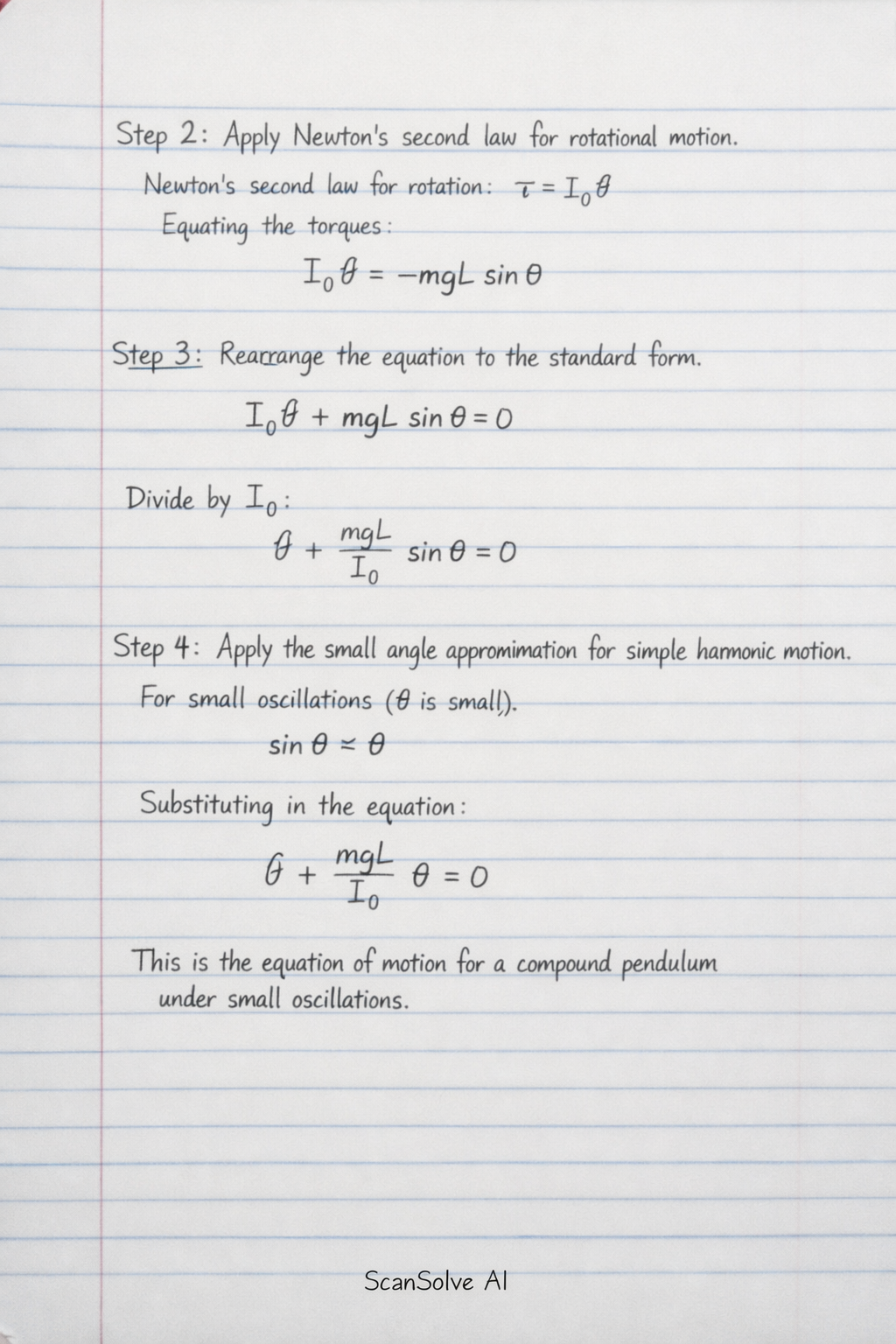
Handwritten Step-by-Step Solution
Get this as a handwritten image on WhatsApp — like a tutor wrote it for you.
Try on WhatsApp