ScanSolve logoScanSolve
Toggle sidebar
  • Homework
  • Tutor
  • Humanizer
  • AI Detector
  • Questions
  • Blog
  • History
  • Mobile App

  • Homework
  • Tutor
  • Humanizer
  • AI Detector

  • Questions
  • Math homework helpMath
    Physics homework helpPhysics
    Chemistry homework helpChemistry
    Biology homework helpBiology
    Computer Science homework helpComputer Science
    History homework helpHistory
    More homework helpMore
  • Blog
  • History

  • Mobile App
ScanSolvePLUS
  • Unlimited answers
  • ScanSolve AI Pro
Start Free Trial →
Try on WhatsApp
Home > Psychology Homework Help > Solution

1. 2) i) Define the term Operating System and state any two (02) of its functions. (4 Marks) ii) Computer hardware can be grouped based on their technology, and their method of accessing data. Classify the following storage media by stating their method of accessing data. Copy and complete the table below Memory Technology Use Method of accessing data (4 Marks) Magnetic tape Flash drive Solid state drive CD-RW b) i) State two examples of an application software that needs to be installed in a computer to; - Enable a learner work with data that requires calculation - Design graduation certificates. (4 Marks) ii) With the aid of a well annotated diagram, explain the machine cycle. (2 Marks) c) With the coming of technology, most computer users are resolving to use cloud-computing technologies. i) What is cloud computing? ii) State and explain any two (02) services offered by cloud computing. (2 Marks) (4 Marks) 2. A teacher intends to write a program to calculate the average between two test marks for a given term. The algorithm will be transformed into a programming language to get the source code and the object code respectively. 3. a) i) Differentiate between source code and object code ii) What is a program? (2 Marks) b) The pseudocode to implement the solution is given below (2 Marks) 1. Start 2. Var T1, T2, Avg 3. Enter the test one-mark TI 4. Enter the test two-mark 12 5. Calculate the average Avg (TI+T2)/2 6. If Avg is greater than or equal to 10? 7: Display "Passed" 8. Else 9. Display "Failed" 10. Output "Goodbye" 11. Stop (3 Marks) -How many variables are in the above algorithm? Name them. (2 Marks) What is a variable? (2 Marks) What is a datatype? (3 Marks) iv) Which datatype is suitable for the variables mentioned in (i) above? (6 Marks) ડ Represent the above algorithm using a flow chart. a) i) Sketch the following logic gates, clearly labelling inputs and outputs XOR, NAND and NOR. (3 Marks) ii) What is a logic gate? (2 Marks) iii) What is a pixel? (2 Marks) b) A black and white image on a screen will require only a single bit to encode each pixel. Figure 2 shows the memory locations where the image is stored. Figure 1 shows a black and white bitmapped image on the screen of a computer. The first byte used for the pixel data is at memory location 187. The pixel stores a byte of data row-by-row, starting with row 1: Black pixels are encoded with the bit set to 1, while White pixels are encoded with the bit set to 0. Page

Asked on March 27, 2026|Psychology

This psychology problem is solved step by step below, with detailed explanations to help you understand the method and arrive at the correct answer.

ScanSolve AI AnswerAnswered on March 27, 2026
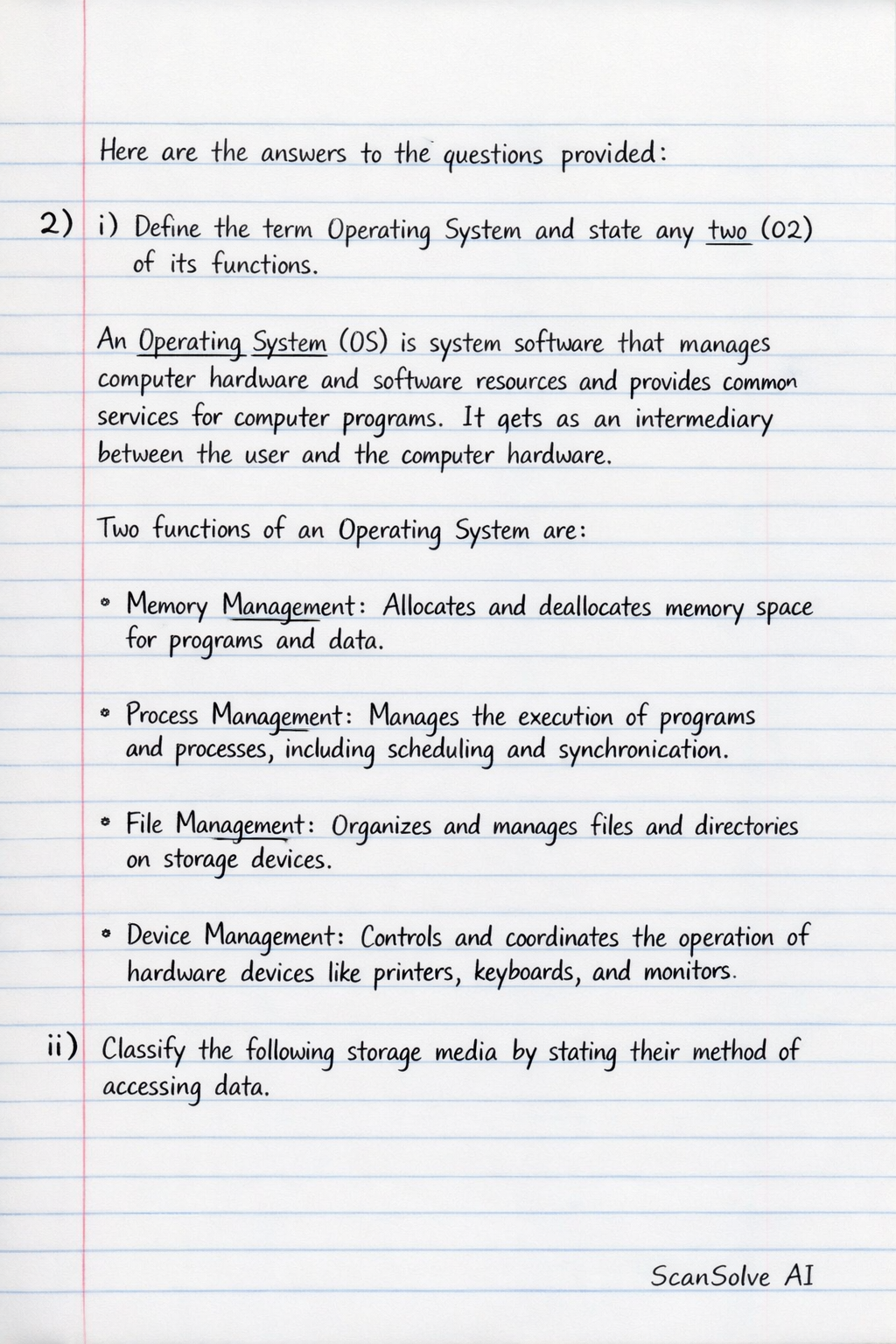
Here are the answers to the questions provided: 2) i) Define the term Operating System and state any two (02) of its functions. An Operating System (OS) is system software that manages computer hardware and software resources and provides common services for computer programs. It acts as an intermediary between the user and the computer hardware. Two functions of an Operating System are: Memory Management*: Allocates and deallocates memory space for programs and data. Process Management*: Manages the execution of programs and processes, including scheduling and synchronization. File Management*: Organizes and manages files and directories on storage devices. Device Management*: Controls and coordinates the operation of hardware devices like printers, keyboards, and monitors. ii) Classify the following storage media by stating their method of accessing data. | Memory Technology Use | Method of accessing data | | :-------------------- | :----------------------- | | Magnetic tape | Sequential access | | Flash drive | Random access | | Solid state drive | Random access | | CD-RW | Random access | b) i) State two examples of an application software that needs to be installed in a computer to; Enable a learner work with data that requires calculation: Microsoft Excel* Google Sheets* Design graduation certificates: Microsoft Publisher* Adobe InDesign* ii) With the aid of a well annotated diagram, explain the machine cycle. The machine cycle (also known as the instruction cycle) is the fundamental process by which a computer's central processing unit (CPU) executes an instruction. It consists of four main stages: Fetch, Decode, Execute, and Store. $$ \begin{tikzpicture}[node distance=2cm, auto] \node (fetch) [rectangle, draw, minimum width=2cm, minimum height=1cm] {Fetch}; \node (decode) [rectangle, draw, right of=fetch, xshift=2cm, minimum width=2cm, minimum height=1cm] {Decode}; \node (execute) [rectangle, draw, below of=decode, yshift=-2cm, minimum width=2cm, minimum height=1cm] {Execute}; \node (store) [rectangle, draw, left of=execute, xshift=-2cm, minimum width=2cm, minimum height=1cm] {Store}; \draw[->] (fetch) -- (decode) node[midway, above] {}; \draw[->] (decode) -- (execute) node[midway, right] {}; \draw[->] (execute) -- (store) node[midway, below] {}; \draw[->] (store) -- (fetch) node[midway, left] {}; \node[below=0.1cm of fetch] {Retrieves instruction from memory}; \node[below=0.1cm of decode] {Interprets instruction}; \node[above=0.1cm of execute] {Performs operation}; \node[above=0.1cm of store] {Writes result to memory}; \end{tikzpicture} $$ Fetch: The CPU retrieves the next instruction from memory. Decode: The CPU interprets the fetched instruction to determine what operation needs to be performed. Execute: The CPU performs the operation specified by the instruction (e.g., arithmetic calculation, data movement). Store: The result of the execution is written back to memory or a register. c) i) What is cloud computing? Cloud computing is the delivery of on-demand computing services—including servers, storage, databases, networking, software, analytics, and intelligence—over the Internet ("the cloud"). Instead of owning computing infrastructure or data centers, businesses can rent access to applications and storage from a cloud service provider. ii) State and explain any two (02) services offered by cloud computing. Two services offered by cloud computing are: Infrastructure as a Service (IaaS): This service provides virtualized computing resources over the internet. Users get access to fundamental computing infrastructure such as virtual machines, networks, storage, and operating systems, but they are responsible for managing their applications, data, and middleware. Software as a Service (SaaS): This service delivers software applications over the internet, on-demand and typically on a subscription basis. Users access the software via a web browser or a client application, and the cloud provider manages all underlying infrastructure, platforms, and software. Platform as a Service (PaaS): This service provides a platform allowing customers to develop, run, and manage applications without the complexity of building and maintaining the infrastructure typically associated with developing and launching an app. It includes operating systems, programming language execution environments, databases, and web servers. --- 2. A teacher intends to write a program to calculate the average between two test marks for a given term. The algorithm will be transformed into a programming language to get the source code and the object code respectively. a) i) Differentiate between source code and object code. Source code* is a set of instructions written in a high-level programming language (e.g., Python, Java, C++) that is human-readable and understandable by programmers. Object code* is machine-readable code, typically generated by a compiler or assembler from source code. It is a low-level representation of the program that the computer's CPU can directly execute. ii) What is a program? A program is a set of instructions written in a specific programming language that a computer can execute to perform a particular task or solve a problem. b) The pseudocode to implement the solution is given below 1. Start 2. Var T1, T2, Avg 3. Enter the test one-mark T1 4. Enter the test two-mark T2 5. Calculate the average Avg = (T1+T2)/2 6. If Avg is greater than or equal to 10? 7. Display "Passed" 8. Else 9. Display "Failed" 10. Output "Goodbye" 11. Stop i) How many variables are in the above algorithm? Name them. There are 3 variables in the algorithm. They are: T1, T2, and Avg. ii) What is a variable? A variable in programming is a named storage location in a computer's memory that holds a value. This value can be changed or updated during the execution of a program. iii) What is a datatype? A datatype is a classification that specifies the type of value a variable can hold (e.g., integer, floating-point number, character, string) and determines the operations that can be performed on that value. iv) Which datatype is suitable for the variables mentioned in (i) above? The suitable datatype for the variables T1, T2, and Avg is Real (or Float). T1 and T2* represent test marks, which could be whole numbers or include decimal points (e.g., 15.5). Avg* is calculated by division, which will often result in a decimal value, even if T1 and T2 are integers. Using a Real/Float datatype ensures accuracy for the average. v) Represent the above algorithm using a flow chart. $$ \begin{tikzpicture}[node distance=1.5cm, auto, >=stealth'] \node (start) [ellipse, draw, fill=blue!20] {Start}; \node (declare) [rectangle, draw, below of=start] {Var T1, T2, Avg}; \node (input1) [parallelogram, draw, below of=declare] {Enter T1}; \node (input2) [parallelogram, draw, below of=input1] {Enter T2};

Related Psychology Questions

  • about the role of the temperature parameter in ChatGPT's response generation. The provided text states: "In response gen...
  • 1.1.1 The primary focus of Physical Education (PE) in the Grade R curriculum is to develop learners' physical confidence...
  • The main of physical therapy
  • Prevention of mental health
  • Briefly explain how a behaviorist teacher will handle their class.
  • A child produces grammatically structured sentences without explicit instruction. Which theory best explains this abilit...
See all Psychology questions

This step-by-step solution was generated by ScanSolve AI. Need help with more psychology problems? Browse Psychology solutions or ask your own question.

Home›Psychology Homework Help›1. 2) i) Define the term Operating System and state any two…
Q

1. 2) i) Define the term Operating System and state any two (02) of its functions. (4 Marks) ii) Computer hardware can be grouped based on their technology, and their method of accessing data. Classify the following storage media by stating their method of accessing data. Copy and complete the table below Memory Technology Use Method of accessing data (4 Marks) Magnetic tape Flash drive Solid state drive CD-RW b) i) State two examples of an application software that needs to be installed in a computer to; - Enable a learner work with data that requires calculation - Design graduation certificates. (4 Marks) ii) With the aid of a well annotated diagram, explain the machine cycle. (2 Marks) c) With the coming of technology, most computer users are resolving to use cloud-computing technologies. i) What is cloud computing? ii) State and explain any two (02) services offered by cloud computing. (2 Marks) (4 Marks) 2. A teacher intends to write a program to calculate the average between two test marks for a given term. The algorithm will be transformed into a programming language to get the source code and the object code respectively. 3. a) i) Differentiate between source code and object code ii) What is a program? (2 Marks) b) The pseudocode to implement the solution is given below (2 Marks) 1. Start 2. Var T1, T2, Avg 3. Enter the test one-mark TI 4. Enter the test two-mark 12 5. Calculate the average Avg (TI+T2)/2 6. If Avg is greater than or equal to 10? 7: Display "Passed" 8. Else 9. Display "Failed" 10. Output "Goodbye" 11. Stop (3 Marks) -How many variables are in the above algorithm? Name them. (2 Marks) What is a variable? (2 Marks) What is a datatype? (3 Marks) iv) Which datatype is suitable for the variables mentioned in (i) above? (6 Marks) ડ Represent the above algorithm using a flow chart. a) i) Sketch the following logic gates, clearly labelling inputs and outputs XOR, NAND and NOR. (3 Marks) ii) What is a logic gate? (2 Marks) iii) What is a pixel? (2 Marks) b) A black and white image on a screen will require only a single bit to encode each pixel. Figure 2 shows the memory locations where the image is stored. Figure 1 shows a black and white bitmapped image on the screen of a computer. The first byte used for the pixel data is at memory location 187. The pixel stores a byte of data row-by-row, starting with row 1: Black pixels are encoded with the bit set to 1, while White pixels are encoded with the bit set to 0. Page

March 27, 2026|Psychology
ScanSolve AI

ScanSolve AI Answer

Answered on March 27, 2026

Here are the answers to the questions provided:

2) i) Define the term Operating System and state any two (02) of its functions.

An Operating System (OS) is system software that manages computer hardware and software resources and provides common services for computer programs. It acts as an intermediary between the user and the computer hardware.

Two functions of an Operating System are:

  • Memory Management: Allocates and deallocates memory space for programs and data.
  • Process Management: Manages the execution of programs and processes, including scheduling and synchronization.
  • File Management: Organizes and manages files and directories on storage devices.
  • Device Management: Controls and coordinates the operation of hardware devices like printers, keyboards, and monitors.

ii) Classify the following storage media by stating their method of accessing data.

| Memory Technology Use | Method of accessing data | | :-------------------- | :----------------------- | | Magnetic tape | Sequential access | | Flash drive | Random access | | Solid state drive | Random access | | CD-RW | Random access |

b) i) State two examples of an application software that needs to be installed in a computer to;

  • Enable a learner work with data that requires calculation:
    • Microsoft Excel
    • Google Sheets
  • Design graduation certificates:
    • Microsoft Publisher
    • Adobe InDesign

ii) With the aid of a well annotated diagram, explain the machine cycle.

The machine cycle (also known as the instruction cycle) is the fundamental process by which a computer's central processing unit (CPU) executes an instruction. It consists of four main stages: Fetch, Decode, Execute, and Store.

\begin{tikzpicture}[node distance=2cm, auto] \node (fetch) [rectangle, draw, minimum width=2cm, minimum height=1cm] {Fetch}; \node (decode) [rectangle, draw, right of=fetch, xshift=2cm, minimum width=2cm, minimum height=1cm] {Decode}; \node (execute) [rectangle, draw, below of=decode, yshift=-2cm, minimum width=2cm, minimum height=1cm] {Execute}; \node (store) [rectangle, draw, left of=execute, xshift=-2cm, minimum width=2cm, minimum height=1cm] {Store}; \draw[->] (fetch) -- (decode) node[midway, above] {}; \draw[->] (decode) -- (execute) node[midway, right] {}; \draw[->] (execute) -- (store) node[midway, below] {}; \draw[->] (store) -- (fetch) node[midway, left] {}; \node[below=0.1cm of fetch] {*Retrieves instruction from memory*}; \node[below=0.1cm of decode] {*Interprets instruction*}; \node[above=0.1cm of execute] {*Performs operation*}; \node[above=0.1cm of store] {*Writes result to memory*}; \end{tikzpicture}
  • Fetch: The CPU retrieves the next instruction from memory.
  • Decode: The CPU interprets the fetched instruction to determine what operation needs to be performed.
  • Execute: The CPU performs the operation specified by the instruction (e.g., arithmetic calculation, data movement).
  • Store: The result of the execution is written back to memory or a register.

c) i) What is cloud computing?

Cloud computing is the delivery of on-demand computing services—including servers, storage, databases, networking, software, analytics, and intelligence—over the Internet ("the cloud"). Instead of owning computing infrastructure or data centers, businesses can rent access to applications and storage from a cloud service provider.

ii) State and explain any two (02) services offered by cloud computing.

Two services offered by cloud computing are:

  • Infrastructure as a Service (IaaS): This service provides virtualized computing resources over the internet. Users get access to fundamental computing infrastructure such as virtual machines, networks, storage, and operating systems, but they are responsible for managing their applications, data, and middleware.
  • Software as a Service (SaaS): This service delivers software applications over the internet, on-demand and typically on a subscription basis. Users access the software via a web browser or a client application, and the cloud provider manages all underlying infrastructure, platforms, and software.
  • Platform as a Service (PaaS): This service provides a platform allowing customers to develop, run, and manage applications without the complexity of building and maintaining the infrastructure typically associated with developing and launching an app. It includes operating systems, programming language execution environments, databases, and web servers.

2. A teacher intends to write a program to calculate the average between two test marks for a given term. The algorithm will be transformed into a programming language to get the source code and the object code respectively.

a) i) Differentiate between source code and object code.

  • Source code is a set of instructions written in a high-level programming language (e.g., Python, Java, C++) that is human-readable and understandable by programmers.
  • Object code is machine-readable code, typically generated by a compiler or assembler from source code. It is a low-level representation of the program that the computer's CPU can directly execute.

ii) What is a program?

A program is a set of instructions written in a specific programming language that a computer can execute to perform a particular task or solve a problem.

b) The pseudocode to implement the solution is given below

  1. Start
  2. Var T1, T2, Avg
  3. Enter the test one-mark T1
  4. Enter the test two-mark T2
  5. Calculate the average Avg = (T1+T2)/2
  6. If Avg is greater than or equal to 10?
  7. Display "Passed"
  8. Else
  9. Display "Failed"
  10. Output "Goodbye"
  11. Stop

i) How many variables are in the above algorithm? Name them.

There are 3 variables in the algorithm. They are: T1, T2, and Avg.

ii) What is a variable?

A variable in programming is a named storage location in a computer's memory that holds a value. This value can be changed or updated during the execution of a program.

iii) What is a datatype?

A datatype is a classification that specifies the type of value a variable can hold (e.g., integer, floating-point number, character, string) and determines the operations that can be performed on that value.

iv) Which datatype is suitable for the variables mentioned in (i) above?

The suitable datatype for the variables T1, T2, and Avg is Real (or Float).

  • T1 and T2 represent test marks, which could be whole numbers or include decimal points (e.g., 15.5).
  • Avg is calculated by division, which will often result in a decimal value, even if T1 and T2 are integers. Using a Real/Float datatype ensures accuracy for the average.

v) Represent the above algorithm using a flow chart.

\begin{tikzpicture}[node distance=1.5cm, auto, >=stealth'] \node (start) [ellipse, draw, fill=blue!20] {Start}; \node (declare) [rectangle, draw, below of=start] {Var T1, T2, Avg}; \node (input1) [parallelogram, draw, below of=declare] {Enter T1}; \node (input2) [parallelogram, draw, below of=input1] {Enter T2};

Need help with your own homework?

Get instant step-by-step solutions to any question. Free to start.

Ask Your Question
Handwritten step-by-step solution

Handwritten Step-by-Step Solution

Get this solution as a handwritten image on WhatsApp — just like a tutor wrote it for you.

Try on WhatsApp

More Psychology Questions

about the role of the temperature parameter in ChatGPT's response generation. The provided text stat…1.1.1 The primary focus of Physical Education (PE) in the Grade R curriculum is to develop learners'…The main of physical therapyPrevention of mental healthBriefly explain how a behaviorist teacher will handle their class.A child produces grammatically structured sentences without explicit instruction. Which theory best…
See all Psychologyquestions →