
We read your photo as:
Chemistry is the scientific study of the properties and behavior of matter. It is a natural science that covers the elements that make up matter to the compounds composed of atoms, molecules, an
ScanSolve AI Answer
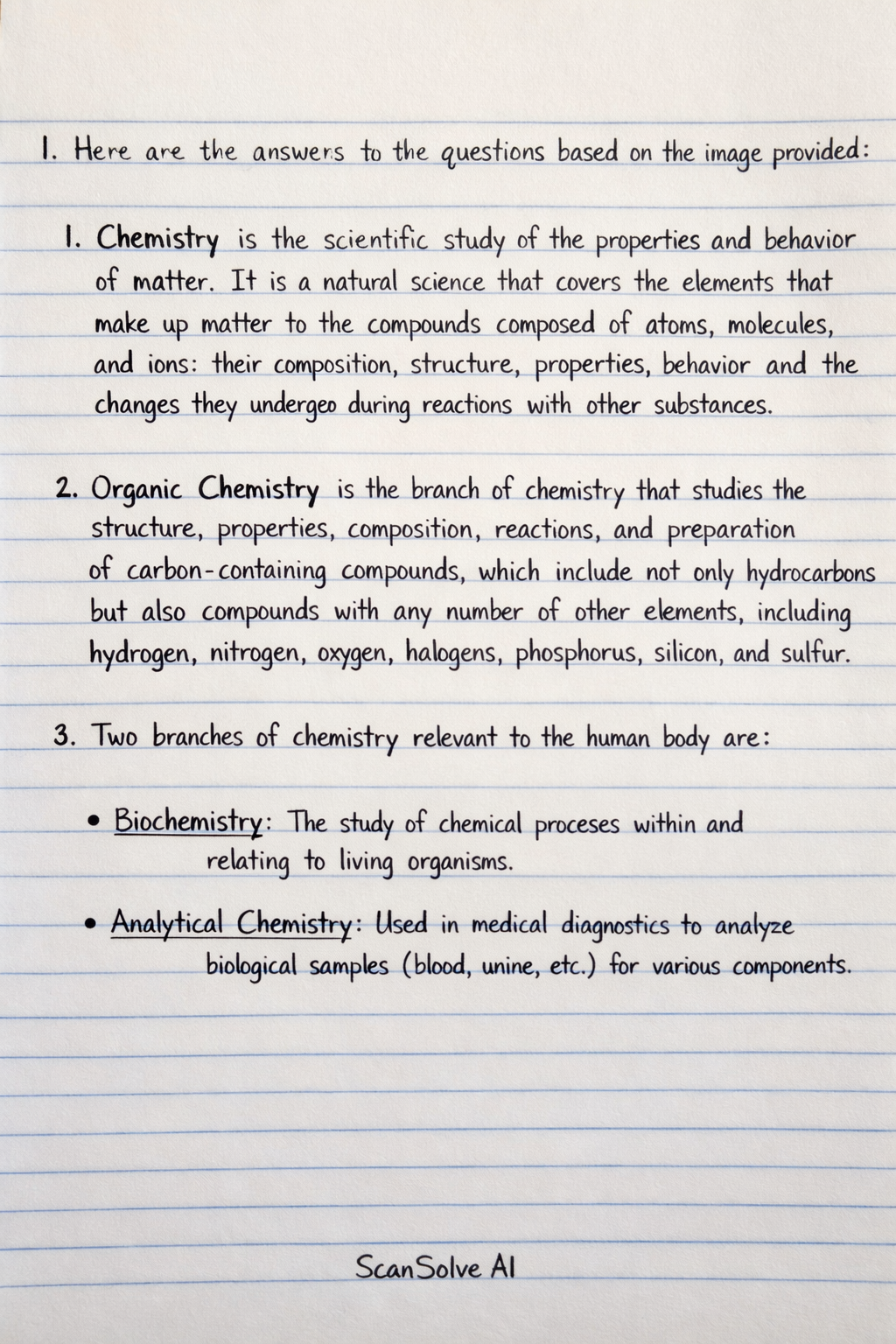
Here are the answers to the questions based on the image provided:
-
Chemistry is the scientific study of the properties and behavior of matter. It is a natural science that covers the elements that make up matter to the compounds composed of atoms, molecules, and ions: their composition, structure, properties, behavior, and the changes they undergo during reactions with other substances.
-
Organic Chemistry is the branch of chemistry that studies the structure, properties, composition, reactions, and preparation of carbon-containing compounds, which include not only hydrocarbons but also compounds with any number of other elements, including hydrogen, nitrogen, oxygen, halogens, phosphorus, silicon, and sulfur.
-
Two branches of chemistry relevant to the human body are:
- Biochemistry: The study of chemical processes within and relating to living organisms.
- Analytical Chemistry: Used in medical diagnostics to analyze biological samples (blood, urine, etc.) for various components.
-
Bohr's atomic model failed to explain several phenomena, including:
- It could not explain the spectra of multi-electron atoms, only working for hydrogen and hydrogen-like ions.
- It failed to explain the splitting of spectral lines when atoms are placed in a magnetic field (Zeeman effect) or an electric field (Stark effect).
- It did not account for the wave nature of electrons or the Heisenberg Uncertainty Principle, which are fundamental to modern quantum mechanics.
-
The main postulates of Dalton's Atomic Theory are:
- All matter is composed of extremely small, indivisible particles called atoms.
- Atoms of a given element are identical in mass and properties; atoms of different elements have different masses and properties.
- Atoms cannot be created or destroyed in a chemical reaction.
- Atoms of different elements combine in simple whole-number ratios to form compounds.
- In a given compound, the relative number and types of atoms are constant.
-
With reference to the representation model of the gold foil experiment (Rutherford's experiment), the evidence regarding an atom provided by lines A, B, and C is:
- Line A (Non-deflected particles): Most alpha particles passed straight through the gold foil, indicating that the atom is mostly empty space.
- Line B (Deflected particles): Some alpha particles were deflected at small angles, suggesting the presence of a small, positively charged region (the nucleus) that repels the positively charged alpha particles.
- Line C (Largely deflected/bounced back particles): A very few alpha particles were deflected at large angles or bounced back, implying that the positive charge and most of the mass of the atom are concentrated in a very small, dense nucleus.
Still stuck on this one?
Ask a follow-up, and the answer starts from this question.
More Psychology Questions
Handwritten Step-by-Step Solution
Get this as a handwritten image on WhatsApp — like a tutor wrote it for you.
Try on WhatsApp