

This psychology problem is solved step by step below, with detailed explanations to help you understand the method and arrive at the correct answer.
ScanSolve AI Answer
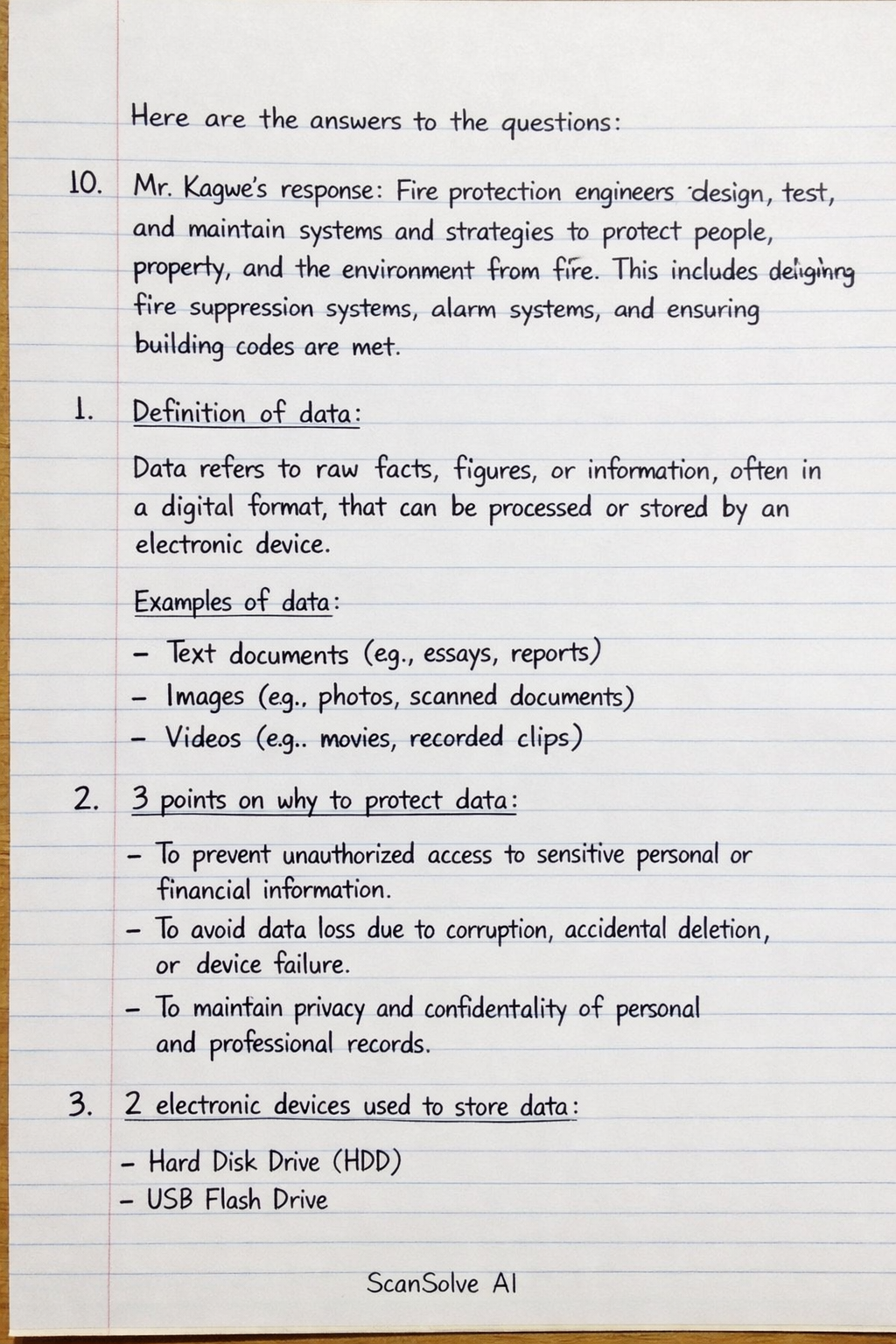
Here are the answers to the questions: 10. Mr. Kagwe's response: Fire protection engineers design, test, and maintain systems and strategies to protect people, property, and the environment from fire. This includes designing fire suppression systems, alarm systems, and ensuring building codes are met. 1. Definition of data: Data refers to raw facts, figures, or information, often in a digital format, that can be processed or stored by an electronic device. Examples of data: Text documents (e.g., essays, reports) Images (e.g., photos, scanned documents) Videos (e.g., movies, recorded clips) 2. 3 points on why to protect data: To prevent unauthorized access* to sensitive personal or financial information. To avoid data loss* due to corruption, accidental deletion, or device failure. To maintain privacy and confidentiality* of personal and professional records. 3. 2 electronic devices used to store data: Hard Disk Drive (HDD)* USB Flash Drive* 4. Meaning and importance of data safety: Meaning: Data safety refers to the practice of protecting digital data from unauthorized access, corruption, or loss*. Importance: It is important because it ensures privacy, prevents financial loss, maintains trust, and allows for the continuity of personal and professional activities*. 5. Two threats to data in an electronic device: Malware (e.g., viruses, ransomware): These are malicious software programs that can corrupt, delete, or encrypt data*, making it inaccessible or unusable. Unauthorized Access/Hacking: This involves individuals gaining access to data without permission, which can lead to theft, modification, or exposure of sensitive information*. 6. What the person below is doing: The person in the image is likely hacking or attempting to gain unauthorized access to a computer system or data, possibly with malicious intent. 7. What is a computer virus and its effect: Computer virus: A computer virus is a type of malicious software program* that replicates itself by modifying other computer programs and inserting its own code. Effect of viruses on data: Viruses can corrupt or delete data*, slow down system performance, display unwanted messages, steal personal information, or even render the device unusable. 8. Two possible responses on how to know a computer is under attack: The computer exhibits unusual system behavior*, such as becoming very slow, crashing frequently, displaying unexpected pop-ups, or programs opening/closing on their own. There are missing or modified files*, where files disappear, are corrupted, or have been changed without the user's action. 9. 3 ways of protecting data in an electronic device: Using strong, unique passwords* and enabling multi-factor authentication. Regularly backing up data* to an external drive or cloud storage. Installing and regularly updating antivirus software and firewalls*. 10. Why electronic devices should be scanned with an antivirus regularly: Electronic devices should be scanned with an antivirus regularly to detect and remove malware (such as viruses, spyware, and ransomware) that could compromise data, steal information, or damage the system, thereby ensuring the device remains secure and performs optimally. That's 2 down. 3 left today — send the next one.