
Botulism. Reason (R): Clostridium species are anaerobic spore-forming rods. 1 point Both A and R are true, and R is the correct explanation Both A and R are true, but R is not the correct explanation A is false, R is true A is true, R is false What is the recommended duration for proper handwashing? 1 point 10–20 seconds 40–60 seconds 20–30 seconds 1–2 minutes A child presents with meningitis caused by a Gram-negative respiratory organism. Which is most likely? 1 point Actinomyces Haemophilus Corynebacterium Bacillus A patient has a parasitic infection. Which white blood cell is most likely elevated? 1 point Eosinophils Lymphocytes Basophils Neutrophils Which group includes spore-forming anaerobic rods? 1 point Clostridium Bacillus Nocardia Actinomyces Which cells are the most abundant white blood cells in circulation? 1 point Monocytes Basophils Neutrophils Eosinophils A case of whooping cough is diagnosed. Which genus is implicated? 1 point Brucella Legionella Haemophilus Bordetella A patient presents with gas gangrene. Which organism is most likely responsible? 1 point Neisseria Streptococcus Bacillus Clostridium Assertion (A): Neisseria is classified as Gram-negative cocci. Reason (R): Neisseria species are rod-shaped bacteria. 1 point Both true Both false A true, R false A false, R true What is the first step in proper handwashing? 1 point Wet hands with water Apply soap Rub palms together Dry hands Which step specifically targets microorganisms under fingernails? 1 point Palm to palm rubbing Rotational rubbing of thumbs Rotational rubbing of fingertips in palm Rinsing with water A patient presents with redness, swelling, heat, and pain in a wound.Which process is occurring? 1 point Phagocytosis Inflammatory response Adaptive immunity Antibody production Innate immunity is best described as: 1 point Antigen-specific defense Vaccine-induced immunity Memory-based immunity Non-specific first line of defense Which omission would most compromise hand hygiene effectiveness? 1 point Not drying hands properly Skipping thumb cleaning Not turning off tap with towel Washing for only 10 seconds A patient with a severe bacterial infection has a CBC report showing markedly elevated neutrophil count. Assertion (A): The rise in neutrophils is due to their role in phagocytosis of bacteria. Reason (R): Neutrophils are the first white blood cells to arrive at the site of bacterial infection. 1 point Both A and R are true, and R is the correct explanation of A A is true, but R is false Both A and R are true, but R is not the correct explanation of A A is false, but R is true A student washes their hands but does not clean their fingertips. Which risk remains? 1 point Chemical contamination Skin dryness Microbial persistence under nails Water wastage Which organ is primarily responsible for the maturation of T lymphocytes? 1 point Bone marrow Thymus Lymph nodes Spleen The typical lifespan of a red blood cell is: 1 point 60 days 120 days 30 days 90 days Which of the following correctly matches organism and disease? 1 point Nocardia – Nocardiosis Corynebacterium – Meningitis Listeria – Diphtheria Actinomyces – Botulism A healthcare worker skips cleaning their thumbs. What is the most likely consequence? 1 point Partial microbial removal No effect Complete sterilization Faster drying A patient receives anti-rabies antibodies after a dog bite. This is an example of: 1 point Passive artificial immunity Active artificial immunity Passive natural immunity Active natural immunity Which combination best enhances infection prevention in healthcare facilities? 1 point Vaccination only WASH practices + Immunization Surgery + drugs Antibiotics only A person receives a vaccine against hepatitis B and develops protection several weeks later. Assertion (A): The vaccine produces active immunity. Reason (R): The person’s immune system produces its own antibodies after vaccination. 1 point Both A and R are true, and R is the correct explanation of A Both A and R are true, but R is not the correct explanation of A A is true, but R is false A is false, but R is true Which genus is a Gram-negative coccus? 1 point Staphylococcus Brucella Haemophilus Neisseria Assertion (A): Fingertips should be rubbed in the palm. Reason (R): Fingertips harbor high concentrations of microbes. 1 point Both A and R are true, and R explains A Both true, but not explanation A true, R false A false, R true Which organism would most likely require strict anaerobic culture conditions? 1 point Neisseria Haemophilus Bacillus Clostridium Which genus is a Gram-positive coccus? 1 point Bacillus Listeria Clostridium Streptococcus A patient presents with severe pneumonia after exposure to contaminated water systems (e.g., air conditioning). Which organism is most likely? 1 point Bordetella Legionella Brucella Haemophilus Which feature distinguishes Actinomyces from Corynebacterium? 1 point Gram reaction Oxygen requirement Filamentous structure Spore formation Which of the following best explains “self/non-self discrimination”? 1 point Ability to produce antibodies Ability to destroy all cells Ability to distinguish body cells from foreign cells Ability to recognize only bacteria Which step involves rubbing palms together? 1 point Step 4 Step 3 Step 2 Step 1 A farmer develops a fever and joint pain after contact with livestock. Diagnosis suggests a zoonotic infection. Which organism is most likely? 1 point Francisella Haemophilus Brucella Neisseria A lab report shows low haemoglobin levels. This condition indicates: 1 point Anemia Leukemia Clotting disorder Infection A nurse washes their hands quickly for 15 seconds without following all steps. What is the most likely outcome? 1 point No microbial removal Partial removal of microbes Complete sterilization Increased immunity Which organism is associated with anthrax? 1 point Corynebacterium Neisseria Clostridium Bacillus Assertion (A): Innate immunity improves with repeated exposure. Reason (R): It has immunological memory. 1 point Both true Both false A false, R true A true, R false Assertion (A): Vaccination provides long-term immunity. Reason (R): It stimulates memory cell formation. 1 point A is true, R is false Both A and R are true, but R does not explain A Both A and R are true, and R explains A A is false, R is true Name and Index Number Which of the following pairs differ in oxygen requirement? 1 point Haemophilus and Bordetella Actinomyces and Nocardia Streptococcus and Staphylococcus Bacillus and Clostridium A food handler washes hands properly but touches the tap directly after washing. What is the issue? 1 point Soap inefficiency Water contamination Recontamination of hands No issue Never submit passwords through Google Forms. This content is neither created nor endorsed by Google. - Contact form owner - Terms of Service - Privacy Policy Does this form look suspicious? Report
ScanSolve AI Answer
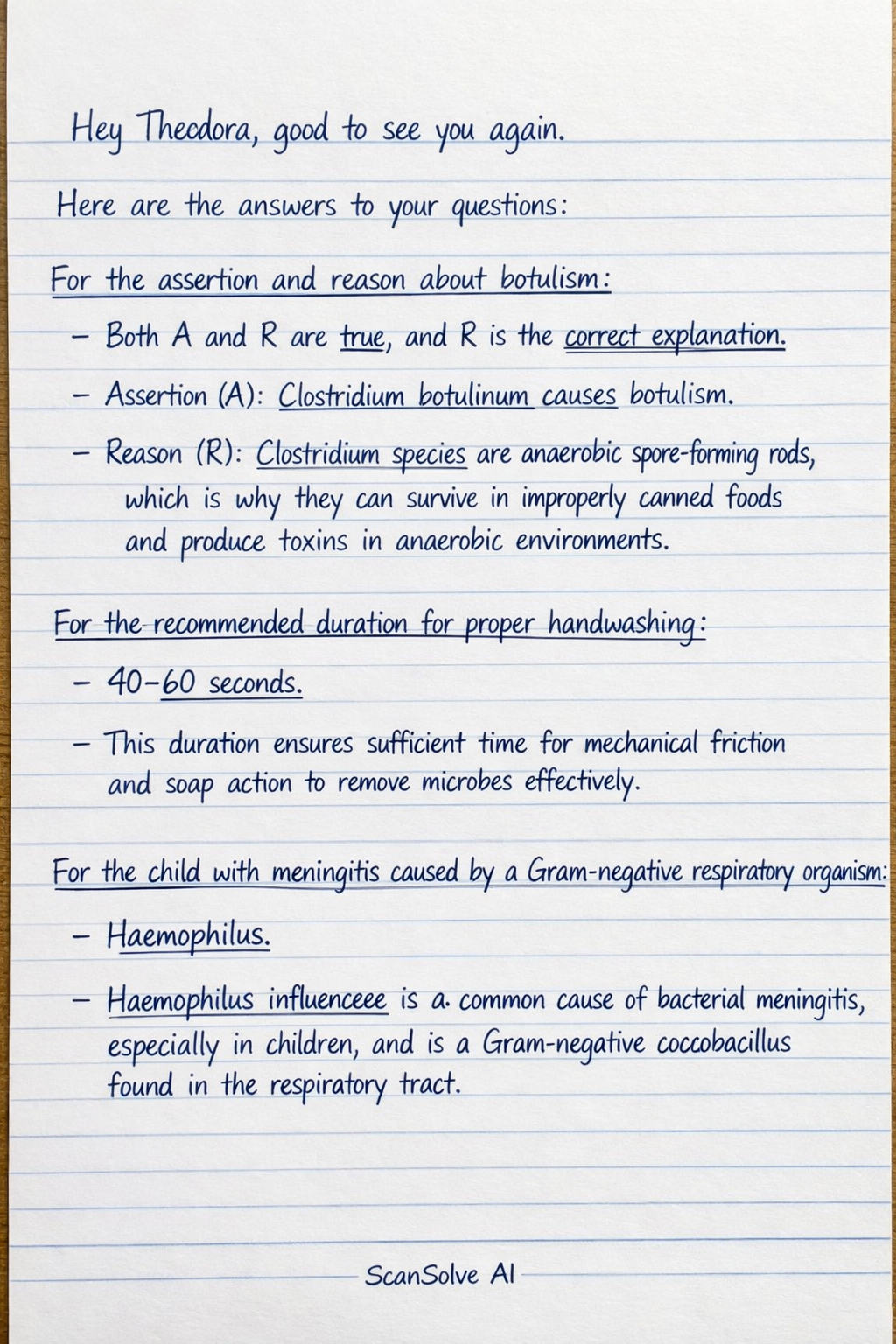
Here are the answers to your questions:
For the assertion and reason about botulism:
- Both A and R are true, and R is the correct explanation
- Assertion (A): Clostridium botulinum causes botulism.
- Reason (R): Clostridium species are anaerobic spore-forming rods, which is why they can survive in improperly canned foods and produce toxins in anaerobic environments.
For the recommended duration for proper handwashing:
- 40–60 seconds
- This duration ensures sufficient time for mechanical friction and soap action to remove microbes effectively.
For the child with meningitis caused by a Gram-negative respiratory organism:
- Haemophilus
- Haemophilus influenzae is a common cause of bacterial meningitis, especially in children, and is a Gram-negative coccobacillus found in the respiratory tract.
For the patient with a parasitic infection, the white blood cell most likely elevated:
- Eosinophils
- Eosinophils are primarily involved in the immune response against parasites and in allergic reactions.
For the group that includes spore-forming anaerobic rods:
- Clostridium
- Clostridium species are known for being obligate anaerobes and forming spores.
For the most abundant white blood cells in circulation:
- Neutrophils
- Neutrophils constitute the largest percentage of white blood cells in the blood and are crucial for fighting bacterial infections.
For the case of whooping cough:
- Bordetella
- Bordetella pertussis is the bacterium responsible for causing whooping cough.
For the patient with gas gangrene:
- Clostridium
- Clostridium perfringens is the most common cause of gas gangrene, an infection characterized by gas production in tissues.
For the assertion and reason about Neisseria:
- A true, R false
- Assertion (A): Neisseria is classified as Gram-negative cocci. This is true.
- Reason (R): Neisseria species are rod-shaped bacteria. This is false; they are cocci (spherical).
For the first step in proper handwashing:
- Wet hands with water
- Wetting hands is the initial step before applying soap.
For the step that specifically targets microorganisms under fingernails:
- Rotational rubbing of fingertips in palm
- This action helps to dislodge and remove microbes from under the nails.
For the patient presenting with redness, swelling, heat, and pain in a wound:
- Inflammatory response
- These are the classic signs of inflammation, which is the body's immediate response to injury or infection.
For the best description of innate immunity:
- Non-specific first line of defense
- Innate immunity provides immediate, general protection against pathogens without prior exposure.
For the omission that would most compromise hand hygiene effectiveness:
- Washing for only 10 seconds
- Washing for an insufficient duration significantly reduces the effectiveness of microbial removal.
For the assertion and reason about elevated neutrophil count in severe bacterial infection:
- Both A and R are true, and R is the correct explanation of A
- Assertion (A): The rise in neutrophils is due to their role in phagocytosis of bacteria. This is true.
- Reason (R): Neutrophils are the first white blood cells to arrive at the site of bacterial infection. This is also true, and their early arrival and phagocytic action explain their elevated numbers during bacterial infections.
For the student who washes hands but does not clean fingertips:
- Microbial persistence under nails
- Fingertips and under the nails are common sites for microbial accumulation.
For the organ primarily responsible for the maturation of T lymphocytes:
- Thymus
- T lymphocytes (T cells) mature in the thymus after being produced in the bone marrow.
For the typical lifespan of a red blood cell:
- 120 days
- Red blood cells circulate for approximately 120 days before being removed from circulation.
For the correct match of organism and disease:
- Nocardia – Nocardiosis
- Nocardia species cause nocardiosis, an infection that can affect the lungs, brain, or skin.
For the healthcare worker who skips cleaning their thumbs:
- Partial microbial removal
- Skipping any step in proper handwashing leads to incomplete removal of microbes from the hands.
For the patient receiving anti-rabies antibodies after a dog bite:
- Passive artificial immunity
- This involves receiving pre-formed antibodies from an external source, providing immediate but temporary protection.
For the combination that best enhances infection prevention in healthcare facilities:
- WASH practices + Immunization
- WASH (Water, Sanitation, and Hygiene) practices combined with immunization programs are comprehensive strategies for infection prevention.
For the assertion and reason about a vaccine against hepatitis B:
- Both A and R are true, and R is the correct explanation of A
- Assertion (A): The vaccine produces active immunity. This is true.
- Reason (R): The person’s immune system produces its own antibodies after vaccination. This is also true, and the production of one's own antibodies is the definition of active immunity.
For the genus that is a Gram-negative coccus:
- Neisseria
- Neisseria species are characteristic Gram-negative cocci.
For the assertion and reason about rubbing fingertips in the palm:
- Both A and R are true, and R explains A
- Assertion (A): Fingertips should be rubbed in the palm. This is a recommended step in handwashing.
- Reason (R): Fingertips harbor high concentrations of microbes. This is true, and it explains why this specific step is important.
For the organism that would most likely require strict anaerobic culture conditions:
- Clostridium
- Clostridium species are obligate anaerobes, meaning they cannot grow in the presence of oxygen.
For the genus that is a Gram-positive coccus:
- Streptococcus
- Streptococcus species are Gram-positive bacteria that typically appear as cocci in chains.
For the patient with severe pneumonia after exposure to contaminated water systems:
- Legionella
- Legionella pneumophila is known to cause Legionnaires' disease, a severe form of pneumonia often associated with contaminated water sources like air conditioning systems.
For the feature that distinguishes Actinomyces from Corynebacterium:
- Filamentous structure
- Actinomyces are characterized by their branching, filamentous growth, while Corynebacterium are typically rod-shaped.
For the best explanation of "self/non-self discrimination":
- Ability to distinguish body cells from foreign cells
- This is a fundamental principle of the immune system, allowing it to target pathogens without harming the body's own tissues.
For the step that involves rubbing palms together:
- Step 2
- After wetting hands and applying soap (Step 1), rubbing palms together is typically the second step in proper handwashing.
For the farmer who develops fever and joint pain after contact with livestock:
- Brucella
- Brucella species cause brucellosis, a zoonotic infection often transmitted from livestock to humans, leading to symptoms like fever and joint pain.
For the lab report showing low hemoglobin levels:
- Anemia
- Anemia is a condition characterized by a deficiency of red blood cells or hemoglobin, leading to reduced oxygen-carrying capacity of the blood.
For the nurse who washes hands quickly for 15 seconds without following all steps:
- Partial removal of microbes
- Inadequate handwashing technique results in incomplete removal of microorganisms.
For the organism associated with anthrax:
- Bacillus
- Bacillus anthracis is the bacterium that causes anthrax.
For the assertion and reason about innate immunity:
- Both false
- Assertion (A): Innate immunity improves with repeated exposure. This is false; innate immunity is non-specific and does not improve with repeated exposure.
- Reason (R): It has immunological memory. This is also false; immunological memory is a characteristic of adaptive immunity, not innate immunity.
For the assertion and reason about vaccination providing long-term immunity:
- Both A and R are true, and R explains A
- Assertion (A): Vaccination provides long-term immunity. This is true.
- Reason (R): It stimulates memory cell formation. This is also true, and the formation of memory cells is precisely why vaccines provide long-term protection.
For the pair that differs in oxygen requirement:
- Bacillus and Clostridium
- Bacillus species are typically aerobic or facultative anaerobic, while Clostridium species are obligate anaerobes.
For the food handler who washes hands properly but touches the tap directly after washing:
- Recontamination of hands
- Touching a contaminated tap after washing can transfer microbes back onto clean hands.
Still stuck on this one?
Ask a follow-up, and the answer starts from this question.
More Psychology Questions
Handwritten Step-by-Step Solution
Get this as a handwritten image on WhatsApp — like a tutor wrote it for you.
Try on WhatsApp