

This psychology problem is solved step by step below, with detailed explanations to help you understand the method and arrive at the correct answer.
ScanSolve AI Answer
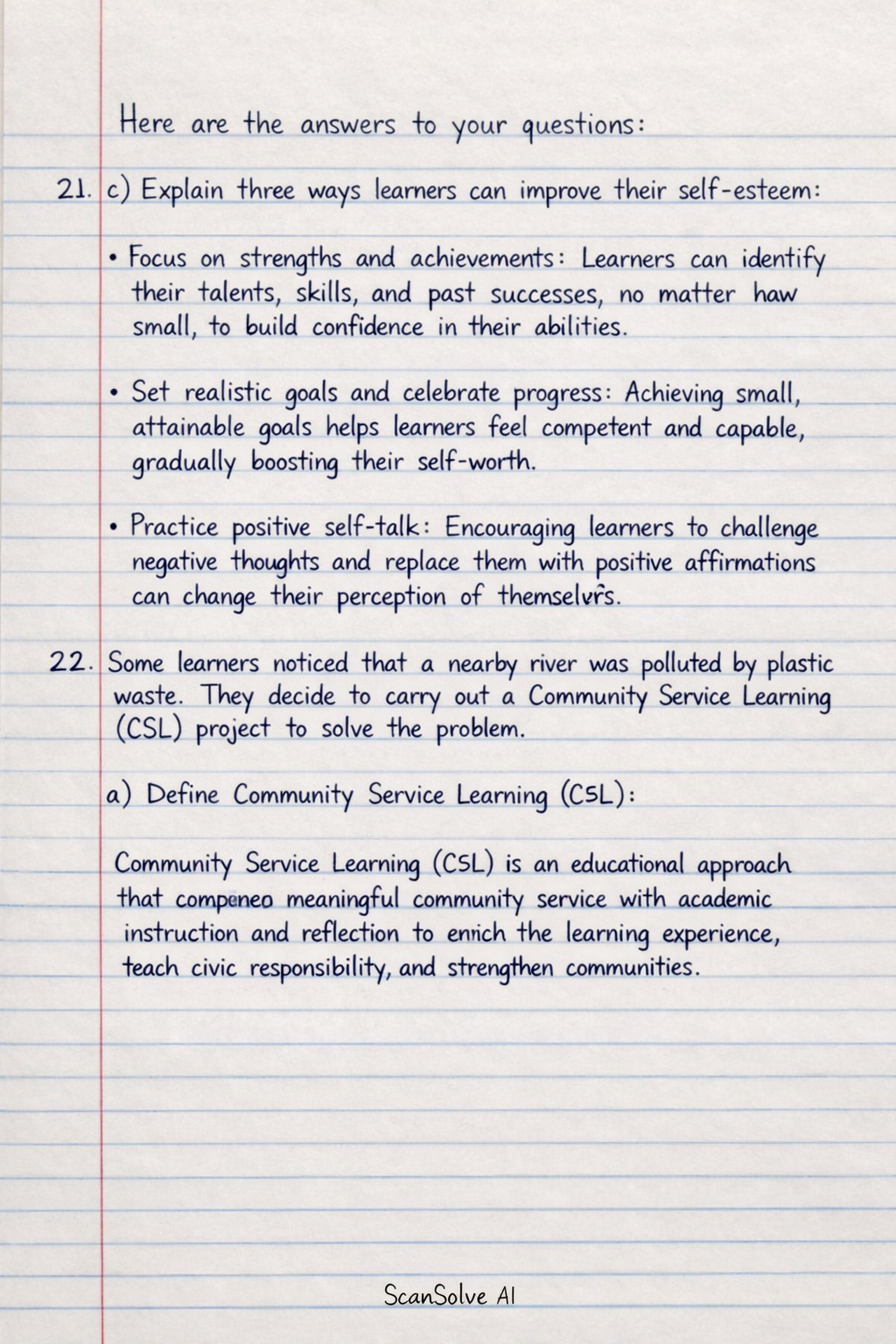
Here are the answers to your questions: 21. c) Explain three ways learners can improve their self-esteem. Focus on strengths and achievements: Learners can identify their talents, skills, and past successes, no matter how small, to build confidence in their abilities. Set realistic goals and celebrate progress: Achieving small, attainable goals helps learners feel competent and capable, gradually boosting their self-worth. Practice positive self-talk: Encouraging learners to challenge negative thoughts and replace them with positive affirmations can change their perception of themselves. 22. Some learners noticed that a nearby river was polluted by plastic waste. They decide to carry out a Community Service Learning (CSL) project to solve the problem. a) Define Community Service Learning (CSL). Community Service Learning (CSL) is an educational approach that combines meaningful community service with academic instruction and reflection to enrich the learning experience, teach civic responsibility, and strengthen communities. b) State four stages of a CSL project cycle. Preparation/Planning: Identifying community needs, setting learning objectives, and planning the service activity. Action/Service: Implementing the planned service activity in the community. Reflection: Critically analyzing the service experience in relation to academic learning and personal growth. Demonstration/Celebration: Sharing the results of the project and reflecting on its impact with others. c) Explain three benefits of CSL projects to the community. Addresses real community needs: CSL projects directly tackle specific problems or gaps within the community, such as environmental pollution, providing tangible solutions. Fosters community engagement and collaboration: These projects bring together learners, educators, and community members, strengthening relationships and promoting a sense of shared responsibility. Raises awareness and promotes civic responsibility: By actively participating in community issues, learners and the wider community become more aware of challenges and are encouraged to take ownership in finding solutions. 23. Learner of Bidii comprehensive school visited a prehistoric site in Kenya where they saw fossils and, early stone tools used by ancient humans. a) State three characteristics of Homo erectus. Upright posture (bipedalism): They walked fully upright, similar to modern humans. Use of fire: Homo erectus* was among the first hominids to control and use fire for warmth, cooking, and protection. Advanced tool-making: They developed more sophisticated stone tools, such as hand axes, belonging to the Acheulean culture. b) Explain two ways early humans adapted to their environment. Tool making: Early humans developed and used various tools made from stone, bone, and wood for hunting, gathering, processing food, and defense, allowing them to exploit new resources and survive in diverse environments. Use of fire: The control of fire provided warmth in colder climates, protection from predators, and allowed for the cooking of food, which improved digestion and nutrient absorption, contributing to brain development. c) State three tools used by early humans. Hand axes Choppers Scrapers Last free one today — make it count tomorrow, or type /upgrade for unlimited.